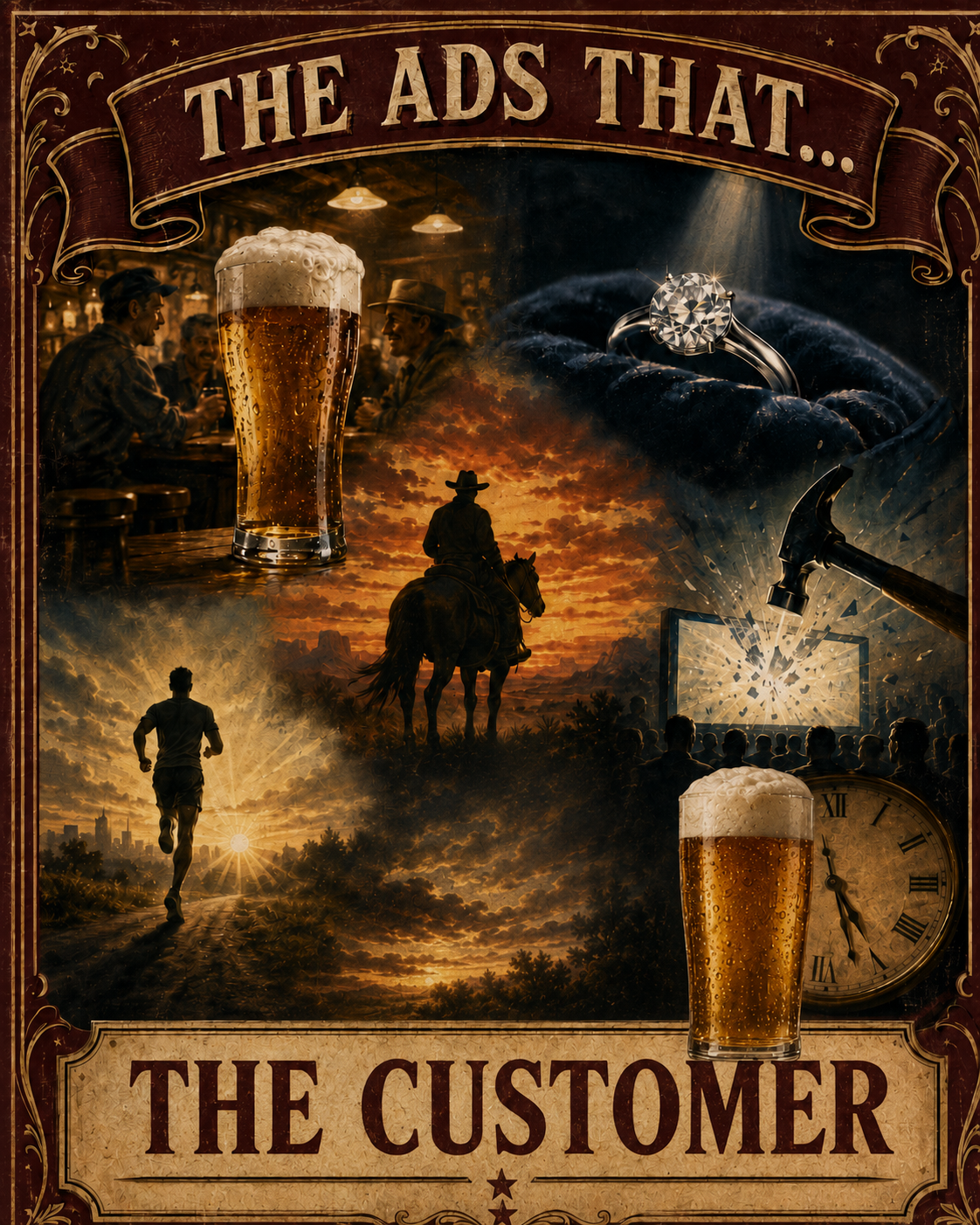
Of the eight critical skills that determine success in the modern career, communication is the most powerful—and its highest form is not describing a customer but creating one.
The advertisements that follow did not find a market and speak to it; they used language to name a person who did not yet exist, and then made the act of buying the proof that you were that person.
That is the whole argument of this essay.
It is easy to think of great advertising as persuasion—a clever pitch that moves an existing buyer from one brand to another. The campaigns that mattered most did something far more radical. They authored a new social role and handed it to the reader: the serious drinker, the properly engaged man, the everyday athlete. The product became the badge of an identity the copywriter had invented. Communication, at its most complete, does not reach the customer.
It constitutes the consumer.
Here are five that did it best, followed by five more that came close. You will probably disagree – that’s fine. I look forward to your comments – and your own list!
Have fun!
The Five
Schaefer — “The one beer to have when you’re having more than one”
Jim Jordan wrote the line at BBDO toward the end of 1961, and it remains one of the most quietly precise pieces of customer-creation in American advertising. Most beer marketing of the era sold flavor, purity, or social aspiration.
Jordan’s line did none of that. It named an occasion—the second beer, the evening that runs long—and in doing so it flattered a specific man: the one for whom “having one” was already a lesser category. The copy did not target beer drinkers in general. It manufactured a prestige identity around the heavy-occasion drinker and made Schaefer the responsible companion to that role.
The strategy grew from research showing what every brewer eventually learns: a small share of drinkers accounts for most of the beer. Jordan’s genius was to speak to that drinker without judgment—to make him feel understood rather than counted. Schaefer rose to national scale in the years the line dominated its identity, standing among the top five American brewers by 1970. The often-quoted figure that sales climbed 83.3 percent over the decade traces to a single retrospective source and should be treated with some caution; what is not in doubt is that a regional brand became a national one on the strength of a sentence that told a man who he was.
De Beers — “A Diamond Is Forever”
Frances Gerety wrote four words late one night in 1947 at N. W. Ayer, and they became, by Advertising Age’s reckoning, the single greatest slogan of the twentieth century. Before the campaign, the diamond engagement ring was not the fixed American ritual it is now; a sapphire, a plain band, or no ring at all were equally ordinary choices.
Gerety’s line—and the decades of Ayer work behind it—did not sell more of an existing product. It relocated romantic legitimacy into a purchasable object and defined the proper fiancé as the man who proves his seriousness with a stone.
The evidence that the campaign manufactured a norm is best read not in the famous dollar figures but in the archive. An Ayer memo from 1951 recorded jewelers reporting that a young woman was no longer considered engaged unless she had a diamond; by 1952, the agency’s research indicated that more than 85 percent of American couples were buying a diamond engagement ring. (The widely repeated claims that U.S. diamond sales rose from $23 million in 1939 to $2.1 billion in 1979, and that bridal adoption climbed from 10 to 80 percent, descend largely from a single 1982 investigation and should be cited with that caveat.)
The campaign also insulated its own product from competition by insisting a diamond should never be resold, quietly suppressing the secondary market. The line endures because it created not a buyer profile but a social script. The irony that trails it is nearly too neat: Gerety, who authored the most successful marriage proposal in history, never married.
Marlboro — “Where there’s a man, there’s a Marlboro”
In 1924, Marlboro was a woman’s cigarette—“Mild as May,” sold with a red “beauty tip” filter designed to hide lipstick. By the early 1950s it held less than one percent of the market.
Then, in 1954, Leo Burnett’s Chicago agency did not broaden Marlboro’s audience; it built an entirely different customer. The cowboy, the tattooed hand, the flip-top box, and finally the line itself made the filtered cigarette a natural predicate of manhood. The words do not say that men buy Marlboro. They say that where a man is, a Marlboro already belongs. That is customer-creation by linguistic reassignment—the boldest such reversal in the history of the craft.
Of all the minds gathered in this essay, Leo Burnett may have been the most purely creative: the Chicago adman who took a cigarette made for women and, with nothing but an image and an idea, conscripted a nation of men.
The commercial result, drawn from the company’s own histories, is staggering—Marlboro sales are recorded rising from roughly 18 million cigarettes in 1954 to 6 billion in 1955, and past 20 billion by 1957. Those figures come from Philip Morris and Burnett internal records and are best read as company-side evidence; the market trajectory, however, is not seriously disputed. Marlboro climbed from the margins to become the best-selling cigarette in America by 1972 and the global leader by the decade’s end.
The darker irony arrived later, when several of the men who embodied the cowboy died of smoking-related disease—the “cowboy killers” of the brand’s moral afterlife.
Apple — “Why 1984 won’t be like ‘1984’”
Steve Hayden and Brent Thomas wrote it and Lee Clow led the creative at Chiat/Day; Ridley Scott directed the sixty seconds that aired once, during Super Bowl XVIII in January 1984, and never showed the product.
The personal computer of 1983 was understood as a business tool—a machine for compliance and productivity.
The Macintosh commercial refused that framing entirely. It cast the buyer as the individual who would not join the gray ranks staring at the screen, and cast the competition, by Orwellian association, as Big Brother. The customer it created was not “a computer buyer.” It was the anti-bureaucratic knowledge worker who wanted technology as liberation, and who could read the purchase as evidence of his own refusal to conform.
Apple’s own launch materials aimed at professionals, students, and businesspeople; the commercial transformed those flat demographics into a moral class. The company is generally credited with selling roughly 70,000 Macintoshes in the first hundred days—a figure well entrenched though largely secondary. (The frequently cited claim of $155 million in sales over the same period is thinner still and does not withstand simple arithmetic against the $2,495 list price; it should not be repeated as settled fact.)
The lasting irony is the one critics never tire of: the company that once cast institutional control as the enemy became, in time, one of the most powerful gatekeepers in the culture. Both the original meaning and the later critique can be true at once.
Nike — “Just Do It”
Dan Wieden wrote the three most recognized words in American advertising in 1988, and their origin is as documented as it is grim: he adapted the reported last words of the condemned murderer Gary Gilmore—“Let’s do it”—and dropped the first word.
In 1988, Nike trailed Reebok and spoke mostly to serious athletes. Wieden’s line collapsed the distance between the professional and everyone else. Its first commercial featured an 80-year-old man running across the Golden Gate Bridge. The customer it manufactured was the everyday athlete—anyone with a body and a moment of hesitation, now told by the language itself that they qualified.
It named a self, not a shoe.
The scale of what followed is a matter of Nike’s own annual reports. Revenue grew from about $877 million in 1988 to roughly $9.6 billion a decade later, and the company’s share of the North American sport-shoe business rose from 18 to 43 percent over the same span—a figure worth stating precisely, since it refers to that business specifically, not to running shoes alone or to all athletic apparel. Advertising Age ranked “Just Do It” the second-greatest slogan of the century, behind only “A Diamond Is Forever.” That two of the century’s two most powerful lines were both acts of customer-creation is the argument of this essay in miniature.
The Five Runners-Up
Miller Lite — “Tastes great / Less filling”
Light beer had failed twice before Miller Lite because it was sold as a diet product for people watching their weight—a customer the market read as female and unserious.
McCann-Erickson, working in the tradition of Bill Backer, made a radical strategic move: the target was not the dieter but the heavy beer drinker who wanted to drink more without slowing down. Casting retired football players to argue “Tastes great!” against “Less filling!”—a debate that never resolves because the customer is both at once—the campaign manufactured a man who had not existed before: the masculine, unapologetic light-beer drinker. It created a category that would eventually claim half the American beer market. (The popular figure that Miller doubled from 12.8 to 24.2 million barrels describes total company volume, not the Lite brand, and should be handled with care.)
Miller pulled the trick twice: a few years earlier, Backer’s “It’s Miller Time” had branded not a product but an hour—the earned release at a shift’s end, the line that entered the culture so thoroughly it turned up in Ghostbusters.
Volkswagen — “Think Small”
In 1959, the American car market meant chrome, tail fins, and size. Julian Koenig wrote the copy and Helmut Krone designed the layout—a small photograph in a sea of white space—at Doyle Dane Bernbach, and together they named a buyer no one had addressed: the economically rational, quietly confident American who preferred engineering honesty to styling theater. “Small” stopped being a deficiency and became a badge of intelligence. U.S. Beetle sales climbed from roughly 89,000 in 1959 to more than 150,000 by 1961, and Volkswagen’s own 1963 report recorded 277,785 American sales that year.
If Burnett was the most daring imagination in this company, William Bernbach was the man who changed what advertising was—who trusted the reader’s intelligence when Madison Avenue only knew how to shout.
His agency’s fingerprints appear three times in these pages: “Think Small,” the Avis campaign below, and the “Daisy” ad that closes it.
Avis — “We’re only No. 2. We try harder”
Paula Green wrote it at DDB in 1962, and it accomplished something no brand had dared: it called itself an also-ran as a strategy. The line named a customer defined by a single act—choosing against the complacent market leader—and made second place a moral virtue rather than a weakness. Avis went from a $3.2 million annual loss to a $1.2 million profit within a year, and the gap behind Hertz narrowed from 61–29 to roughly 49–36 between 1963 and 1966. The smart contrarian consumer it invented became the template for every challenger brand that followed.
Wendy’s — “Where’s the beef?”
Cliff Freeman wrote it at Dancer Fitzgerald Sample and Clara Peller delivered it in January 1984, and the three words created a customer by negation: the buyer who sees through the fluffy bun and demands substance over spectacle.
The Wendy’s customer was manufactured in the act of refusing to be the fast-food mark. The line crossed instantly into the culture—Walter Mondale used it against Gary Hart in that year’s primaries—proof that it had named something real. Wendy’s revenue rose about 19 percent to $1.13 billion in 1985. Tellingly, when the campaign ended, the brand slumped for years—evidence of how completely the language had defined its buyer.
Lyndon Johnson — “Daisy”
The one non-commercial entry belongs here because it created a political consumer.
Produced by Tony Schwartz with DDB’s Sid Myers, Aaron Ehrlich, Stanley Lee, and Gene Case, “Peace, Little Girl” aired exactly once, on September 7, 1964, and was replayed endlessly as news. It never named Barry Goldwater. Its power was to manufacture a voter—the parent who experiences politics as an immediate threat to a child.
Schwartz described the theory without euphemism: the goal was to package the voter and deliver him to the ballot box. There is no sales metric, only a landslide and the Library of Congress’s judgment that it may be the most effective political commercial ever made. It did not ask the voter to prefer Johnson. It made not choosing him feel like failing to protect one’s own.
The Lesson
Across all ten, the pattern holds.
The copy did three things at once:
- It selected a buyer,
- It gave that buyer a flattering self-description, and
- It made the product the easiest public proof of that identity.
That is why these lines outlived the products they sold.
They were not merely memorable. They were constitutive—acts of communication so complete that they authored the very people who would answer them.
For anyone building a career, the lesson is not about advertising at all.
It is about the skill beneath it.
The most powerful communicators do not describe the world as it is.
They give others a role to step into, and make belonging feel like a choice the listener made freely.
That is the work.
Everything else is just reaching.
* * * * *
Charles C. Jett is an author, civic educator, and Professional Certified Coach based in Chicago. A graduate of the U.S. Naval Academy (Class of 1964) and Harvard Business School, he served during the Cold War aboard the nuclear submarine USS Ray (SSN 653), where his tactical innovations helped inspire Tom Clancy’s Jack Ryan character. He developed the Field Studies methodology to teach “Critical Skills” and was endorsed by the Department of Labor in 1994. He is the author of six books, including Super Nuke!, hosts three podcasts, and writes across his Critical Skills Blog and Civic Sage platforms on history, leadership, and the health of the American republic. He and his wife, Dr. Nancy Church, co-host the Chicago Salons at Water Tower Residences.




Leave a Reply