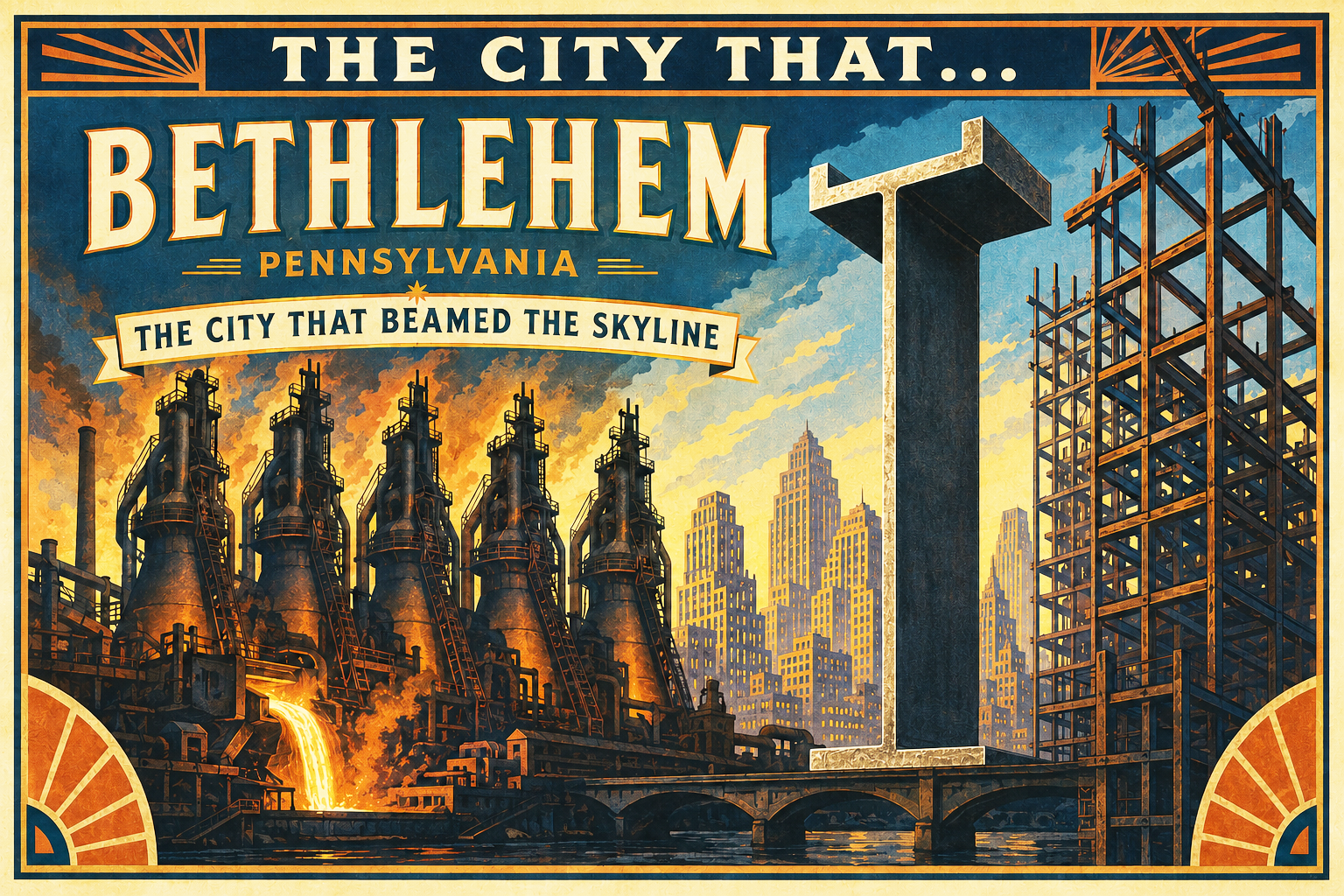
For nineteen years, only one place in America could make the beam that built the skyscraper.
This is the ninth profile in The City That…, a series about American cities that invented an industry, led the world in it, and then watched the center move on. We tell their stories plainly and with affection — what they made, what it cost, and what they still are.
The Founding
They were pacifists, and they named the town for Bethlehem of Judea.
On Christmas Eve of 1741 a small band of Moravians stood in a log house on the Lehigh River and sang, and Count Nicolaus Ludwig von Zinzendorf gave the settlement its name. They were refugees from religious persecution. They held property in common. They did not believe in war.
They were also relentless workers. By 1747 the town exported the goods of thirty-six trades. They built a tannery in 1761 and a waterworks in 1762, the first pumped municipal water system in North America. The habit of disciplined communal labor was set in that ground a century before anyone thought of steel.

The wars came anyway. In 1777 the Brethren’s House was taken as a hospital for the Continental Army, and more than five hundred American soldiers died in it and were buried on a hillside in the pacifists’ town.
The iron came because of where the town sat. Anthracite moved south on the Lehigh Canal. Two railroads crossed below the river. New York lay ninety miles east and Philadelphia sixty miles south — the two greatest building markets on the continent. In 1857 a Moravian merchant named Augustus Wolle chartered the Saucona Iron Company, and after a panic and a war and a flood, the first iron was made in January of 1863.
They rolled rails, then armor plate for the Navy, and by 1905 they were selling guns and armor to Russia and Japan both. It was a small company doing specialty work. Its revenue that year was sixteen million dollars. United States Steel took in four hundred and forty-six million.
Then a man from Pittsburgh bought it.
The Height
Charles Schwab had been Carnegie’s protégé and the first president of U.S. Steel, and he had left it, and he wanted something Pittsburgh did not have.
An Englishman named Henry Grey had it. Grey had spent years in American mills on one problem: how to roll a beam wide enough to carry a building higher. In 1897 he patented a mill that produced a broad-flanged section from a single ingot. In cross-section it looked like a squat capital H.
Nobody wanted it. Carnegie told him pioneering don’t pay. U.S. Steel turned it down. Grey went to Luxembourg, and a German firm built his first mill in 1902.
Schwab bought the American rights in 1905. Then he mortgaged the company and borrowed five million dollars from friends and suppliers and contractors to build the mill at Saucon. The company’s entire revenue was sixteen million. He bet a third of it on one machine no American would touch.
In January of 1908 the mill rolled the first wide-flange beams made in America.
Understand what the beam did. Before it, a deep column had to be riveted together out of plates and angles, at nine to fourteen dollars a ton in labor alone. Grey’s beam came out of the rolls in one piece, and the wide flanges carried the bending load without the weight. The old I-beam gave out at about twenty stories. The wide flange took the ceiling off.
They called it the Bethlehem Beam, and for nineteen years, from 1908 to 1927, Bethlehem was the only company in America that could make it. When U.S. Steel finally built a Grey mill of its own, it built it in violation of the patent and settled by paying royalties.
Gimbel Brothers went up on the beam first, then the Woolworth Building. Fifty-two thousand tons went into the Merchandise Mart. Forty-four thousand tons stand in each tower of the Golden Gate Bridge, made in Pennsylvania and shipped around through the Panama Canal. The company’s chief engineer for buildings said it plainly: U.S. Steel made its mark in Chicago, but Bethlehem owned New York. Bethlehem was king in Manhattan.
The mills ran and the town filled. Irish, Slovak, Hungarian, Ukrainian, Polish — the company advertised in the old countries, promised wages and a road to citizenship, and the men came and settled the wards of South Bethlehem. The work was hot and loud and it killed people. In 1910 they struck against compulsory Sunday work and stayed out a hundred and four days. In February a state trooper fired two shots through the doorway of the Majestic Hotel. One killed Joseph Szambo, thirty-seven, Hungarian, who had gone in to buy wine for his sick pregnant wife.
The strike failed. The union did not come to Bethlehem until 1941.
Then the wars. By the Armistice, Bethlehem had made sixty percent of the finished guns the United States ordered and more than sixty-five percent of the finished artillery pieces made by all the Allied nations together. In the second war it delivered one thousand and eighty-five ships — three hundred and eighty in 1943 alone, a ship a day. Employment at the plant went from thirteen thousand men in 1939 to thirty-one thousand five hundred and twenty-three in 1943.
From 1916 to 1984 it was the second-largest steel producer in the United States. In the late fifties it poured twenty-three million tons a year.
The town that would not go to war had become the arsenal.
The Turn
The story America tells itself is that cheap foreign steel killed Bethlehem. That is part of it. It is not the heart of it.
In Austria they perfected the basic oxygen furnace. It made a heat of steel in forty-five minutes. The open hearth took six to eight hours. Europe and Japan had been bombed flat and rebuilt on the new furnace because they had to build on something. The American companies had the old furnaces and kept them. Bethlehem came to oxygen steelmaking a decade late.
Ask why and you arrive at the bonus. Bethlehem paid its executives on current profit, and current profit is highest when you are not spending on new mills. In 1929, under oath, Eugene Grace was made to say what his bonus had been: one million six hundred and twenty-three thousand seven hundred and fifty-three dollars. The historians who have looked hardest at this company say the bonus taught the men at the top to milk the plant rather than rebuild it.
Then the minimills came, melting scrap in electric furnaces, lean and cheap. One historian says flatly that Nucor did more to kill American steel than the Chinese ever did.
Labor gets the blame in the barroom version. Labor did not make the capital decisions.
In 1967 Bethlehem lost the bid for the World Trade Center — fifty thousand tons, the largest structural job of the age, and the company that invented the beam did not get it. In 1972 it built Martin Tower, twenty-one stories, the tallest thing in the valley. Ten years later the layoffs began. In 1982 it lost a billion and a half dollars in one year.
On the eighteenth of November, 1995, the last iron was cast at Bethlehem. Eighteen hundred men were let go that day. It had been a hundred and forty years.
What Was Lost
The company filed for bankruptcy in October of 2001, the twenty-sixth American steel company to fail in three years. In 2003 it was dissolved and sold for parts.
But the men had been paid in promises, and the promises came due.
By 2002 there were seven retirees for every man still working. The pension fund held forty-five cents against every dollar it owed. That December the federal pension corporation took the plan over — ninety-five thousand people, sixty-seven thousand of them already retired — the largest such takeover in the agency’s history.
The federal insurance does not cover health insurance. In March of 2003 the court permitted Bethlehem Steel to end medical and life benefits for some ninety thousand retirees and their wives. Three billion dollars in promises, shed in an afternoon.
They had made the guns and the ships and the beams. They were old now, and the company that asked them to do it was gone.
What Remains
The furnaces stood along the river, five of them in a row, rusting.
The town did not know what to do with them. Many wanted them torn down. A ruin is a hard thing to look at every morning when it is the ruin of your own working life, and there was real anger in Bethlehem at the company that had left. Jeff Parks, who ran the local arts nonprofit, wanted them down too. Then he spent six days in Germany’s Ruhr Valley looking at what the Germans had done with their dead mills, and came home changed. It wasn’t until we got to Germany that I saw the error of my way, he said. This is probably the biggest piece of art that we are ever going to have in this community, and it is part of our heritage.
So they kept them. The furnaces stand above an arts campus now, the old trestle that carried ore to their throats is a walkway, and there is music under the stacks all summer. The woman who runs the arts organization says most cities hide their failures, and Bethlehem put a spotlight on hers.
Do not make it tidier than it is. The casino employs about twenty-three hundred and the arts center about four hundred, against thirty-one thousand at the plant in 1943. The median household here earns sixty-six thousand dollars against seventy-five thousand for the country, and nearly one person in six is poor. Brookings puts Bethlehem in the top tier of America’s older industrial cities. That is true, and so is the rest of it.
The old hands will tell you the name is wrong. They call it SteelStacks, but those five towers were blast furnaces, and blast furnaces make iron. The steel was made elsewhere on the property. The men who worked there notice this. They are not being difficult. They are saying that if you keep a thing, you ought to know what it is.
And still they tell you what it was for. One of them, who gave the plant twenty-seven years, said that when the steelworkers went on vacation they would look up at the bridges and the buildings and say: I had a hand in making that.
Come in December, when the market sets up in the old plant yard and the choir sings the lovefeast at Central Moravian, and look up. The five furnaces stand over the Christmas market, lit red and green.
The pacifists named this place for the town where the child was born, and then it made the beams that lifted the American century off the ground, and the guns, and the ships, and the men who did that are mostly gone now, and their sons look up at the towers.
The furnaces are cold.
The river runs clean.
The steel is still standing in Manhattan and across the Golden Gate, holding up everything, where nobody has to think about it — which is what steel is for.
Bethlehem beamed the American skyline, and that is worth remembering.
* * * * *
Why Bethlehem? It did not merely make steel; it made the wide-flange beam, and for nineteen years it was the only place in America that could — the beam that took the ceiling off the skyscraper and framed the century.
Charles C. Jett is an author, civic educator, and Professional Certified Coach based in Chicago. A graduate of the U.S. Naval Academy (Class of 1964) and Harvard Business School, he served during the Cold War aboard the nuclear submarine USS Ray (SSN 653), where his tactical innovations helped inspire Tom Clancy’s Jack Ryan character. He developed the Field Studies methodology to teach “Critical Skills” and was endorsed by the Department of Labor in 1994. He is the author of six books, including Super Nuke!, hosts three podcasts, and writes across his Critical Skills Blog and Civic Sage platforms on history, leadership, and the health of the American republic. He and his wife, Dr. Nancy Church, co-host the Chicago Salons at Water Tower Residences.


Leave a Reply