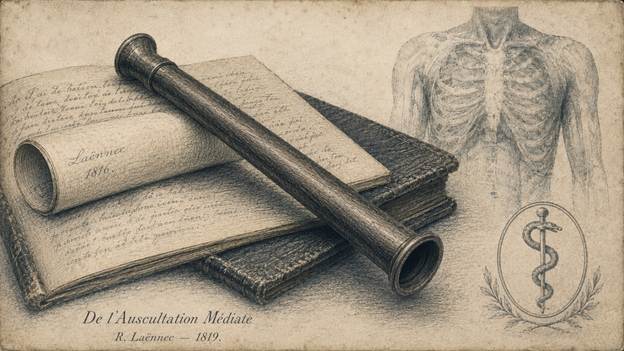
In 1816, in a Paris hospital, a young doctor was too embarrassed to do his job. The patient was a stout woman with a bad heart. To hear it, the custom of the day required him to lay his ear against her chest. He could not bring himself to do it. Her age, her sex, her size — all of it stopped him at the edge of the bed.
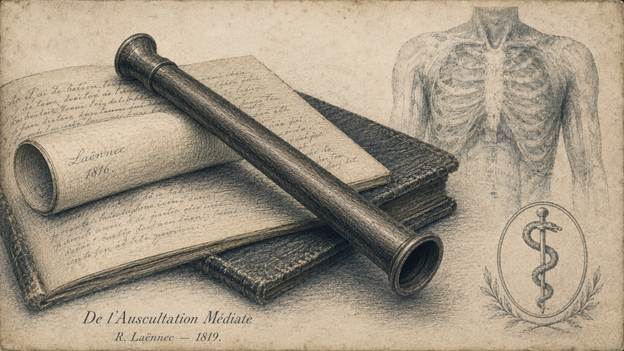
So he rolled a sheet of paper into a tight tube. He set one end over her heart and put his ear to the other. He had remembered a thing he had seen children do in a courtyard, scratching a pin against one end of a wooden beam while a friend pressed an ear to the far end and heard it clear. Sound runs better through a solid than through open air. He had not expected much. What he heard astonished him. The heart came through the paper louder and cleaner than his bare ear had ever caught it.
His name was René Laënnec. The paper tube became a wooden cylinder he turned himself on a lathe, about a foot long with a narrow bore down its center, an instrument a man could carry in his bag. He held no patent on it and sought none; he sold the cylinder for about two francs, bundled with the book that explained it. He named it from the Greek for chest and for looking. The stethoscope.
To understand what he changed, you have to understand what came before. Before Laënnec, the body was mostly closed to the doctor. A physician worked from the outside and from the patient’s own account. He took the pulse. He looked at the tongue and the color of the skin. He pressed his hands to the belly. Above all, he listened to the patient talk — where it hurt, when it started, what made it worse. The patient’s story was the chief evidence. The doctor was a kind of interpreter, reading a tale told to him by the sick.
Some doctors did lay an ear directly on the chest. The technique was old, mentioned as far back as the Greeks, and it worked, after a fashion. But it was awkward, and it was unclean — lice and worse passed between the sick and the man bent over them — and on a heavy patient it heard almost nothing. With a woman it was nearly impossible to do with decency. So the inside of the chest stayed dark. The heart and the lungs kept their secrets, and the doctor guessed. He named diseases by their outward signs and treated them by rule, and when he was wrong he rarely learned how wrong, because the proof lay sealed inside the body until death opened it.
The body had been inching open for half a century. Decades before, a Vienna physician had found that tapping a patient’s chest and listening to the pitch — dull where there should be hollow — told him something of what lay beneath, the way a man sounds a cask to learn if it is full. Napoleon’s own doctor revived the method in Paris and taught it to his students. Laënnec was one of them. The impulse was already in the air: read the body itself, not only the patient’s account of it. Laënnec did not invent that impulse. He built the instrument that won it.
Laënnec’s tube ended the dark. Over the next three years he did something more important than the invention itself. He listened to hundreds of patients through his cylinder, wrote down every sound — the crackles, the wheezes, the rubs, the murmurs — and then, when those patients died, he opened their bodies and looked. He matched the sound to the ruin beneath it. A certain crackle meant fluid in the lung. A certain dull silence meant the lung had filled. He built, sound by sound and corpse by corpse, a dictionary that linked what the living chest said to what was actually wrong inside it.
In 1819 he published it: De l’Auscultation Médiate — “on mediate listening,” listening through an instrument rather than with the naked ear. It was one of the founding books of modern medicine. For the first time, a doctor could stand at the bedside and know, with reasonable confidence, what was happening inside a chest he could not see. Diagnosis stopped being a reading of the patient’s story and started becoming a reading of the patient’s body. The doctor’s own trained senses, armed with a tool, became the evidence.
The instrument spread across Europe within a few years. Translations carried it to London and Dublin and Vienna, and the young doctors took to it fastest, the way the young take to any tool that lets them do what their teachers could not. A handful of older physicians grumbled that a real doctor needed no tube, that the ear God gave him was enough. They lost. The wooden cylinder became two flexible tubes and a chest piece, the shape we know, and it hung around the neck of every doctor on earth. It became the badge of the profession itself. When you draw a doctor, you draw the stethoscope.
And here the gift shows its price.
Laënnec moved the truth of the illness off the patient’s tongue and into the doctor’s ear. That was an enormous gain in accuracy. It was also a quiet loss. The patient had been the author of the story; now the patient became the object of the examination. What the sick person felt and said grew less important than what the instrument found. The center of authority shifted from the bed to the man standing over it. Medicine became more objective and a little less human in the same motion. The doctor gained the inside of the body and began, slowly, to stop listening to the person who lived in it.
We are still living inside that trade. Every machine that came after the stethoscope — the X-ray, the scan, the blood panel, the screen full of numbers — followed the path Laënnec opened. Each one saw deeper. Each one moved the doctor’s attention a little further from the patient’s words and a little closer to the readout. The best physicians spend their careers trying to close that gap again, trying to listen to the person as well as the data. Laënnec, who started it, would understand the struggle.
He understood the chest better than anyone alive. He could hear tuberculosis eating a lung from across a ward. In 1826, at forty-five, he died of it — the disease he had spent his life learning to hear, working in his own chest, sounding through his own famous instrument when his nephew listened to him at the end. The man who taught medicine to hear death coming heard it come for himself.
This is a series about changes like that one. There are hundreds we could tell. We have chosen forty — not the whole body of medicine, but its heart, the changes that remade what it means to be sick and to be healed. We begin here, with a rolled tube of paper, because everything modern medicine became started the moment a doctor decided to listen through an instrument instead of with his bare ear.
The stethoscope put a doctor’s senses inside the living body for the first time. Everything since has been a deeper reach through a longer tube.
It cannot be undone, and most of us would not undo it. That is the bargain medicine made.
Within a lifetime, another instrument would let the doctor see clear through the body to the bone — and pay for the seeing in a way no one understood until it was too late.
* * * * *
Charles C. Jett is an author, civic educator, and Professional Certified Coach based in Chicago. A graduate of the U.S. Naval Academy (Class of 1964) and Harvard Business School, he served during the Cold War aboard the nuclear submarine USS Ray (SSN 653), where his tactical innovations helped inspire Tom Clancy’s Jack Ryan character. He developed the Field Studies methodology to teach “Critical Skills” and was endorsed by the Department of Labor in 1994. He is the author of six books, including Super Nuke!, hosts three podcasts, and writes across his Critical Skills Blog and Civic Sage platforms on history, leadership, and the health of the American republic. He and his wife, Dr. Nancy Church, co-host the Chicago Salons at Water Tower Residences.



Leave a Reply