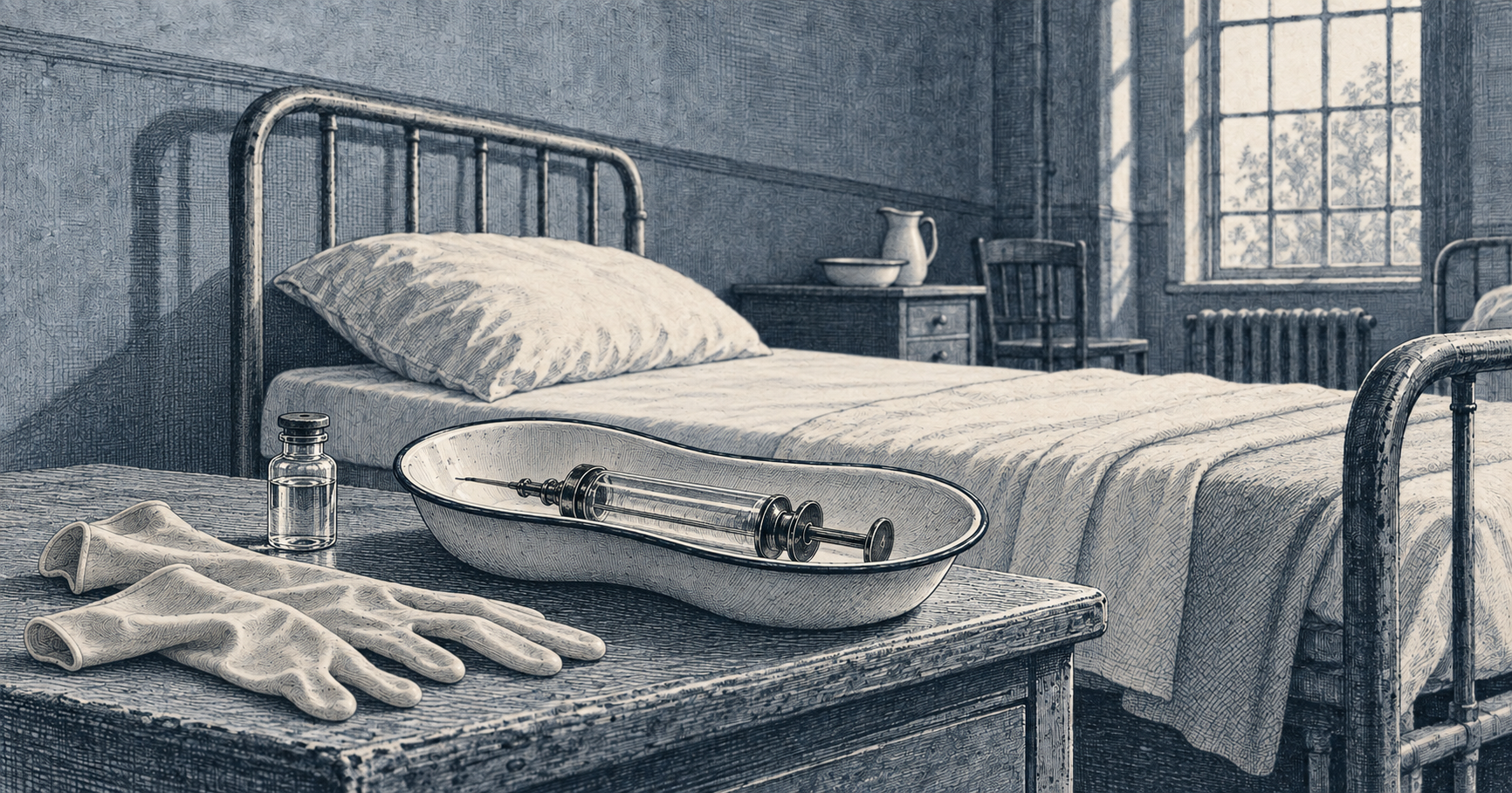
New Haven, 1942 — a cousin of a battlefield gas, given on purpose; the children who came after; and the bill that came with the cure
* * * * *
On August 27, 1942, at New Haven Hospital, a man of forty-seven from Meriden, Connecticut, was given an injection of a classified compound known only by a letter. He had lymphosarcoma. The tumors were so extensive he could barely move his head, and radiation had failed. The record identifies him only as J.D. The dose was a tenth of a milligram for every kilogram he weighed.
Within days the masses softened. He could move his head again, and he slept more easily. For a time his doctors could not find the cancer by examination at all.
The compound was a nitrogen mustard, a chemical cousin of the gas that had blistered and blinded soldiers in the First World War. It attacked cells that divide quickly. Cancer cells divide quickly, and so does the marrow that makes the blood. J.D.’s white count fell. The disease came back. He died on December 1, 1942, ninety-six days after the first injection.
The whole bargain is already there in one man’s chart: the cancer driven back, the body poisoned along with it, the cancer returning. What was new was the route. The poison was given on purpose, into a vein, to follow the cancer through the whole body.
Then the chart was lost. For decades the first dose was dated to December 1942, from the recollection of Alfred Gilman, one of the two Yale pharmacologists who led the work, and the December date passed into the histories. In 2010 two Yale surgeons, John Fenn and Robert Udelsman, recovered the record from the files of the pathology department, in a search led by the pathologist Michael Kashgarian, and the next year they published the August date.
Meanwhile a better story had taken hold. On the night of December 2, 1943, German bombers struck the harbor at Bari, in southern Italy, and hit the John Harvey, an Allied cargo ship secretly carrying two thousand mustard bombs. Men pulled from the oily water seemed to recover and then began to die, their white counts gone. An Army physician, Lieutenant Colonel Stewart Alexander, worked out that they had been poisoned by their own side’s gas. His report may have mattered afterward; his wartime superior, Cornelius Rhoads, became one of chemotherapy’s fiercest champions at Memorial Hospital in New York, and the journalist Jennet Conant has argued that the report helped drive him. Textbooks, and a 2003 World Health Organization report, have told Bari as the beginning of cancer chemotherapy. It is a true story fastened to the wrong date. J.D. had been dead a year and a day when the bombs fell.
Before the drug
Physicians who treated the gassed soldiers of the First World War had already seen what mustard did inside the body. It wrecked the bone marrow and shrank the lymph glands. Cancer, in those years, was generally understood as a local disease, a lump in one place, to be cut out or burned out with X-rays. Surgeons took that idea a long way. The historian Barron Lerner has described the super-radical mastectomy of the postwar years, in which surgeons removed parts of a woman’s rib cage and breastbone along with the muscles of the chest wall. A chance to cut, the saying went, was a chance to cure.
Leukemia gave the knife nothing to cut. The historian Gretchen Krueger, whose history of childhood cancer I have relied on throughout this piece, describes how a pediatrician at Memorial Hospital, Harold Dargeon, compared the hospital’s records with New York City’s vital statistics in the 1930s and helped establish cancer as a rare but major killer of children. For a child with acute leukemia in the 1940s, the arithmetic was close to absolute. Fewer than one in twenty lived a year.
The work that led to J.D. had begun with a government contract. After the United States entered the war, the Office of Scientific Research and Development, worried that chemical weapons would return, contracted with Yale’s pharmacology department to study the mustards. Louis Goodman and Alfred Gilman, two young assistant professors, found that nitrogen mustard shrank lymphomas in mice. The surgeon Gustaf Lindskog found them a patient. After J.D., the work spread under wartime secrecy to Memorial, to Utah, and to the University of Chicago’s Billings Hospital here in Chicago, among patients of varied ages. By 1948 nearly 150 had been treated.
The results stayed classified until 1946, when Goodman and his colleagues reported them in the Journal of the American Medical Association. In patients with Hodgkin’s disease, large tumor masses shrank or vanished, fevers broke, and appetite and strength came back; some patients recovered enough to return to work for weeks or months. In the same journal Rhoads, speaking for a committee of the National Research Council, endorsed the drugs and warned that the regressions were temporary.
One of the nitrogen mustards, mechlorethamine, sold as Mustargen, became the first chemotherapy drug approved by the Food and Drug Administration.
Boston
Sidney Farber was the chief pathologist at Children’s Hospital in Boston, and the number of children he autopsied after leukemia troubled him. Working with Yellapragada SubbaRow’s chemists at Lederle Laboratories, he wanted a drug that would block folic acid, which dividing cells need. Lederle made one, aminopterin.
Late in 1947 Farber’s team began injecting it daily into children with acute leukemia. One of the first, by the James Lind Library’s account of the trial, was an eight-year-old boy with a fever of 106 degrees. Farber announced the work in April 1948, and on June 3 the New England Journal of Medicine published it under a title that began Temporary remissions. Of sixteen children, ten went into remission, two did not respond, and four died within a few months.
Not everyone believed him. Some clinical investigators doubted that Farber had been fully truthful about his methods and results, and their doubts grew when others could not reproduce his findings in adults. Krueger writes that Farber went around his critics. He took his case to the American Cancer Society, to Congress, and to the public.
The public came first. In 1948 the Variety Club of New England, raising money for a new foundation built around Farber’s work, put a Maine boy named Einar Gustafson on national radio from his hospital bed. The publicists renamed him Jimmy and played up his love of the Boston Braves, and the Jimmy Fund was born while the real boy went home to his family’s farm.
In the spring of 1948 a family doctor in Fall River, Massachusetts, sent a little girl named Mary Sheila Burns to Farber. She made the trip to Boston and back every day, fifty miles each way, and often waited an hour for her turn at the clinic. Aminopterin gave her a remission of two or three weeks. Her mother, Angela, wrote that she was “as well and blooming and normal as she had ever been.”
Then came the cycle that would be familiar on leukemia wards for the next two decades. The drug lowered her white count and shrank her swollen spleen and liver, and it left her open to infection. Daily nausea stopped her eating. Each time the doctors halted the drug to let the nausea pass, the leukemia surged back. By that fall the bleeding had begun, from her nose, then her mouth and gums and bowel, a dozen severe hemorrhages in all. She died in January 1949, at six. When she died, a needle was still in a vein in her ankle, waiting for a transfusion.
In a seventeen-page letter to the writer John Gunther, Angela Burns explained why they had gone to Boston. There was, she wrote, “nothing to lose, and perhaps, miraculously, everything to gain.”
In leukemia, no single drug beat the resistance. By 1953 a new compound, 6-mercaptopurine, from the Wellcome laboratories of Gertrude Elion and George Hitchings in Tuckahoe, New York, was in use at Memorial, and it attacked the cell by a different route. Doctors there learned to give the drugs one after another, switching when the cells stopped responding. In Memorial’s figures, as Krueger reports them, five percent of untreated children with acute leukemia lived a year, and fifty-two percent of those given the drugs in sequence did. The figures come from different groups of children, so they measure the progress only loosely. Farber went to Congress with Mary Lasker beside him and photographs of a child before and after treatment. By 1957 a national program to find more drugs took nearly half the National Cancer Institute’s budget.
Some of the earliest proof that drugs alone could cure a cancer that had spread came from the obstetric side of medicine. In 1956 Min Chiu Li and Roy Hertz at the National Cancer Institute reported that methotrexate, the successor to aminopterin, could drive back choriocarcinoma, a cancer that grows from the tissue of a pregnancy and had nearly always been fatal. Li measured a hormone the tumor made, human chorionic gonadotropin, and he kept treating after the visible tumors were gone, because the hormone said the cancer was still there. The practice was controversial. When Hertz and Li shared a Lasker Award in 1972, the citation reported five-year cure rates above 90 percent for women treated within four months of onset, and 70 percent for women whose cancer had already spread. The leukemia doctors arrived at the same logic: keep treating a child for years after the last cell anyone could see was gone.
Emil Frei, Emil Freireich, and James Holland, who in the mid-1950s founded a cooperative study group linking the National Cancer Institute with other hospitals, began giving leukemic children several drugs at once, reasoning that cells resistant to one might die of another. In Memphis, at St. Jude Children’s Research Hospital, Donald Pinkel added radiation to the skull and spine, because the leukemia kept coming back in the central nervous system, where the drugs reached poorly. By the 1970s the protocols put nine children in ten with acute lymphocytic leukemia into remission, and they stayed on chemotherapy for two to five years afterward. In 1977 Joseph Simone of St. Jude told a national conference that it was no longer controversial to say that a significant share of children with acute lymphocytic leukemia could live long without leukemia and, possibly, be cured. Some of his former patients had finished college, married, and had children of their own.
The mustard came back too. At the National Cancer Institute, Vincent DeVita’s group made nitrogen mustard the M in MOPP, a four-drug regimen for advanced Hodgkin’s disease, and in 1980 they published a paper whose title stated what they believed they had shown: the curability of advanced Hodgkin’s disease with chemotherapy.
The war
Meanwhile cancer had acquired a lobby. Mary Lasker, the wife of an advertising executive, had been pushing for cancer money since the 1940s. On December 9, 1969, her Citizens Committee for the Conquest of Cancer ran a full-page advertisement in the Washington Post: “Mr. Nixon: You can cure cancer.” In his State of the Union address on January 22, 1971, Richard Nixon asked for an extra $100 million and said that the effort that split the atom and took man to the moon should be turned toward “conquering this dread disease.” He signed the National Cancer Act on December 23.
Nixon did not use the phrase “war on cancer” in that address, and it appears nowhere in the act. He came close at the signing, when he said that more Americans died of cancer each year than had died in all of the Second World War. The word stuck anyway, because the country had been hearing it for half a century.
The American Society for the Control of Cancer, forerunner of the American Cancer Society, took a Sword of Hope as its emblem, and in the 1930s it raised a Women’s Field Army in khaki uniforms. In 1955 the American Cancer Society photographed two small boys standing shoulder to shoulder with oversized swords, one considered cured of a childhood tumor and the other in a second remission from leukemia, one of them holding a sign that read “Strike back at cancer, man’s cruelest enemy.” The language had a use. Rhoads likened the treatment of leukemic children to a wartime emergency to dramatize the need for speed, and speed, with clinics built beside laboratories, is what carried new compounds from the animal to the child. After the act was signed, Lerner records, one cancer specialist predicted that cancer would be gone by the Bicentennial in 1976.
Susan Sontag wrote Illness as Metaphor in 1978, out of her own experience as a cancer patient, and argued that the metaphors did the sick no good and left them feeling that their illness came from something in themselves. Later critics have pointed to the implication buried in the language of battle, that those who die did not fight hard enough.
What the children paid
In the 1960s, under the VAMP-type protocols at the National Cancer Institute, children in complete remission were brought back into the hospital for further cycles of experimental drugs that made them extremely ill. There was a reason. Remission was not eradication, as Li’s work had shown, and continued treatment was meant to kill the cells no one could see. The children felt well when they came in and sick when they left. Parental permission was required. Few parents refused. John Laszlo, in his 1995 history of the leukemia cures, records that one leading investigator at the institute was criticized repeatedly by his own colleagues for trying regimens on children before the animal and toxicity studies the FDA expected had been done.
Farber and Rhoads played down, in public, the line between treatment and experiment. Farber said his clinic strongly emphasized its research program to parents, in the hope that the next advance would come in time for their child; he also said there was “no research, in the popular sense of the term,” on his patients with advanced cancer. Amid public and professional pressure to put promising drugs into general use before careful studies were done, the clinical studies panel of the Cancer Chemotherapy National Service Center recommended that the patient’s care be under the complete control of the investigator. At a 1966 conference whose papers appeared in Pediatrics, the Seattle pediatric oncologist John Hartmann asked his colleagues a different question, about the dying: whether it was morally and ethically right to give these compounds to a child already in the terminal stage of the disease. He weighed the short remissions against the child’s quality of life and the benefit to other children, and he told them to keep asking it.
Stated at its strongest, the case is this. The cures for childhood leukemia were bought in part with the suffering of children who gained weeks or months from it at most, enrolled by parents who had been told, accurately, that there was nothing else, and treated by doctors who needed those children as subjects as surely as they wished them well as patients.
What came later does not change what was done to those children.
The children who lived paid too. As survival climbed in the 1970s, doctors began to see what were called late effects: children cured of their cancer and left with learning disabilities, second cancers, and damage to the heart, the kidneys, and the glands. In 2006 the Childhood Cancer Survivor Study reported on 10,397 adults who had been diagnosed as children between 1970 and 1986. Sixty-two percent had at least one chronic health condition, and 27.5 percent had one that was severe or life-threatening. Their brothers and sisters, studied for comparison, had chronic conditions too, but the survivors’ risk of a severe one was about eight times theirs. Most of the survivors had received radiation as well as chemotherapy, so the drugs cannot carry the whole bill. Another speaker at Simone’s 1977 conference observed that success now let physicians turn some of their attention from cure to the consequences of the treatment they were giving.
The numbers
Two questions hide inside the war, and they have different answers.
- The first is whether the national effort begun in 1971 bent the death rate. In 1986 John Bailar, a biostatistician who would later chair health studies at the University of Chicago, and Elaine Smith examined American cancer mortality from 1950 through 1982 and wrote in the New England Journal of Medicine that “we are losing the war against cancer.” The age-adjusted death rate had risen. In 2008 the Harvard economist David Cutler put numbers to the two halves: the rate rose about 8 percent between 1971 and 1990 and fell 13 percent between 1990 and 2004. The American Cancer Society’s 2026 report puts the rate 34 percent below its 1991 peak, an estimated 4.8 million deaths averted. Measured that way, the rate rose for two decades after the act and has fallen for three.
- The second question is how much of the fall belongs to chemotherapy, and I have gone back and forth on it. The Cancer Society credits smoking reductions, earlier detection, and improved treatment, and no national series I have seen separates the drugs from the rest. Cutler, looking at the four commonest cancers, found treatment after detection the least decisive of the three causes he weighed. A 2024 modeling study led by the National Cancer Institute, covering five cancers from 1975 to 2020, credited prevention and screening with most of the deaths averted overall, but for breast cancer it credited treatment advances, a category that includes more than chemotherapy, with three-quarters of the million deaths averted. The randomized evidence points the same way for chemotherapy itself: an analysis of about 100,000 women in 123 trials found that certain regimens given for early breast cancer cut deaths from the disease by about a third. Bailar and Heather Gornik made the sharpest point about children in 1997. Death rates from the major childhood cancers had fallen by about half since the 1970s, but children under fifteen accounted for fewer than one-third of one percent of cancer deaths.
My reading is that chemotherapy’s achievement shows more plainly cancer by cancer than in the national rate. It turned a handful of cancers, many of them cancers of the young, from near-certain death to probable cure, and it took a real share of the deaths out of common ones like breast cancer, while most of the national decline came from elsewhere.
A modern study shows how far hope can run ahead of a prognosis, in a setting different from Farber’s ward. Researchers led from Dana-Farber, the institute that grew out of Farber’s clinic, asked patients diagnosed in the mid-2000s with metastatic lung or colorectal cancer what they expected from their chemotherapy, and published the answers in 2012. In that setting, the authors noted, the drugs can prolong life by weeks or months and may ease symptoms; they are not curative. Sixty-nine percent of the lung cancer patients and 81 percent of the colorectal patients did not report understanding that the treatment was not at all likely to cure them. Patients who rated their doctors’ communication most highly were the more likely to give answers the researchers counted as inaccurate.
What remains
Chemotherapy is still a poison given on purpose, in a dose measured against what the patient’s body can bear.
It is better supported now, with antibiotics and transfusions and drugs for the nausea, and it shares the work with medicines that act in other ways. For children and teenagers diagnosed with leukemia between 2016 and 2022, five-year relative survival in the National Cancer Institute’s registry was 86.7 percent. For those diagnosed in 1975, the same registry recorded about 37 percent. In the 1940s, fewer than one child in twenty with acute leukemia lived a single year.
What endured is the wager made in New Haven in 1942: that a drug sent through the whole body could reach a cancer spread too far for any knife, and that the patient would outlast the poison more often than the cancer did.
It cannot be undone, and most of us would not undo it.
That is the bargain medicine made.
The next drug in this series was first tried as a way to steady patients going into surgery. A French surgeon noticed that it left them strangely indifferent, and psychiatrists in Paris asked for samples.
* * * * *
CHARLES CRANSTON JETT is an author, civic educator, and Professional Certified Coach based in Chicago. A graduate of the U.S. Naval Academy (Class of 1964) and Harvard Business School, he served during the Cold War as an officer aboard nuclear submarines. He is the author of six books, including Super Nuke!, hosts four podcasts, and writes across his Critical Skills Blog platform on history, leadership, and the health of the American republic. In his writing he employs AI tools in a limited, supporting role for research, occasional image creation, and editing, while the prose and judgment remain entirely his own. He and his wife, Dr. Nancy Church, live and co-host the Chicago Salons at Water Tower Residences.

Leave a Reply