
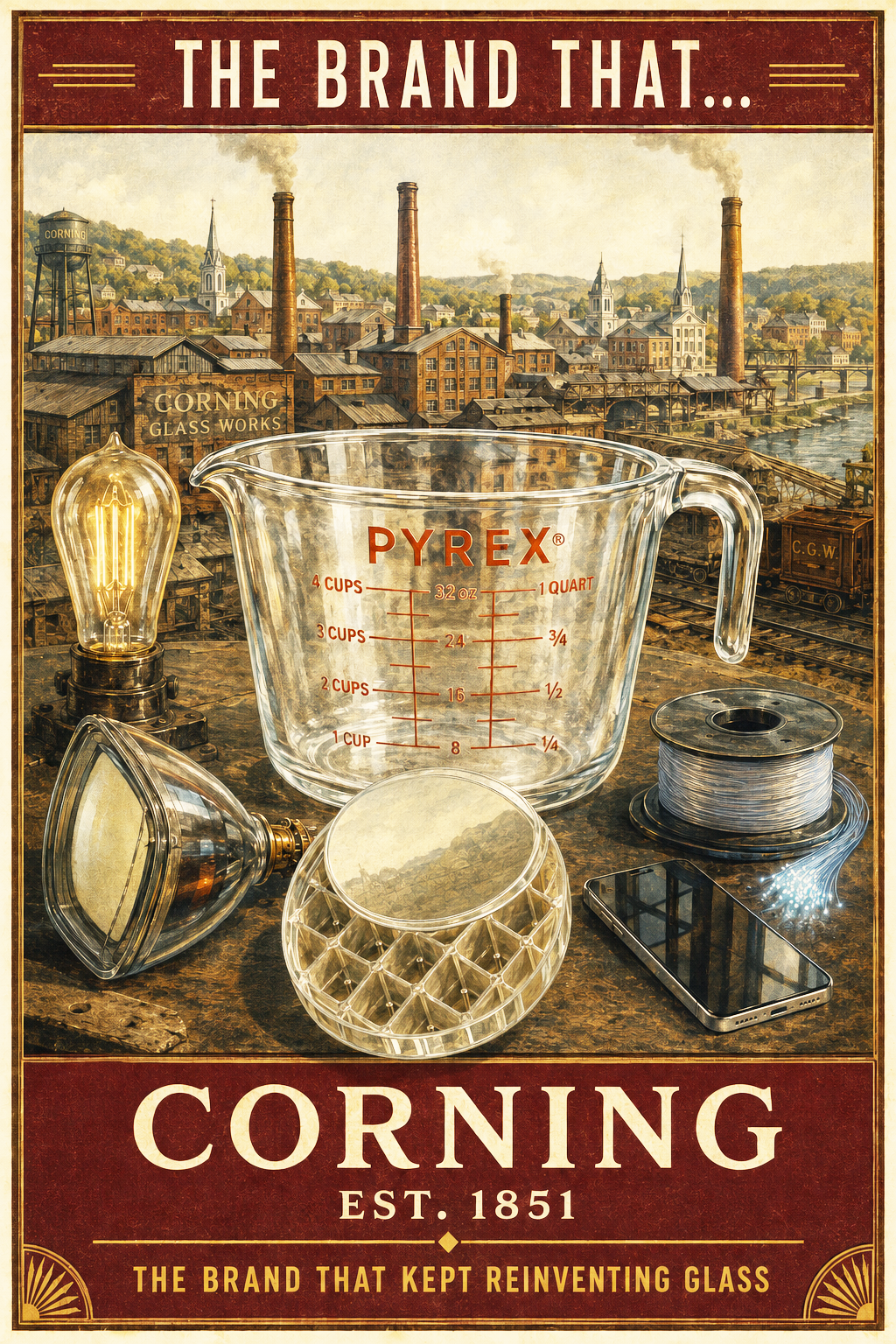
“Seventeen decibels, whoopee.” — three words in a lab notebook that built the internet.
This is the twelfth profile in The Brand That…, a series about American brands that taught the country a habit, became the word for the thing itself, and outlived the world that made them. We tell their stories plainly and with respect — what they made, what it cost, and what they still are.
The Founding
Amory Houghton failed at glass three times before it held.
He bought into a small works at East Cambridge, Massachusetts, in 1851. Three years later he started his own in Somerville and lost it in the panic. In 1864 he and his son bought the Brooklyn Flint Glass Works, and within four years it had burned once and was running out of money.
Then a banker named Elias Hungerford came down from a town on the Chemung River with an offer. Cheap coal. A canal. A railroad. Local money. In May of 1868 the Houghtons put the works on barges and moved it three hundred miles upriver to Corning, New York. In 1875 the firm incorporated as Corning Glass Works.
The company dates itself to 1851, though its own librarians will tell you the firm does not reach back that far — the family does. A heritage date, not a legal one, and worth holding onto.
The Rise
The habit was simple to state and hard to keep: take the material and ask what else it can do.
In 1879 Edison came looking for an envelope strong enough to hold a filament, and by 1880 Corning was his sole supplier. That November it shipped him three hundred and seven dozen hand-blown bulbs, invoiced at $311.97.
A gaffer and his assistant could blow two bulbs a minute, and for forty years that was the ceiling on electric light — until a glassblower named William Woods sagged molten glass through holes in a moving plate and blew it into shape with air. His ribbon machine ran by 1926, turning out four hundred thousand blanks a day. Light got cheap.
In 1908 the Houghton grandsons had hired a chemist named Eugene Sullivan to build a laboratory, a rare thing in American industry then. He ran it for fifty-four years. His people made a low-expansion borosilicate for lantern globes and battery jars and called it Nonex. A physicist named Jesse Littleton took one of those jars home sawed in half; his wife Bessie baked a sponge cake in it, and the glass held. The museum at Corning calls that story near-mythological and says the truth ran through many more people and experiments. Bessie kept testing — custard cups cut from lamp chimneys, recipe after recipe, written down.
In 1915 Corning trademarked the result and called it Pyrex.
Then came the disk.
On the twenty-fifth of March, 1934, five thousand people came to Corning to watch the company pour a two-hundred-inch mirror blank for George Hale’s telescope. Three ladles ran between the furnace and the mold, seven hundred and fifty pounds of glass in each, near a hundred pours in all. Partway through, part of the mold broke loose and rose into the glass. The disk was ruined. George McCauley, the physicist running the job, annealed it anyway — slowly, over months — because he wanted to know what he had made. It cooled into twenty tons of pale glass with a honeycomb of hollow pockets across its back and the wreckage of the mold set into its face. They poured a second one in December, and that one went into the Hale Telescope in 1948. The first never left town. It stands in the museum at Corning, a failure kept where anyone can walk up and look at it.
The pattern held: television tubes, then a glass-ceramic pulled from a lab oven at the wrong temperature in 1953 that reached American kitchens as CorningWare. And on a Friday in August of 1970, three researchers drew a fiber that lost seventeen decibels of light per kilometer where the best optical glass lost a thousand. Donald Keck wrote it in the databook: seventeen decibels, whoopee.
The Turn
The sale closed on the first of April, 1998. Pyrex, CorningWare, Corelle, Revere Ware — all of it, to an affiliate of Borden controlled by KKR, in a deal valued near $603 million. Corning kept eight percent, the trademarks, and the proceeds, and turned toward optical fiber.
Three years later the telecommunications industry collapsed. Sales fell from $6.0 billion in 2001 to $3.2 billion in 2002. The company lost $5.5 billion that first year, cut eight thousand jobs, halved its workforce, suspended the dividend, and watched a stock that had touched $113 fall to $1.10.
It is tempting to read the 1998 exit as foresight — the old company shedding its past to fund its future. I do not think the clean version survives contact with the record. What Corning sold was the stable business, the one in every kitchen in America. What it bought into nearly killed it inside of three years. What carried it through was not the timing of the exit but the thing underneath it: the laboratory, and a display-glass business the telecom mania had made everyone forget. Corning was right about the material and wrong about the market, and the material proved the more durable of the two.
The Reckoning
Two things belong here, and they are not the same size.
Corning owned half of Pittsburgh Corning, a joint venture with PPG. From 1962 to 1972 that company made a pipe insulation called Unibestos out of amosite asbestos. Men who cut it and packed it around steam lines breathed it. Pittsburgh Corning filed for bankruptcy in 2000 against more than two hundred thousand claims of asbestosis, lung cancer, and mesothelioma, and did not emerge until 2016, into a trust valued above three and a half billion dollars. Corning did not run that company. Corning owned half of it, took the earnings for decades, and paid into the trust at the end. Both sentences are true, and the second does not cancel the first.
The other thing is the plant at Charleroi, Pennsylvania. Glass was made there from 1893. Corning bought the plant at the end of 1936 and sold it with everything else in 1998. What came after happened to a brand Corning no longer owned — World Kitchen, bankruptcy, private equity, bankruptcy again in 2023, and finally Centre Lane Partners, which also owned Anchor Hocking and moved Charleroi’s work to Ohio. Pennsylvania sued and lost. On the eleventh of April, 2025, the lunch bell rang for a hundred and thirty-two seconds, one for each year, and about three hundred people went home.
Here is the part that flatters nobody, including the people who miss it most. The story is that Pyrex got worse in 1998, cheapened the moment the grown-ups sold it. That story is mostly false. Corning changed the glass itself, beginning in the 1940s, moving its clear bakeware from borosilicate to tempered soda-lime. Soda-lime survives a drop better. Borosilicate survives a sudden change of temperature better. It was a trade, and Corning made it, product by product, decades before it sold the brand. Much of what the nostalgia mourns was never taken by private equity. It was given up by the company being mourned.
In June of 1972 the dikes gave way and the Chemung came through Corning before dawn. The museum took five feet four inches of water. Amory Houghton Jr. went on the radio to say the company was not leaving, and then paid to rebuild the town. The museum reopened in thirty-nine days. Twenty miles downriver, Elmira lost its downtown. Same storm.
What Endures
Corning Incorporated is still in Corning, New York, still doing the only thing it has ever done.
The fiber business Keck’s measurement started is now the largest thing the company makes — up thirty-two percent to $2.07 billion in the second quarter of 2026, with Meta, Amazon, and NVIDIA all signed to long-term agreements for the cable AI data centers run on. The glass on the phone in your pocket came off a shelf: a formula called Chemcor, developed in the early 1960s, sold almost nowhere, filed away for forty years, until Steve Jobs called about a screen and Wendell Weeks remembered it was there. Jobs told him not to be afraid. It shipped in six months as Gorilla Glass.
Corning still owns the Pyrex trademark and makes Pyrex for laboratories. The measuring cup in your kitchen is licensed from a company that has not made a casserole dish in twenty-eight years — a strange kind of endurance, and a real one. The city’s own side of this story is coming in the companion series, as The City That Reinvented Glass Forever.
What lasts is not a product. It is a bulb blown by hand at two a minute; a sponge cake in a sawed-off battery jar; a ruined twenty-ton mirror kept on display because the second one worked; a line in a notebook that says whoopee; a shelf of glass nobody wanted for forty years until a phone needed it.
Other glass towns held onto what they knew and watched the world walk past.
This one kept asking the same question of the same material, century after century, and kept getting a different answer.
Corning kept reinventing glass, and that is worth remembering.
Why Corning? Because the thing it made became the word for the thing itself — Pyrex, for a generation, simply meant glass you could bake in — and because Corning then did it again in categories where its own name never appeared at all: the bulb, the telescope, the fiber, the screen. The deeper advantage was never a product. It was a laboratory old enough to have outlived every market it ever served.
* * * * *
Charles Cranston Jett is an author and civic educator based in Chicago. A graduate of the U.S. Naval Academy (Class of 1964) and Harvard Business School, he served aboard nuclear submarines during the Cold War. He is the author of six books, including Super Nuke!, hosts four podcasts, and writes across his Critical Skills Blog platform on history, leadership, and the health of the American republic. In his writing he uses AI tools for research, editing, and occasional image creation; the arguments, the voice, and the final judgment are his. He and his wife, Dr. Nancy Church, live at Water Tower Residences, where they co-host the Chicago Salons.

Leave a Reply