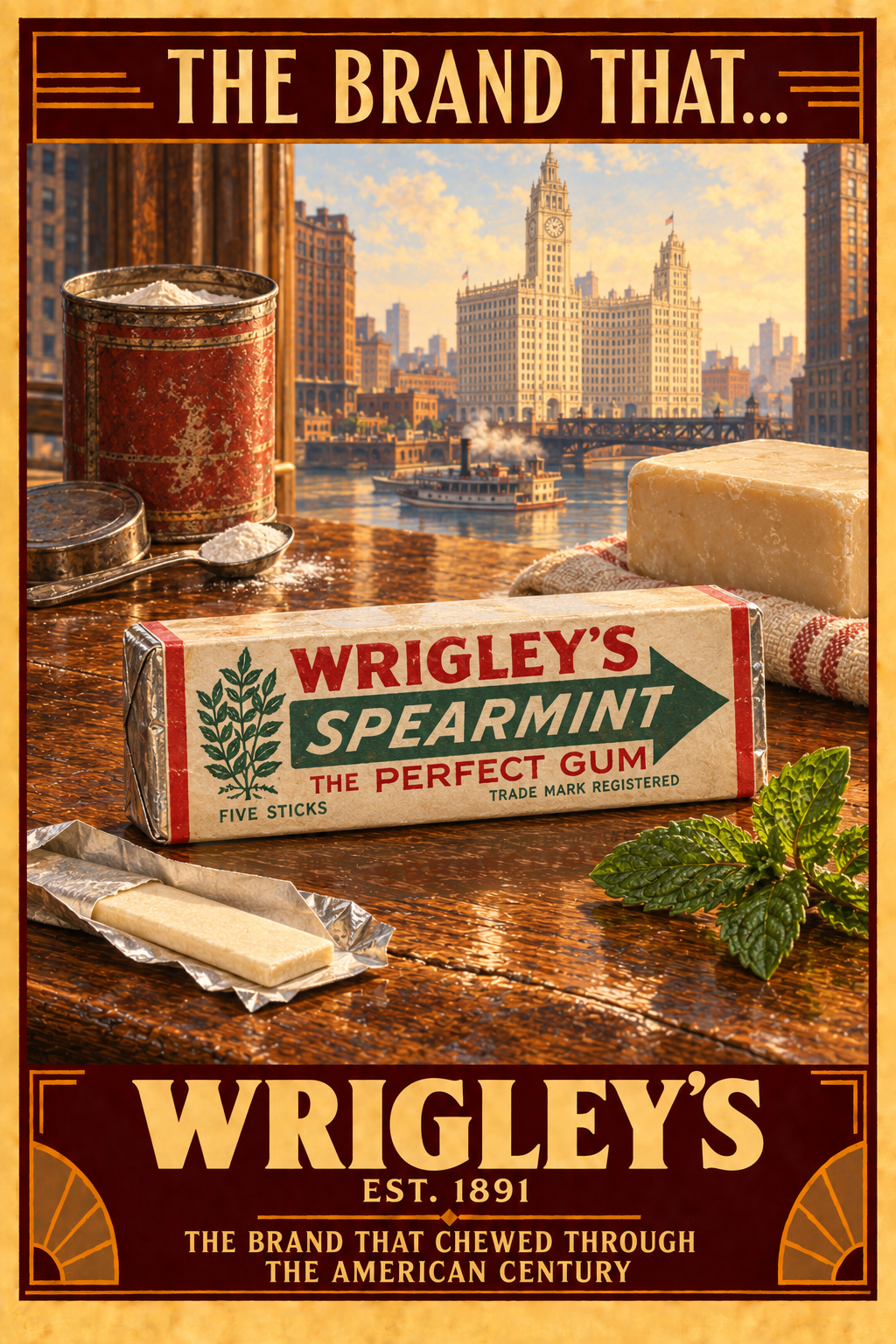
Five sticks for a nickel, and a habit built to last.
This is the twenty-fifth profile in The Brand That…, a series about American brands that taught the country a habit, became the word for the thing itself, and outlived the world that made them. We tell their stories plainly and with respect: what they made, what it cost, and what they still are.
The Founding: Soap, Baking Powder, and a Free Pack of Gum
Wrigley’s gum began with soap. At eleven, William Wrigley Jr. was selling his father’s soap from a basket in a Philadelphia market. In 1891, at 29, he came to Chicago to sell it for himself. The company dates its founding to April 1 of that year and says he arrived with $32 in his pocket. Its own 2012 history adds a second figure: a $5,000 check from an uncle.
From the start Wrigley sold with something extra in the box: watches, umbrellas, spoons, a cookbook. As the story goes, he took on baking powder and gave away two packages of chewing gum with each can, and the gum proved more popular than anything else he had. He dropped the rest and sold gum, made for him by the Zeno Manufacturing Company of Chicago. Juicy Fruit and Wrigley’s Spearmint followed, both in 1893 by the company’s account.
The Rise: “Tell ’Em Quick, and Tell ’Em Often”
The first big push failed. In 1902 he put $100,000 into advertising in New York City. “I didn’t even make a ripple on the surface,” he admitted afterward, as Merle Crowell told it in The American Magazine in 1920. He failed there twice before he won.
The panic of 1907 made him, in Crowell’s telling. While other advertisers pulled back, Wrigley went to New York and in three days bought up, by Crowell’s figure, a million and a half dollars’ worth of contracts for advertising space. Coupons went out through the trade, each good for a free box of twenty packages. Dealers suspicious of anything free threw many away, then dug them out of their wastebaskets when word spread that the gift was real. The campaign’s two slogans held: “Look for the Spear” and “The Flavor Lasts.” By 1910, according to later company histories, Spearmint was the best-selling gum in the country.
In 1915, Crowell reported, Wrigley gathered the country’s telephone directories and mailed four sample sticks to each of the 1,500,000 listed subscribers. In 1919 he did it again, to more than 7,000,000 homes. Asked the secret, he said, “Tell ’em quick, and tell ’em often.” He added a condition, “You must have a good product in the first place and something that people want, for it’s easier to row down stream than up,” and ended: “keep everlastingly coming at them.”
Wrigley priced the five-stick pack at a nickel and held it there for decades. When his white terra-cotta tower opened on Michigan Avenue on April 1, 1921, every office already rented, people called it the building “Built by Nickels.” He bought into the Chicago Cubs in 1916; the ballpark took his name in 1926.
The rise had a hard edge, and the courts named it. In 1911 Wrigley sued a rival, the L. P. Larson company, over a package it said imitated Spearmint’s, and lost. “Wrigley’s oppression of his opponent, and his attempt to deceive the court,” the appeals court wrote, “were ample grounds for refusing him relief in equity.”
In 1914 Wrigley brought out Doublemint in a package the courts found infringed Larson’s Wintermint, then sued again, alleging that Wintermint came second. Wintermint was seven months older, the courts found, and Larson won. In 1928 the Supreme Court cited the finding of “conscious and deliberate wrongdoing.” That December, Wrigley paid Larson $1.9 million to settle.
The Turn: The Empty Wrapper
The founder died in 1932, and his son Philip carried the company into the war. By 1944, the company says, rationing left it unable to make enough top-quality gum for everyone. To support the troops and protect its brands’ reputation, it took Spearmint, Doublemint, and Juicy Fruit off the civilian market and sent their whole output to the armed forces. People at home got a stand-in called Orbit, in a wrapper without the arrow.
Its billboards and print ads showed an empty Spearmint wrapper under the words “Remember this wrapper!” A surviving streetcar card explains the picture in the company’s words: the wrapper means gum of the finest quality and flavor, and it will stay empty until gum of Spearmint’s quality can be made again.
I keep thinking about that card. A company paid for space on a streetcar to show its riders a package with nothing in it, and to promise that the nothing was temporary.
In 1971 the nickel pack gave way. Early that year Wrigley raised its wholesale price, and newspapers found the “nickel” pack already selling for seven cents in some stores. In November, The New York Times reported, the company announced a seven-stick pack at a suggested dime. A penny a stick became nearly a penny and a half.
On June 26, 1974, at a supermarket in Troy, Ohio, a cashier passed a ten-pack of Juicy Fruit over an early laser scanner, and it rang up 67 cents. It was the first purchase rung up by scanning the new Universal Product Code. The store’s research man chose gum, he explained later, because no one had been sure a bar code could be printed on anything that small, and Wrigley had found a way.
The Reckoning: What the Gum Was Made Of
All of it, the nickel and the mailings and the empty wrapper, rested on something that grew in a forest. For more than half a century Wrigley’s gum was made with chicle, the latex of the chicozapote tree of the Yucatán, Belize, and the Petén of northern Guatemala. A study from Guatemala’s University of San Carlos describes the seasons of the men who gathered it, the chicleros: six and seven months in the jungle, climbing on a rope with spurs, cutting V-shaped channels in the bark with a machete, cooking the sap down by hand on weekends. The study names the dangers: a rope that gave way, a snake, illness.
Wrigley bought chicle through contractors, who hired the men by what the study calls engagement through debts: a man took an advance and worked it off. Its author concluded that the international chicle companies were the main beneficiaries. A photograph in the study (from Alfonso Arrivillaga Cortés’s 1997 article La Chiclería en Petén) is captioned as showing bags of chicle bound for Chicago, to be delivered to the Wrigley Import Company.  A 1930 arbitration award, over the cancelled concession of an American who had sold chicle under contract to Wrigley, lists his claim for “Chicleros’ accounts due on account of advances, $7,600.91.” The arbitrator called most of them old accounts and allowed $1,309.96.
None of these papers shows Wrigley setting a chiclero’s pay. They show a Chicago company at the far end of a chain whose near end was men working off debts in the rain forest.
The tree could not keep up. It grows slowly, and an over-tapped tree dries out, the anthropologist Jennifer Mathews told Popular Science. Around the 1950s, that account says, Wrigley looked for another natural gum and found nothing to match chicle’s quality and quantity. Gum makers turned to synthetic bases made from petroleum. I can’t show Wrigley’s costs or reasons. But had I been selling a five-cent habit to millions, I would have wanted a gum base that did not depend on a forest and a man on a rope, and I think most businessmen would have. For much of the twentieth century, the San Carlos study says, chicle had been the key to the economy of the Petén.
What Endures: Wrigley’s Gum Under Mars
Wrigley closed its Chicago gum plant at 35th Street and Ashland Avenue in late 2006, and about 600 jobs went with it. In 2008 Mars bought the company for about $23 billion, with financing help from Warren Buffett’s Berkshire Hathaway. In 2011 the company sold the Wrigley Building.
Wrigley is a Mars brand now, part of Mars Snacking, which keeps its global headquarters in Chicago, on Goose Island. In March 2026 Mars Snacking and the state announced a $100 million commitment and 602 new full-time jobs to expand that headquarters. Spearmint, Doublemint, and Juicy Fruit are still sold. In its last annual report as an independent company, for 2007, Wrigley called itself the world’s largest manufacturer and marketer of chewing gum, and said its wholesale customers typically restocked gum and candy every ten days to two weeks.
Gum sells in fewer units than it did before the pandemic. In 2024 the Associated Press, citing Circana data, reported 2023 U.S. gum sales of 1.2 billion units, 32 percent below 2018 though up slightly on the year, with dollar sales restored by higher prices. Explanations abound: the pandemic, worries about sugar and sweeteners, younger buyers drifting to sour gummies, more shopping done online. I can’t tell from the record which weighs most. The one I keep weighing is the last. Gum was an impulse buy from a rack by the register, and a screen has no register. That is my guess, not the record’s.
An empty wrapper on a streetcar card. Four sample sticks in a mailbox in 1915. A white tower on the river that people said nickels built. Bags of chicle on a Petén airstrip, addressed to Chicago. A ten-pack of Juicy Fruit in Troy, Ohio, read by a beam of light. And a name on a ballpark the family no longer owns.
Wrigley’s chewed through the American century, and that is worth remembering.
Why Wrigley’s? Wrigley’s never became the common word for gum, the way Kleenex became the word for tissue. It became a habit: a pack cheap enough to buy without a second thought, advertised without letup, and held at a nickel for most of the twentieth century.
* * * * *
Charles Cranston Jett is an author, civic educator, and Professional Certified Coach based in Chicago. A graduate of the U.S. Naval Academy (Class of 1964) and Harvard Business School, he served aboard nuclear submarines during the Cold War. He is the author of six books, including Super Nuke!, hosts four podcasts, and writes across his Critical Skills Blog platform on history, leadership, and the health of the American republic. In his writing he uses AI tools for research, editing, and occasional image creation; the arguments, the voice, and the final judgment are his. He and his wife, Dr. Nancy Church, live at Water Tower Residences, where they co-host the Chicago Salons.


Leave a Reply