
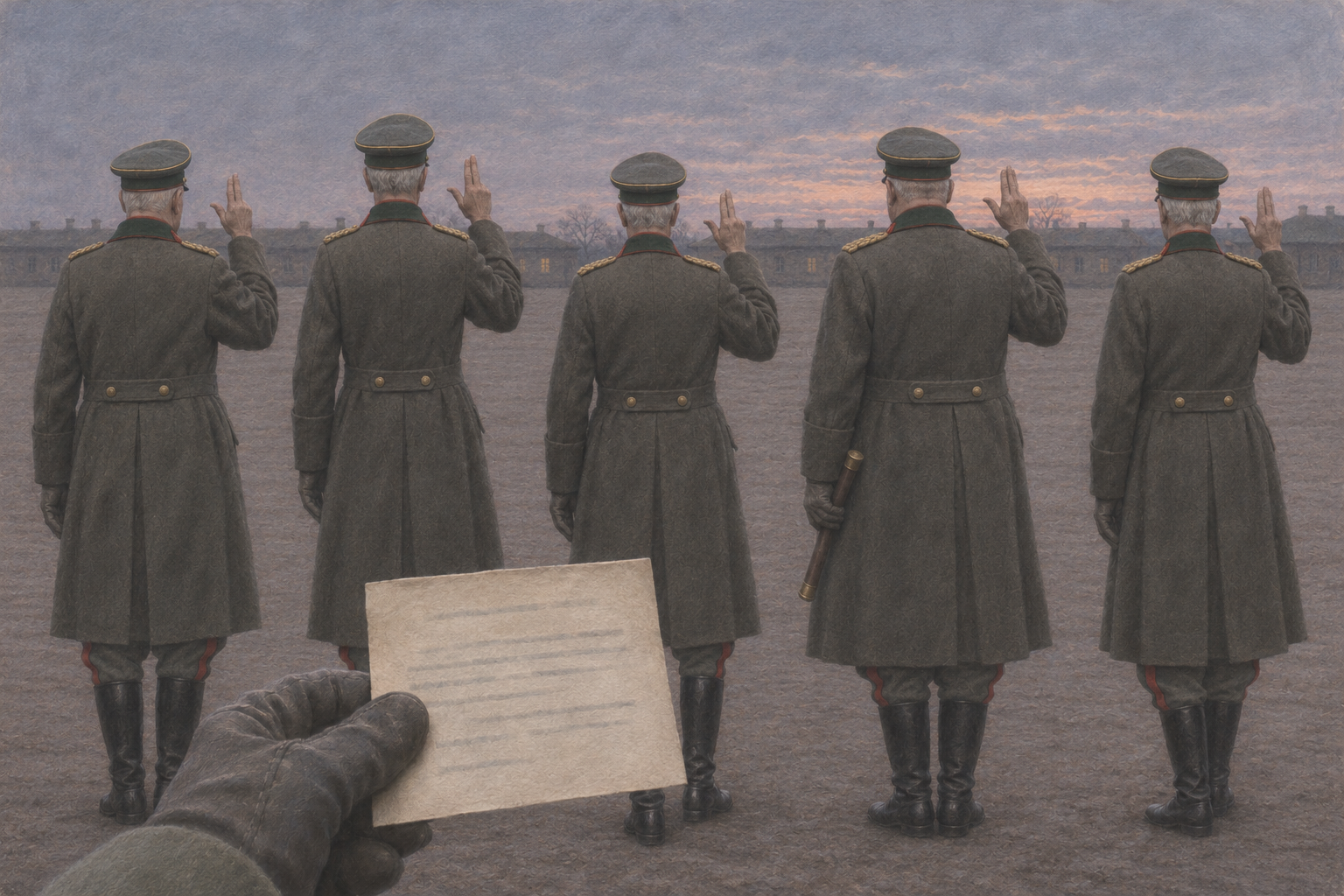
The army’s own leaders wrote it. After the war it was offered as the generals’ defense.
This is a follow-up to Hitler’s Generals: Who They Were, What They Did, and What Happened to Them, which has become one of the most-read articles on this blog. That article told what the generals did and how they ended. This one asks why they followed him. It is the second of five in the series.
On August 2, 1934, President Paul von Hindenburg died at his estate in East Prussia. That same day General Ludwig Beck, who ran the army’s Troop Office, was called to a military roll call. There it was announced that the officers present would swear an oath to the new head of state, in words none of them had heard before. Beck was taken unawares. He took the oath.
The words were these: I swear by God this sacred oath, that I will render unconditional obedience to the Leader of the German Reich and people, Adolf Hitler, Supreme Commander of the Armed Forces, and that as a brave soldier I will be ready at any time to stake my life for this oath.
On his way home Beck said to a fellow officer, “This is the blackest day of my life.”
We have that remark from Hans Bernd Gisevius, a member of the German resistance, who repeated it under oath at Nuremberg twelve years later. Beck could not speak for himself by then. Gisevius told the court that Beck never stopped asking whether he should have refused.
The usual explanation for Hitler’s generals is that oath. They had sworn, the argument runs, and German officers kept their word. The record tells a harder story. The generals had reasons of their own for following Hitler, and the oath itself came from inside the army.
Three Oaths in Fifteen Years
The German soldier swore three different oaths between the two world wars.
Before 1918 he had sworn to his monarch. An oath to a person was the tradition the older officers grew up in. The republic broke with it. From August 1919, soldiers swore loyalty to the Reich constitution and obedience to the Reich President.
Seven months later that oath met its first test. In March 1920 General Walther von Lüttwitz sent a brigade into Berlin to overthrow the elected government, in what became known as the Kapp putsch. The government asked the army to stop him. The army’s commander, Walther Reinhardt, was willing. Most of his generals were not. Hans von Seeckt’s answer is remembered as: troops do not fire on troops. The government fled Berlin. A general strike, and the refusal of civil servants to take the putschists’ orders, ended the affair within days.
The generals who stood aside were serving under that constitutional oath. It had not, by itself, made them defend the constitution.
The second oath came in December 1933, ten months after Hitler became Chancellor. The constitution and the President were gone from it. Soldiers now swore to serve “people and fatherland.”
The third was the one Beck took. It named a man.
Their Own Idea
It is natural to assume Hitler forced that oath on the army. The documents point the other way. Defence Minister Werner von Blomberg, a general, ordered it on the day Hindenburg died. The head of his ministerial office, General Walther von Reichenau, composed the wording on his own initiative. The historian Ian Kershaw writes that the two acted without any request from Hitler.
Hitler was not surprised by it. The minutes of the cabinet meeting on the night of August 1, with Hitler in the room, record Blomberg announcing that he would swear the armed forces to him as soon as Hindenburg was dead. The next day Hitler personally swore in Blomberg and the chiefs of the three services.
The generals’ motive is a matter of interpretation. A month earlier Hitler had destroyed the leadership of the SA, the Party’s brown-shirted militia and the army’s only rival. Many historians read the oath as the army’s side of that exchange: a personal bond with the Leader, which Blomberg and Reichenau expected would bind him to them. No such bargain was ever written down.
Blomberg also had no authority to do it. The oath law then in force was the one from December 1933, and a minister could not rewrite it by order. In 1954 West Germany’s Federal Constitutional Court said so plainly: Blomberg’s order had no legal basis and disregarded the law. The government supplied a law on August 20, eighteen days after the armed forces had already sworn.
So the oath that would later be called sacred and binding was composed by one general and ordered by another, with Hitler’s knowledge and without lawful authority.
What They Wanted
The generals of 1934 were not Nazis by background. Most were conservatives who had regarded Hitler as an upstart. He offered them what they wanted most. He tore up the limits of the Versailles treaty and rebuilt the army they had watched shrink to 100,000 men. He shared their hatred of Bolshevism. Rearmament meant commands and promotions. The early campaigns in Poland and France meant victories. Men who doubted Hitler’s judgment in 1938 found fewer reasons to say so in 1940.
The army lost its independence in the first weeks of 1938. Blomberg was forced out in January over a scandal about his new wife. The army’s commander, Werner von Fritsch, followed in February on a charge that was later shown to be false. Hitler abolished the War Ministry and took command of the armed forces himself, through a new high command under General Wilhelm Keitel.
That summer Beck, now Chief of the General Staff, tried to stop the drift toward war over Czechoslovakia. On July 16, 1938, in a note for the army’s new commander, he set down a principle: a soldier’s obedience ends where his knowledge, his conscience, and his responsibility forbid him to carry out an order. He proposed that the senior generals resign together. If they all acted, he argued, the war could not be fought.
The generals heard the case in August and largely agreed with his reading. None joined him. Beck resigned alone on August 18. Hitler and the army’s commander asked him to keep the resignation quiet, and he did. The announcement came at the end of October, after the crisis had passed. Gisevius said Beck came to regret that silence deeply.
Then there was money. The historian Norman Goda has documented that from 1940 officers of the two highest ranks received secret, tax-free monthly payments from a fund in Hitler’s Chancellery, enough to more than double their salaries. On milestone birthdays some received cheques for 250,000 Reichsmarks. Later came landed estates. Heinz Guderian, whom readers met in the first article, was given a confiscated Polish estate in October 1943. The officers were told that the payments depended on their future conduct and were not to be discussed. After the war some of those who had been paid, the army’s former commander among them, denied or evaded the matter when questioned.
And there was the war in the East. The Commissar Order of June 1941, which directed that captured Soviet political officers be shot, came from the armed forces’ own high command. The United States Holocaust Memorial Museum concludes that the military’s part in the regime’s crimes ran from the generals to the ranks.
Protest short of conspiracy was possible. General Johannes Blaskowitz objected in writing to SS killings in occupied Poland, and went on serving.
July 20, 1944
The oath did weigh on the men who finally acted. Gisevius testified that it troubled the conspirators more and more as the years went on. They hoped the field marshals would lift the burden by refusing obedience one after another. The field marshals never did.
Their reasons were mixed, and most of what we know of them was said afterward. The historian Joachim Fest writes that Günther von Kluge, like Fedor von Bock before him, always fell back on the oath he had sworn. Kluge would move only once Hitler was dead. Erich von Manstein testified at Nuremberg in 1946 that he had feared chaos. Fear of civil war, doubt that a coup could succeed, and a sworn duty to a living commander could all sit in the same man. Those who declined kept their commands.
On July 20, 1944, Colonel Claus von Stauffenberg’s bomb went off at Hitler’s headquarters at 12:42 in the afternoon. Stauffenberg flew back to Berlin believing Hitler was dead. The plotters’ instrument was Valkyrie, an existing army plan for putting down unrest at home, which they had quietly rewritten to seize the government. Orders went out that afternoon announcing that Hitler was dead and the army was taking control. Then word came from Hitler’s headquarters that he was alive, and commanders across Germany found themselves holding two sets of orders.
Here the oath did its work. The commander of the Berlin military district, summoned to the plotters’ headquarters, refused to obey and invoked his oath. In Paris, General Carl-Heinrich von Stülpnagel ordered the arrest of the SS. Stülpnagel is a hard man to place: three years earlier, commanding an army in the Soviet Union, he had issued orders for harsh treatment of Jews and cooperated with the SS killing squads. Kluge, his superior, already knew Hitler had survived. He cancelled the order and dismissed Stülpnagel. Stülpnagel’s troops seized some 1,200 SS and security men anyway, and released them after midnight.
By the early hours of July 21 it was over. Beck, who was to have been head of state, died that night in the plotters’ headquarters. Stauffenberg was shot in its courtyard. One field marshal had joined them, Erwin von Witzleben. He was hanged in August.
The men of July 20 were not all of one kind. Some acted from horror at the regime’s crimes and some to spare Germany a total defeat, and several had served that regime for years. They are remembered because, in the end, they acted.
I find what the others did next hard to read. On August 2, 1944, ten years to the day after the oath, Hitler set up a Court of Military Honour to expel suspected officers from the army. Expelled, they could be sent before the Nazi People’s Court as civilians, stripped of their rank. Gerd von Rundstedt, the army’s senior field marshal, chaired it. He had accepted a birthday cheque for 250,000 Reichsmarks from Hitler in December 1941. Keitel and Guderian sat with him. In six weeks 55 officers were expelled and 29 more discharged. As I read it, the men on that court went along to save themselves. That falls short of what I understand by honor.
In October Erwin Rommel, implicated in the plot, was offered poison or a trial and took the poison to spare his family. The public was told he had died of his wounds. Rundstedt spoke at his state funeral.
The Defense
After the war the oath came back as a defense. Hans Laternser, counsel for the General Staff and High Command, told the Nuremberg Tribunal in August 1946 that the German officer had been bound by his military oath. Rundstedt, called as a witness that month, said that a coup against Hitler would have been “base, barefaced treachery.”
The Tribunal declined, on technical grounds, to declare the General Staff a criminal organization. It did not accept the argument. The judges called these officers a disgrace to the profession of arms and said many of them had “made a mockery of the soldier’s oath of obedience to military orders.” When it suited their defense, the judgment observed, they said they had to obey. When confronted with crimes they had known about, they said they had disobeyed.
Two Oaths of My Own
I do not remember the words I spoke when I entered the Naval Academy in July 1960, or when I graduated and was commissioned in June 1964. The record does. Both times I swore to support and defend the Constitution of the United States. Dwight Eisenhower was President the first time and Lyndon Johnson the second, and neither oath mentioned either man. Congress wrote the words “support and defend the Constitution” into the officer’s oath during the Civil War and settled its present form in 1884.
Germany’s Answer
The argument over the oath did not end at Nuremberg. It was taken up again in a German courtroom.
Otto Ernst Remer was the major whose battalion helped put down the coup in Berlin on July 20. By 1951 he was a leader of a far-right party. That May he told a rally in Braunschweig that the conspirators had been traitors in the pay of foreign powers. Fritz Bauer, Braunschweig’s chief prosecutor, charged him with defamation. For four days in March 1952 the court heard the families of the executed, survivors, and expert witnesses, theologians among them, on the right to resist. The defense asked to call Manstein and Kesselring to testify on the soldier’s oath. The court refused. Remer was convicted and sentenced to three months. The court rejected the charge of treason: the men of July 20, it found, had acted out of love of country.
Four years later the Federal Republic set a new oath in law. A German career soldier swears, and a conscript or volunteer pledges, to serve the Federal Republic and to defend the law and the freedom of the German people. The words name no one. The same statute sets limits on obedience. A soldier commits no disobedience by refusing an order that violates human dignity, and he must not obey an order to commit a crime. Each July 20, recruits make that pledge in public at the Bendlerblock in Berlin, the building where Beck and Stauffenberg died.
Beck drew his line in 1938 at knowledge, conscience, and responsibility, and he drew it alone. The law his country wrote in 1956 draws a narrower one, at human dignity and at crime. It is the same kind of line, and it now stands in the statute book. That is worth remembering.
Next in this series: Hitler’s Generals and the Admirals.
* * * * *
Charles Cranston Jett is an author and civic educator based in Chicago. A graduate of the U.S. Naval Academy (Class of 1964) and Harvard Business School, he served aboard nuclear submarines during the Cold War. He is the author of six books, including Super Nuke!, hosts three podcasts, and writes across his Critical Skills Blog platform on history, leadership, and the health of the American republic. In his writing he uses AI tools for research, editing, and occasional image creation; the arguments, the voice, and the final judgment are his. He and his wife, Dr. Nancy Church, live at Water Tower Residences, where they co-host the Chicago Salons.



Leave a Reply