
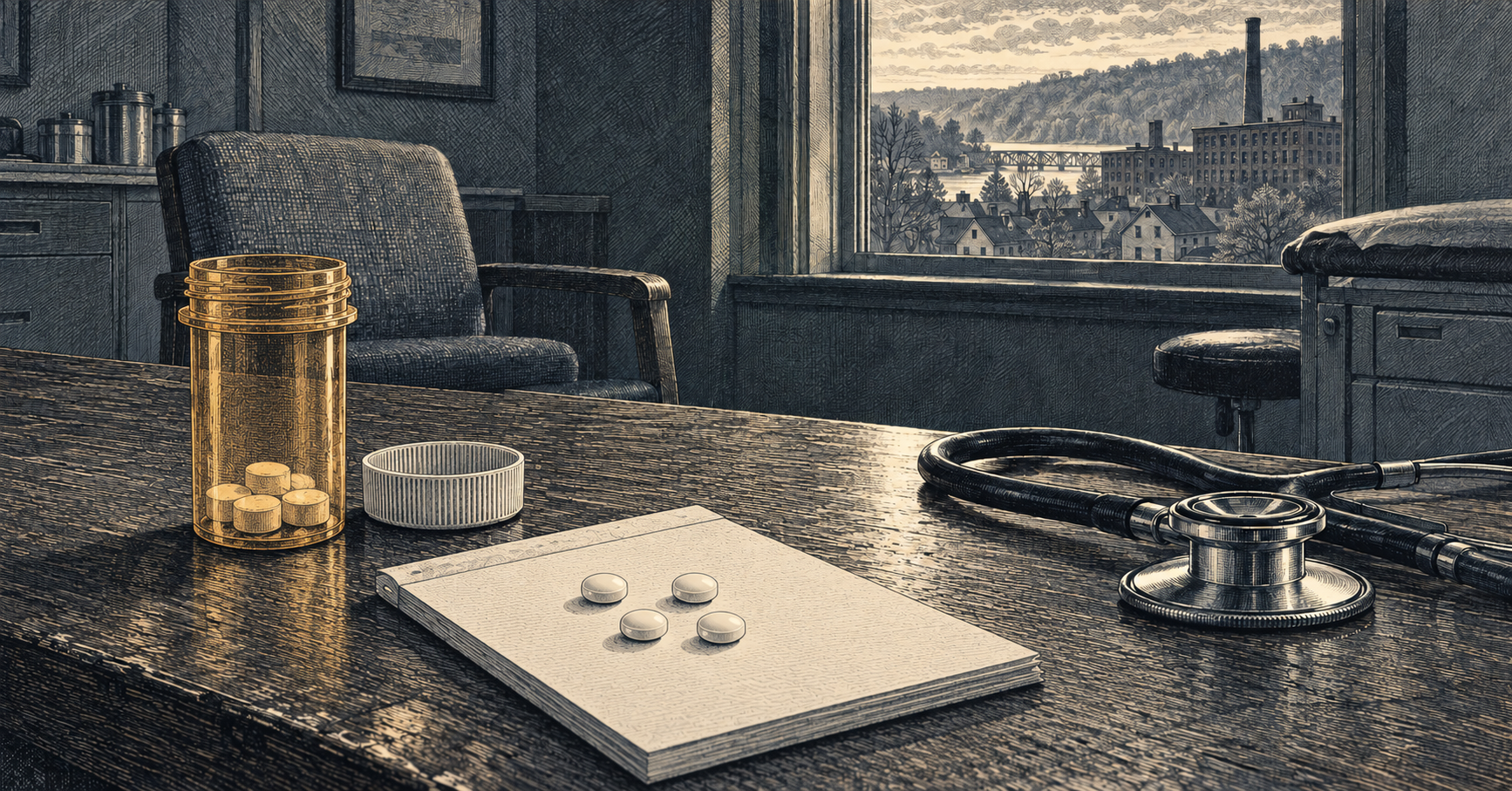
A painkiller approved on one hopeful sentence, and the worst drug epidemic in American history that followed.
* * * * *
On December 12, 1995, the Food and Drug Administration approved a new painkiller from Purdue, a Connecticut drug company owned by members of the Sackler family. It was oxycodone in a controlled-release tablet, to be taken every twelve hours. The company called it OxyContin.
The package insert carried a sentence that Purdue’s sales representatives were told to use in their calls on doctors: “Delayed absorption, as provided by OxyContin tablets, is believed to reduce the abuse liability of a drug.”
Believed. Purdue’s application had not claimed that the tablet was safer than other pain medicines. Its studies showed that the new tablet, taken every twelve hours, was as safe and as effective as ordinary oxycodone taken every six. The company had no clinical study showing that OxyContin was less addictive or less likely to be abused, and it gave the FDA none. The FDA’s medical review of the application’s safety data, completed that October with Purdue’s assistance, judged the tablet’s efficacy equivalent to that of ordinary oxycodone, with an adverse-event profile as good. “I would not allow a ‘better’ claim,” the reviewer wrote. The company admitted all of this twelve years later, in federal court in Virginia.
Pain, taken seriously
The tablet arrived in a profession that had decided, with good reason, that it had been too stingy with pain relief. In 1986 the World Health Organization determined that cancer pain could be relieved in most if not all patients, and it published a three-step ladder for treating it that ended in strong opioids such as morphine. In 1995 the American Pain Society urged that pain be treated as the fifth vital sign, so that asking about it would become common practice. The Veterans Health Administration made that policy in 1999. In 2001 the Joint Commission’s new hospital standards required that patients’ pain be assessed and treated.
The movement was right about the suffering. Patients with cancer had been dying in pain that medicine knew how to ease, and the conviction that a patient’s pain was the physician’s business was a real advance. A woman dying in a hospital bed could be kept comfortable, and the doctor who kept her that way was practicing good medicine. The reforms built on the conviction were another matter: at one Veterans Affairs medical center, measuring pain at every visit had not improved the quality of pain care.
At one point that mattered, it also rested on very little. In January 1980 the New England Journal of Medicine had printed a one-paragraph letter from Jane Porter and Hershel Jick of the Boston Collaborative Drug Surveillance Program. Among 11,882 hospitalized medical patients who had received at least one narcotic, they had found four cases of addiction they judged reasonably well documented in patients with no history of it. They concluded that addiction was rare in medical patients. Every patient in the count had been in hospital, and the letter gave no doses, no durations, and no follow-up after discharge.
In 2017 five researchers in Toronto counted what had become of it. The letter had been cited 608 times. In 439 of those citations, 72 percent, it was offered as evidence that addiction was rare in patients treated with opioids. In 491, the citing authors did not mention that the patients had been hospitalized. Other letters published in the Journal around the same time had been cited a median of eleven times. The Journal attached an editor’s note to the 1980 letter.
A second idea came from a single patient. In 1989 the journal Pain published a case report on a 17-year-old with leukemia, pneumonia, and chest-wall pain whose pain had been undertreated, and who had begun to behave in ways that looked like addiction. The authors gave the pattern a name, pseudoaddiction: a syndrome produced by inadequate pain relief, to be relieved by adequate treatment of the pain. One of the two authors, J. David Haddox, later became a vice president of Purdue. A review in 2015 found the term discussed in 224 articles. None had tested it.
To start with and to stay with
In February and March 1995, while its application was still before the FDA, Purdue obtained market research that included focus groups of forty primary-care physicians, rheumatologists, and surgeons, to learn whether they would use the drug for pain other than cancer. Some worried about its addictive potential. “The biggest negative of [OxyContin] was the abuse potential,” the research recorded. OxyContin went on sale in January 1996.
The company built a sales force to sell it. In 1996 Purdue had 318 sales positions, and Abbott Laboratories supplied at least 300 more representatives under a co-promotion agreement. By 2000 Purdue’s own force had grown to 671 positions. In 2001 the average Purdue representative earned a salary of $55,000 and a bonus of $71,500, and the largest bonus came to nearly $240,000.
The representatives carried two messages to primary-care doctors and other high prescribers. OxyContin was the drug “to start with and to stay with.” Its twice-a-day dosing was the easy way, and the alternatives were the hard way. In its first five years on the market, Purdue held more than forty national pain-management and speaker-training conferences, usually at resorts such as Boca Raton and Scottsdale, for more than 5,000 physicians, pharmacists, and nurses whose travel, rooms, and meals the company paid. Doctors received OxyContin fishing hats and plush toys, and patients redeemed some 34,000 coupons for a free first prescription.
Beginning in 1998, the company sent out 15,000 copies of a video called I Got My Life Back. In it a physician said that opioid painkillers had been shown to cause addiction in less than 1 percent of patients. Purdue did not submit the video to the FDA when it was first used, as the rules required. The FDA later said that the claim had not been substantiated.
What some of the representatives said in doctors’ offices, the company later admitted in court. They told doctors that it was harder to extract the oxycodone from an OxyContin tablet for injection, although Purdue’s own study had shown that an abuser could pull about 68 percent of the drug from a single 10-milligram tablet by crushing it, stirring it in water, and drawing the liquid through cotton into a syringe. They said the drug caused no “buzz,” carried less risk of addiction, and could be used to “weed out” addicts and drug seekers.
By the count of government auditors, OxyContin sales rose from about $45 million in 1996 to about $1.35 billion in 2001, when it became the most prescribed brand-name narcotic for moderate to severe pain in the country. Prescriptions for pain other than cancer rose from about 670,000 in 1997 to about 6.2 million in 2002, until they made up 85 percent of all OxyContin prescriptions. By 2003 nearly half of all OxyContin prescribers were primary-care physicians.
Swallowed whole
The label carried a warning, too. The tablets were to be swallowed whole and were not to be broken, chewed, or crushed, because a crushed tablet could release a potentially toxic dose of oxycodone all at once. The auditors later concluded that it may have shown abusers how to defeat the design. FDA officials told them that neither they nor other experts had anticipated that crushing the tablets to snort or inject the drug would become widespread, and they called the label’s original wording on abuse unfortunate, though based on what was known at the time.
In 2000 news stories began to describe OxyContin abuse in rural Appalachia and Maine. In parts of Kentucky, a 20-milligram tablet that cost a patient about $2 sold illegally for as much as $25.
In July 2001 the FDA added a black-box warning, its strongest. The sentence about delayed absorption, which had stood in the package insert since 1996, came out. The old label’s statement that addiction caused by a physician’s prescribing was rare gave way to one saying that data were not available to establish the true incidence of addiction in chronic patients.
In 2007 the Purdue Frederick Company pleaded guilty to misbranding OxyContin with intent to defraud or mislead, a felony, and agreed to pay $600 million. Its former president, its chief legal officer, and its former chief scientific officer pleaded guilty to a misdemeanor as responsible corporate officers. They were not charged with knowing of the misconduct. Together they agreed to pay $34.5 million. That July, in a federal courthouse in Abingdon, Virginia, a judge accepted the pleas. None of the three went to prison. The judge called that question a close one.
The waves
Federal epidemiologists describe what followed in three waves. The first began with the rise in opioid prescribing in the 1990s, and deaths involving prescription opioids rose from at least 1999. The second began in 2010, with heroin. The third began in 2013, with synthetic opioids, chiefly illegally made fentanyl.
In August 2010 Purdue replaced the original OxyContin with an abuse-deterrent version. Three economists, William Evans, Ethan Lieber, and Patrick Power, found that national opioid consumption stopped rising that month and that heroin deaths began to climb the next. They attributed the quadrupling of heroin death rates that followed to the reformulation. By their analysis, combined deaths from heroin and prescription opioids did not fall: each prevented opioid death was replaced with a heroin death. The finding is disputed. A later working paper by Shiyu Zhang and Daniel Guth at Caltech, found that users switched to generic oxycodone after the reformulation, that the reformulation had no overall effect on opioid or heroin deaths, and that exposure to generic oxycodone was what predicted the move to heroin.
Deaths kept rising through the fentanyl years, with one brief pause, until 2022. That year, by the final count, 107,941 Americans died of drug overdoses, and 81,806 of those deaths involved opioids. From 1999 through 2023, the Centers for Disease Control and Prevention counts about 806,000 deaths from opioid overdose, prescription and illegal together.
The cost reached the newborn nursery. From 2004 to 2014, the rate of newborns diagnosed with neonatal abstinence syndrome, a withdrawal syndrome that most often follows exposure to opioids in the womb, rose from 1.5 to 8.0 per 1,000 hospital births, which by 2014 meant one such baby about every fifteen minutes.
Five states
How much of this belongs to one company and one drug is the question I find hardest. The economists Anne Case and Angus Deaton pointed to something deeper: a rise in what they called deaths of despair among middle-aged white Americans, from drugs, alcohol, and suicide, as economic and social conditions worsened. And OxyContin was one opioid among many.
The best evidence I know comes from an accident of state law. When OxyContin launched, five states, California, Idaho, Illinois, New York, and Texas, required doctors to write prescriptions for Schedule II drugs on state-issued triplicate forms, one copy of which went to a state agency. Illinois had kept its program since 1961. Purdue’s pre-launch research found doctors in those states unenthusiastic and recommended, in its own words, that “the product should only be positioned to physicians in non-triplicate states.”
Abby Alpert, William Evans, Ethan Lieber, and David Powell, working from the company’s unsealed documents, compared the two groups of states. OxyContin distribution per person was more than 50 percent lower in the triplicate states after the launch. Hydrocodone, which the forms did not cover, was distributed at nearly identical rates in both. Before 1996 the triplicate states had the higher overdose death rates. That flipped within a few years of the launch, and the gap was still widening two decades later. By the authors’ estimate, the other states would have had 34 percent fewer drug overdose deaths and 45 percent fewer opioid overdose deaths from 1996 through 2017 if they had been triplicate states when OxyContin arrived.
The same paper extrapolates that OxyContin’s introduction explains 79 percent of the rise in the national overdose death rate since 1996. I am wary of that number. It carries the study’s design a long way past the five states that anchor it, and the authors say plainly that their findings do not rule out a meaningful role for economic and cultural causes, and that they made no attempt to count the pain the drug relieved. Christopher Ruhm, studying counties from 1999 to 2015, found that changes in local economic conditions explained less than a tenth of the rise in drug deaths, and that the drug environment mattered more. And most people who misused painkillers did not go on to heroin: in federal survey data, only 3.6 percent of those who began misusing pain relievers started heroin within five years, although nearly four in five new heroin users had misused pain relievers first.
The triplicate study is also contested. The economist Robert Kaestner has argued that its evidence is largely uninformative. Hydrocodone, he notes, outsold OxyContin in morphine equivalents in every year from 1996 to 2017. When he ran the same comparison on deaths from digestive and respiratory illness, those too rose faster in the non-triplicate states, a sign that the two groups differed in ways the study could not see. The authors’ own tests answer part of this. States that had dropped their triplicate programs two years before the launch tracked the states that never had one, and no set of five other states, swapped in for the triplicate states, reproduced the gap. The paper’s check on other causes of death, though, covered only suicide and alcohol-related liver disease. My reading, and I mark it as mine, is that a country’s pain, its poverty, and its medicine all fed what happened, and that no study can apportion the dead among them with precision. The triplicate evidence still persuades me that the marketing of one drug, in the states its makers planned to target, accounts for a substantial share of the deaths that followed. I would not put a number on that share.
The prescription pad
In 2018 a lawyer for Purdue argued that the epidemic was caused by doctors who wrote improper prescriptions and by third parties who put the drugs in the wrong hands. The argument served the company. It deserves an answer from the profession all the same.
Under federal rules, every prescription for a Schedule II drug such as OxyContin had to be written and signed by the prescriber, with narrow exceptions, and none could be refilled. Elsewhere on the same 1995 label that carried the hopeful sentence, OxyContin was described as a Schedule II controlled substance with an abuse liability similar to morphine.
Purdue’s representatives called on lists of 70,500 to 94,000 physicians by 2000, visiting each every three or four weeks, and the Drug Enforcement Administration expressed concern that the company had promoted the drug to physicians who may not have been adequately trained in pain management. By the company’s own count, fewer than 1 percent of the physicians it called on attended its conferences in a given year. Where prescribing was watched, doctors held back. In 1996, four of the five triplicate states, where a copy of every Schedule II prescription went to the state, were among the five states with the fewest OxyContin prescriptions per person.
Purdue did not write a single prescription. Physicians did.
The correction
When the country turned against the drugs, it turned hard. In March 2016 the CDC issued a guideline for prescribing opioids for chronic pain, recommending dosage thresholds for caution and tapering when the harms of continued use outweighed the benefits. Some health systems and states enacted strict dose limits that were applied with few exceptions. In 2019 three of its authors wrote in the New England Journal of Medicine that some policies said to be derived from the guideline had been inconsistent with it and often went beyond it. Clinicians, they warned, might dismiss patients from care or stop prescribing opioids altogether, even where the benefits might outweigh the risks.
Caught in the middle were patients on stable long-term opioid therapy. A study of nearly 200,000 of them, all taking at least 50 morphine milligram equivalents a day, privately insured and with no sign of misuse in their claims from 2010 to 2018, was designed to imitate a randomized trial. Tapering was associated with an 11-month risk of an overdose or suicide event of 1.10 percent, against 0.96 percent for a stable dose. The increase is small. The authors concluded that their results did not suggest that mandatory tapering would reduce short-term harm for such patients. A survey of 1,588 patients on long-term opioids at one health system, taken between 2014 and 2016, found that its risk-reduction measures may have lowered trust in their doctors for a minority of them.
Retail dispensing of opioid prescriptions had peaked in 2012, at about 81 for every 100 Americans in the CDC’s earlier series, and fell steadily afterward; in the agency’s current series it went from 46.8 in 2019 to 35.4 in 2024. The sustained decline in overdose deaths did not begin until 2023, and by then most opioid deaths involved illegally made fentanyl.
The room
On March 10, 2022, three members of the Sackler family attended a hearing of the federal bankruptcy court in White Plains, New York, held over video. They had agreed to come. Richard Sackler, Purdue’s former president, listened by audio. His son David appeared on screen, and so did Theresa Sackler, the widow of his uncle Mortimer. More than two dozen people from nineteen states spoke to them, and under the rules of the hearing the family could not answer.
They held up photographs. Dede Yoder told them about her son Christopher, who was first prescribed OxyContin at fourteen, after a knee injury, and who died of an overdose at twenty-one. Kara Trainor spoke about her son Riley, eleven years old, born with neonatal abstinence syndrome because of her own dependence on opioids. One mother played the recording of the 911 call she made for her son. On screen, David and Theresa Sackler showed little reaction.
Purdue had filed for bankruptcy in September 2019. In 2020 Purdue Pharma pleaded guilty to three federal felonies: conspiracy to defraud the United States and two kickback conspiracies. The headline figure was more than $8 billion, much of it in claims against a bankrupt company. Members of the Sackler family agreed to pay $225 million to settle the government’s civil claims against them. An audit commissioned in the bankruptcy found that from 2008 through 2017 the family had taken more than $10 billion out of the company, nearly half of it in distributions designated for taxes.
A first settlement would have shielded the family from civil opioid lawsuits in exchange for about $6 billion. On June 27, 2024, the Supreme Court held, five to four, that the bankruptcy code did not allow such releases without the consent of those whose claims were released. A new plan, confirmed in November 2025, totals about $7.4 billion, with the Sacklers paying $6.5 billion to $7 billion over fifteen years.
On April 28, 2026, in Newark, Purdue was sentenced on its 2020 plea to $5.5 billion in criminal fines and forfeiture, the criminal part of that deal. Most of it will go unpaid: the Justice Department will collect $225 million, and the rest yields to Purdue’s creditors, largely state and local governments. Judge Madeline Cox Arleo said she could not jail Purdue’s executives or owners, because the Justice Department had charged only the company. “Your government failed you,” she told the victims in her courtroom. The plan took effect on May 1, 2026. Purdue’s business passed to a new company, Knoa Pharma, which is owned by a nonprofit foundation and still makes OxyContin under court-ordered restrictions.
The plan sets aside up to $865 million for individual victims. The trust that pays them has set its initial awards for qualified claims: $16,294 for six months or more of prescribed use of a Purdue opioid, and $25,653 for a child born with neonatal abstinence syndrome, before lawyers’ fees, costs, and medical liens. Victims who agreed to release their own claims against the Sacklers receive more than those who did not.
What remains
The deaths are falling now. In 2024, by the final count, 79,384 Americans died of drug overdoses, and 54,045 of those deaths involved opioids. The overdose death rate fell 26 percent in a single year. The provisional count for 2025 is about 70,000, and researchers are still sorting out why.
What endured is a count the CDC still keeps by the year, and beneath it the change the selling came in on: medicine’s decision that a patient’s pain was its business.
It cannot be undone, and most of us would not undo it. That is the bargain medicine made.
In 1995, the year that label was approved, a biochemist in Philadelphia whose grant applications kept being rejected accepted a demotion to keep working on the molecule she believed in.
* * * * *
CHARLES CRANSTON JETT is an author, civic educator, and Professional Certified Coach based in Chicago. A graduate of the U.S. Naval Academy (Class of 1964) and Harvard Business School, he served during the Cold War as an officer aboard nuclear submarines. He is the author of six books, including Super Nuke!, hosts four podcasts, and writes across his Critical Skills Blog platform on history, leadership, and the health of the American republic. In his writing he employs AI tools in a limited, supporting role for research, occasional image creation, and editing, while the prose and judgment remain entirely his own. He and his wife, Dr. Nancy Church, live and co-host the Chicago Salons at Water Tower Residences.


Leave a Reply