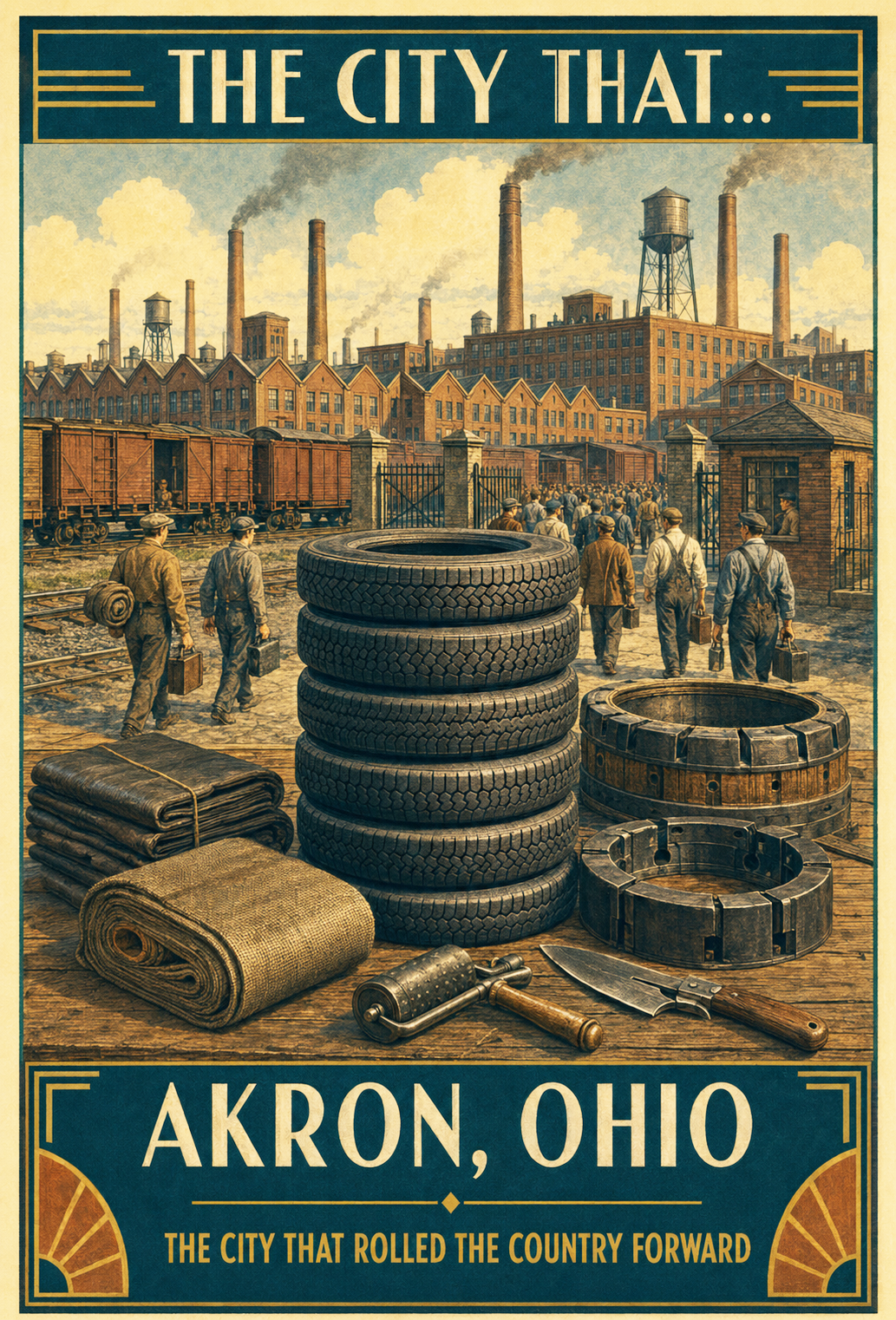
No rubber tree within three thousand miles. Every tire in America.
This is the fifteenth profile in The City That…, a series about American cities that invented an industry, led the world in it, and then watched the center move on. We tell their stories plainly and with affection — what they made, what it cost, and what they still are.
THE FOUNDING
The name is Greek. Akron means summit, and the city sits on the divide where the water has to choose between Lake Erie and the Ohio River. The canal crossed that high ground, and for fifty years Akron was a canal town — oats, matches, iron, clay marbles by the millions.
No rubber tree grows within three thousand miles of Ohio. The gum came up out of the Amazon and across an ocean, and Akron had no natural claim on it. What it had was water, which vulcanizing takes in quantity, coal a short haul off, railroads crossing, and men trained to work in factories.
In 1870 a physician named Benjamin Franklin Goodrich was failing at the rubber business in Melrose, New York, unable to compete with the established houses on the coast. The Akron Board of Trade raised thirteen thousand six hundred dollars to bring him west. In March of 1871 the Akron Rubber Works opened on the canal bank south of Exchange Street with about twenty men making cotton-wrapped fire hose — the first rubber factory west of the Alleghenies.
Hose, then garden hose, then in 1889 pneumatic tires for bicycles. The automobile was still a rumor. The city did not yet know what it held.
THE HEIGHT
Frank Seiberling bought an abandoned strawboard plant with borrowed money in 1898 and named the company for Charles Goodyear. Goodyear had invented vulcanization, died broke, and never set foot in Akron. Harvey Firestone came in 1900 with Henry Ford’s friendship, worth more than a patent. William O’Neil started General Tire in 1915, and behind the four came a hundred smaller firms.
By 1919 the city held fifty-three thousand eight hundred six rubber workers out of sixty-five thousand factory workers of every kind — five of every six people making anything in Akron were making rubber. The city could not grow that many hands. The companies advertised in West Virginia papers and sent recruiters into the hill towns — Spencer, and the counties of Roane and Calhoun and Clay — and when a recruiter found a man he wanted, he pinned a tag with the company’s name to the man’s buttonhole and put him on the train north. They came up what the hills called the Hillbilly Highway. Akron got called the capital of West Virginia. Akron’s own workers called them snakes.
They did not all stay. Miller Rubber hired 10,742 people in 1918 and lost 9,433 the same year. The city went from about sixty-nine thousand in 1910 to 208,435 in 1920, and in June of 1920 the shops held more than seventy-five thousand men. By December, fewer than twenty thousand. It hired you, let you go, and hired you again.
The work was filthy. A man who mixed rubber said the carbon black got into his pores and would not come out, that he took off his shoes and his clothes before he came in the house. A chemist who started at Goodrich in 1963 said she still remembered what carbon black smelled like. The whole valley smelled of it, and a man recalling the 1950s called it the smell of money, which was accurate, and was the reason nobody complained.
In 1929 the Akron area held 53,172 rubber production workers — 35.6 percent of every rubber production worker in the United States, the highest share the city would ever hold.
The same recruiting that filled the shops filled something else. Through the 1920s Summit County Klan No. 27 claimed 52,980 members; historians put the true figure nearer eighteen thousand, and no roster survives to settle it. It grew on the friction the boom made — mountain Protestants against Catholic immigrants against Black families up from the South, all of them brought here by the same companies for the same reason. By 1925 Klan-aligned men held four of seven seats on the Akron school board, the presidency among them. Perhaps four thousand Black men and women worked the plants at the height, and they worked the curing pit and the mill room and the mop, and the cafeterias stayed segregated into the 1960s. The boom was ugly while it was rich, and the men who got rich on it knew that.
The union came out of the same hills. Men at General Tire found in 1934 that they could stop a line by sitting down at it, and in September 1935 the United Rubber Workers was founded in Akron. On February 17, 1936, Goodyear men voted not to work. Rose Pesotta, sent to help organize, described a picket line covering Goodyear’s forty-five gates and running eleven miles. They held a month. On March 22 Goodyear recognized the union.
THE TURN
Here is what the story usually gets wrong. Akron began losing the work while it was still winning.
Kelly-Springfield moved its whole plant to Cumberland, Maryland in 1920. Goodyear opened Los Angeles that year and Gadsden, Alabama in 1929. The heaviest movement out came after 1935 — after the union — and by 1938 Akron wage rates ran forty to fifty percent above every other rubber district in the country. The companies chose where to put the next plant and mostly chose somewhere else. That was a decision, not a weather event.
Michelin’s radial arrived at the end of that migration. It lasted about twice as long as a bias-ply tire, which cut the replacement market roughly in half, and converting to it took capital and floor space Akron’s old multi-story plants could not give. Between 1978 and 1981 American manufacturers closed nineteen tire plants.
So which of these killed it? Nobody has done the arithmetic. No study apportions the loss among branch plants, radial conversion, imports, and the oil shocks. What can be said is the order of events. The leaving started in 1920 and the radial came in the 1970s, and a city already exporting its own work for fifty years met the new tire with old buildings and the highest wages in the trade. Past that I would be guessing, and so is anyone who tells you it was the union, or the French, or four boards of directors.
WHAT WAS LOST
B.F. Goodrich stopped building passenger tires in Akron in 1975. Goodyear stopped in 1978, about fourteen hundred jobs, and no passenger car tire has been built in the city since. Firestone closed Plant 1 in 1980, 1,345 jobs. General Tire, the last, shut its 1915 plant in August 1982, 1,265 more.
In March of that year, of roughly twenty-three thousand people still drawing a living from Akron’s rubber economy, about seven hundred were actually building tires.
Rubber and plastics employment across the metropolitan area fell from 26,000 in 1980 to 7,200 by 2007. The city that held 290,351 people in 1960 counted 190,469 in 2020. The companies went as well — Continental bought General in 1987, Bridgestone merged with Firestone in 1988, Michelin took Uniroyal Goodrich in 1990.
Goodyear kept a museum at headquarters called the World of Rubber. It closed in August 2009, after sixty-one years, partly for want of visitors. The city that had been the word for the thing could not fill the room where it kept the thing.
WHAT REMAINS
The chemistry stayed.
The University of Akron taught the world’s first courses in rubber chemistry in 1909, and in 1942, when Singapore fell and the natural rubber fell with it, the government contracted the university to stand up a Rubber Research Laboratory. George Whitby’s people worked out cold rubber there. That laboratory became the Institute of Polymer Science in 1964, and in 1988 the first College of Polymer Science and Polymer Engineering anywhere.
That knowledge is the city’s principal export now. The Polymer Industry Cluster has drawn fifty-one million dollars from the Commerce Department and thirty-one and a quarter million from the state, and the Chamber counts more than a hundred and fifty polymer manufacturers in the metro area. Bridgestone put a technical center here in 2012. Goodyear never left: global headquarters, and racing tires still built by hand on three floors of a 1916 building.
The rest has to be said plainly. Polymer science is Akron’s identity; medicine is Akron’s payroll. The largest employers now are two hospital systems, the university, a children’s hospital, and a utility. Goodyear is eighth. The city is a third smaller than it was in 1960, though the metro area still holds around seven hundred thousand.
Go down South Main to the old B.F. Goodrich works, where the first rubber west of the Alleghenies was mixed by twenty men in 1871. Nine floors of it are full again, sixty-odd young companies under the name Bounce, chemistry labs on the floors where the hose was made. Three miles off, in a building put up in 1916, a man lays up a stock car tire by hand. The air over the valley is clean and has been for years, and the people who remember what it used to smell like are getting old. The city that put the country on wheels still knows more about long molecules than anywhere on earth — the same knowledge it always had, in different work clothes.
Akron rolled the country forward, and that is worth remembering.
* * * * *
Why Akron? No rubber grew within three thousand miles of it, and still, from 1870 into the 1970s, Akron invented, dominated, and defined the American rubber industry — holding at its 1929 peak better than a third of every rubber production worker in the United States.
* * * * *
Charles Cranston Jett is an author, civic educator, and Professional Certified Coach based in Chicago. A graduate of the U.S. Naval Academy (Class of 1964) and Harvard Business School, he served aboard nuclear submarines during the Cold War. He is the author of six books, including Super Nuke!, hosts four podcasts, and writes across his Critical Skills Blog platform on history, leadership, and the health of the American republic. In his writing he uses AI tools for research, editing, and occasional image creation; the arguments, the voice, and the final judgment are his. He and his wife, Dr. Nancy Church, live at Water Tower Residences, where they co-host the Chicago Salons.



Leave a Reply