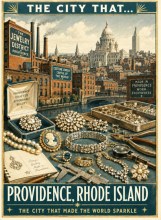
This is the sixth profile in The City That…, a series about American cities that invented an industry, led the world in it, and then watched the center move on. We tell their stories plainly and with affection — what they made, what it cost, and what they still are.
The Founding
A man named Nehemiah Dodge worked at a bench in Providence in 1794, and he wanted to make gold go further than it wanted to go.  He took a thin sheet of it and laid it over a thicker bar of copper, bonded the two with silver solder, and ran the sandwich through a rolling mill until it came out as a single skin, gold on the outside, base metal within. He sold the plated stock to other jewelers. The gold was real, but there was almost none of it, and that was the whole idea.
Providence already knew metal. It was a New England port with a habit of small precise work, and Dodge’s uncle Seril had been the town’s first jeweler, so the boy had learned the trade close to home. But Nehemiah did something his uncle had not.
He made shine cheap.
Before him, jewelry was for the few who could buy the weight of it.
After him, a clerk or a mill girl could pin something bright to a collar and not go hungry for it. They came to call him the father of America’s jewelry industry, and the title fit, because he did not invent the ring or the chain. He invented the price.
By 1810 the shops around him employed about a hundred hands.
It was a small thing then.
It did not stay small.
The Height
For the better part of a century Providence made more jewelry than anywhere in the country, and then more than anywhere in the world. By the late 1800s the city turned out roughly a quarter of all the jewelry made in America and wore the crown openly: the Jewelry Capital of the World. The work climbed into tall brick and concrete buildings just south of downtown, some of them seven stories, held up by mushroom-headed columns and lit through great arched windows cut to throw daylight onto the benches, because a man setting a rhinestone the size of a match head needs to see.
The names rode out on the magazine pages and stood in the glass cases of every department store in the country. A woman in Omaha knew Coro. A woman in Mobile knew Trifari. The city she had never seen was pinned to her coat. Coro, the largest of them, put up a reinforced-concrete headquarters at 167 Point Street in 1929. Trifari brought a French designer named Alfred Philippe to the bench and turned faux stones and rhodium-plated metal into something the rich were not ashamed to wear. When Mamie Eisenhower went to the Inaugural Ball in 1953 she wore no diamonds at all. She wore a triple strand of Trifari’s imitation pearls, and the country understood that fake could be first-class.
The Depression, of all things, made the work better.
When the fine-jewelry houses laid off their master craftsmen, those men carried their hands down to the costume trade and set glass with the same care they had once given diamonds. The cheap jewelry got good. Coro rose on it. At the height the state shipped a million pounds of costume jewelry a week — shine sold by the pound, boxed and hauled out by the ton to every five-and-dime in America.
The hands that did it belonged largely to immigrants. Federal Hill filled with Italian families, and beside them worked the Irish, the Portuguese, the French Canadians, the Scandinavians.
Women and children strung the beads and set the stones and ran the link machines. And when the factory closed for the night the work followed them home. Under the homework system a mother carried a heavy box of parts up to a tenement kitchen and carded buttons and glued rhinestones by the piece past midnight, her children beside her, because the piece rate was the difference between rent and no rent.
The labor historian Nina Shapiro-Perl found that the boxes let the manufacturers slip past the hour laws and the safety laws both.
The sparkle had a kitchen table under it.
It had a cost in the body, too. The plating ran on cyanide and acid and ammonia that burned the skin and the lungs, and the casting ran on lead, and the runoff — silver, copper, cyanide — went into the water for decades because no one told it not to.
The city made beauty. It did not make it clean.
The Turn
The thing that killed the mass trade was not a better idea.
It was a cheaper one, made somewhere else. By the middle 1980s the low end of the business — the pieces that sold for a dollar or five — had gone almost entirely to Taiwan and Hong Kong and Korea, where hands cost less.
Imports of jewelry into the United States rose eighty-three percent in a few short years, from a billion dollars to nearly two, and a bench in Providence could not underprice a bench in Taipei.
The numbers tell it flat.
In 1978 the trade employed more than forty thousand people across Rhode Island — the high-water mark. By 1986 the dollars peaked, a billion and a half in a year, the industry still the state’s largest, still eighty percent of all the costume jewelry made in America.
But under the dollars the jobs were already going. Between those two dates the state lost more than eight thousand jewelry jobs and three hundred companies folded. The money crested while the work drained out beneath it, and then the money went too.
What Was Lost
What went was not only the paycheck. It was a particular kind of knowing that lived in the fingers — how a stone seats, how a chain wants to lie, how much heat a joint will take before it runs.
A city had spent a hundred and eighty years putting that knowledge into people’s hands, and now the hands had nowhere to go. The tall factories emptied floor by floor. The five-and-dimes that had bought the shine by the ton bought it from across an ocean now, and never noticed the difference, because the difference was only the people.
There is a name that holds the whole shape of it. Engelhart Østby, a Norwegian who had come to Providence and built the jewelry house of Ostby & Barton, was aboard the Titanic in 1912 with his daughter Helene. When the ship struck, he left her at a lifeboat and went back down for warmer clothes and did not come up again. Helene lived. She came home to Providence and ran the firm for decades.
The city was like that — it lost people and kept working, kept the bench warm, until at last the bench itself went cold.
What Remains
Providence did not let the making die. It could not make cheap shine anymore, so it made fine things instead, and fewer of them.
The empty mills filled with artists and small studios, and the Rhode Island School of Design, which had opened in 1877 in the middle of all that industry, kept turning out people who wanted to work in metal and glass with their hands. The dexterity did not leave town. It changed address, and it changed scale, and it kept going — small-batch now, careful, signed.
The memory is kept on purpose. The Providence Jewelry Museum holds the largest jewelry-making archive in the world — not the shiny trinkets but the tools and molds and bench stations and the recorded voices of the people who sat at them. It works for now out of a rented space over in Cranston, raising the money to come home to a historic house in Providence where it belongs. And the old district, the National Register district of arched windows and mushroom columns, is a walkable neighborhood again, its factory floors turned to offices and apartments, the light still pouring through the windows that were cut to let jewelers see.
Walk it in the late afternoon and the sun comes through those tall arched windows the way it was built to, falling now on someone’s kitchen where a bench once stood.
The shine that Providence sold by the pound is scattered across a hundred years of collars and cuffs and jewelry boxes in every town in the country, most of it worth little and remembered fondly, which is its own kind of endurance.
The city took gold it could not afford and made it reach, and taught America that a working woman could wear something bright on a Tuesday.
That was never a small thing.
It only looked like one.
Providence made the world sparkle, and that is worth remembering.
* * * * *
Why Providence? From a single 1794 trick for stretching gold, Providence became the Jewelry Capital of the World, making a quarter of America’s jewelry by the late nineteenth century and eighty percent of its costume jewelry at the 1980s peak — the city that made shine cheap enough for everyone to wear.
Charles C. Jett is an author, civic educator, and Professional Certified Coach based in Chicago. A graduate of the U.S. Naval Academy (Class of 1964) and Harvard Business School, he served during the Cold War aboard the nuclear submarine USS Ray (SSN 653), where his tactical innovations helped inspire Tom Clancy’s Jack Ryan character. He developed the Field Studies methodology to teach “Critical Skills” and was endorsed by the Department of Labor in 1994. He is the author of six books, including Super Nuke!, hosts three podcasts, and writes across his Critical Skills Blog and Civic Sage platforms on history, leadership, and the health of the American republic. He and his wife, Dr. Nancy Church, co-host the Chicago Salons at Water Tower Residences.

Leave a Reply