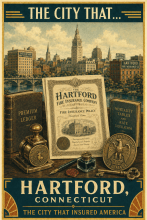
This is the seventh profile in The City That…, a series about American cities that invented an industry, led the world in it, and then watched the center move on. We tell their stories plainly and with affection — what they made, what it cost, and what they still are.
The Founding
The river made the city, and the city made the trade.
Hartford sat at the head of navigation on the Connecticut, forty miles up from the Sound, and in the eighteenth century the wharves were thick with the traffic of a river port.  Rum and molasses and coffee came up the water.
Ships went out to England and the West Indies and the Far East, and some of them did not come back. A captain who lost a hull lost everything he owned. A merchant whose warehouse burned in the night was a poor man by morning.
So the men who had the most to lose learned to share the losing. They met on the wharves and in the coffee houses, and they agreed, one with another, to carry a piece of each other’s risk. It was a plain idea. If enough men each took a small share of every danger, no single fire could ruin any one of them. Marine coverage came first, because the sea was the oldest danger. Fire came close behind it.
In 1794 a Hartford merchant named Jeremiah Wadsworth and a few of his friends began writing fire policies on an informal footing, and the first Hartford fire policy was issued that year.
In 1810 a group of them met at an inn, put up fifteen thousand dollars in working capital, and took a charter from the legislature for the Hartford Fire Insurance Company, the state’s first publicly owned fire insurer.
They took for their emblem a stag — the hart in Hartford, the old pun in the colonial seal — and set it on their papers and their brass. Aetna followed in 1819. The thing had begun, and it was not a factory, and it made nothing you could hold. It made a promise.
The Height
A promise is only worth what a man will pay to keep it, and Hartford learned that on a December night in 1835, when New York City burned.
The fire took the financial district block by block, seven hundred buildings, and it took with it insurers up and down the coast who had written more than they could cover. Many of them simply folded and paid nothing.
Eliphalet Terry was president of the Hartford Fire Insurance Company then. He and his directors did not fold. They pledged their own personal fortunes to make the company good, and every Hartford claim was paid in full.
The story Hartford tells is that Terry rode down to the smoking city himself, stood in the ruin, and sold new policies on the spot to men who had just watched their neighbors go unpaid. Whether or not it happened in exactly that way, the lesson traveled faster than any advertisement.
Hartford paid.
When the rest of the country needed to insure something and wanted to be sure the money would truly be there, it wrote to Hartford.
They paid again after New York burned a second time in 1845, and after Chicago burned in 1871, and after San Francisco shook and burned in 1906 — each time standing when lesser houses went down.
The reputation for solidity became the whole business. Abraham Lincoln insured his Illinois home with the Hartford.
The companies multiplied: Connecticut Mutual for life, Travelers for accident, Hartford Steam Boiler for the machines of the new age.
Travelers began in 1864 when its founder, James Batterson — a man who had made his money carving cemetery monuments — met a banker at the post office and sold him two cents’ worth of accident coverage on his four-block walk home. That was the first premium. The company keeps the two coins still.
The money built a skyline. The towers of the insurance giants went up over the river, and the Travelers Tower, finished in 1919, stood for a time the tallest building in New England and among the tallest in the world. After the Civil War Hartford was, for a stretch of years, the richest city in America.
Mark Twain came to live there and wrote that of all the beautiful towns it had been his fortune to see, this was the chief. It was a city that had grown wealthy not by making a thing but by keeping a promise, and for a while there was no better place in the world to make one.
The Turn
The industry did not die. It consolidated, and that is a slower and quieter thing than dying, and in some ways a harder one to watch. Beginning in the 1980s the old order changed. The companies grew past the city that had made them. A new kind of chief executive came in, younger, from somewhere else, thinking in national and then in global markets, and the first thing such men look for is cost, and cost in an insurance company is people.
The mergers came one after another.
In 1995 Aetna sold its property-casualty business to Travelers, and thousands of jobs were marked to go, and the newspapers began to say the old title was sounding out of date.
In 2018 the drugstore chain CVS bought Aetna — the company founded in Hartford in 1853 and named for a volcano — for sixty-nine billion dollars, and the firm that had helped insure America against fire became a health-benefits unit of a retailer in Rhode Island.
The decisions moved out of the city, to Rhode Island and to New York, and a decision that is made somewhere else is the beginning of a city’s losing its grip on a thing.
What Was Lost
Count it in people, because that is the only honest way to count it.
Greater Hartford’s insurance houses employed better than sixty thousand men and women around 1990. A generation later the number was under forty thousand. That is a third of the work gone — the underwriters and the clerks and the actuaries, the whole patient army of the trade, the desks emptied floor by floor in the towers their own premiums had built.
And the work had never been shared out evenly, even at its height. When Aetna hired its first women clerks in 1910 to run the new punch-card machines, it put them on the sixth floor by themselves and made them ride the freight elevators in the back, out of sight. The insurance boom opened the office to women and then walled them into a corner of it. That is part of the honest record of what the trade was, and it belongs in the ledger next to the towers and the payouts, because a city is made of all of it.
What Remains
It remains the insurance city. The title is contested now — Des Moines wants it, and London — but the thing the title names is still here.
Hartford still employs insurance people at a rate no other American city comes close to. The Hartford and Travelers still anchor the downtown. New houses have come in as old ones shrank, and the university runs programs to train the next underwriters in the new risks — the cyber policy, the climate model — that the old hands never dreamed of. What the city kept was not the buildings and not the payrolls but the knowledge, the two-century habit of measuring a danger and pricing it and standing behind the number. That does not leave a place easily. It is in the water there, like the river.
And it made room for stranger things than actuarial tables. For thirty years a vice president at the Hartford Accident and Indemnity Company walked two miles to work down Asylum Avenue, a heavy, solitary man who never learned to drive and did not much like to be disturbed.
His name was Wallace Stevens, and as he walked he was making poems in his head — some of the greatest American poems of the century — and then he would come into the office and price bonds all day and walk home and make more.
He won the Pulitzer Prize in 1955 and kept his desk. That is the truest thing Hartford has to say about itself: that a man could spend his whole life inside the great gray fortress of caution the city built, and carry the wildest imagination in America up the stairs with him every morning, and no one on the sixth floor need ever know.
The promise and the poem, in the same building, keeping each other’s books.
Hartford insured America, and that is worth remembering.
* * * * *
Why Hartford? It did not make a product; it made a promise, and by keeping that promise when other insurers failed — after the great fires of New York, Chicago, and San Francisco — it drew the nation’s coverage to one small river city and held the name Insurance Capital of the World for the better part of two centuries.
Charles C. Jett is an author, civic educator, and Professional Certified Coach based in Chicago. A graduate of the U.S. Naval Academy (Class of 1964) and Harvard Business School, he served during the Cold War aboard the nuclear submarine USS Ray (SSN 653), where his tactical innovations helped inspire Tom Clancy’s Jack Ryan character. He developed the Field Studies methodology to teach “Critical Skills” and was endorsed by the Department of Labor in 1994. He is the author of six books, including Super Nuke!, hosts three podcasts, and writes across his Critical Skills Blog and Civic Sage platforms on history, leadership, and the health of the American republic. He and his wife, Dr. Nancy Church, co-host the Chicago Salons at Water Tower Residences.



Leave a Reply