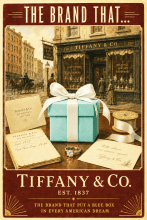
This is the sixth profile in The Brand That…, a series about American brands that taught the country a habit, became the word for the thing itself, and outlived the world that made them. We tell their stories plainly and with respect — what they made, what it cost, and what they still are.
The Founding
The Panic of 1837 had emptied the counting-houses and shuttered the banks, and into that ruined autumn a twenty-five-year-old merchant’s son from Connecticut opened a store.
His name was Charles Lewis Tiffany.  His father ran a cotton mill in Killingly and lent him a thousand dollars, and Tiffany took the money and a school friend named John B. Young down to 259 Broadway, across from City Hall Park, and opened the doors of a stationery and fancy-goods emporium on the eighteenth of September.
They sold what a curiosity shop sold then — writing paper and pencils, umbrellas and porcelain, Chinese bric-a-brac and cheap costume jewelry. There was no diamond in the place. For the first three days the two men took in four dollars and ninety-eight cents, and the next day they added two dollars and seventy-seven cents, and that was the whole of it.
A man could have looked in the window that first week and seen nothing to remember.
But Tiffany did one thing no other merchant on Broadway did. He marked a price on every article and he held to it. No haggling, no bartering, no reading a customer’s coat to guess what the coat could pay. Cash, and a fixed number on the tag. It was a small thing and it was the beginning of everything, because it told a stranger walking in off the street that here, at least, the price was the price and the house could be trusted.
The Rise
Trust was the product. The jewels came later.
By 1845 the shop was selling real jewelry and had put out the Blue Book, a mail-order catalog wrapped in a particular shade of robin’s-egg blue — the first of its kind in the country, and the first appearance of the color that would one day be worth more than most of what it wrapped.
Partners came and went; the firm became Tiffany, Young & Ellis, and then in 1853 Charles Tiffany bought the others out, took sole command, shortened the name to Tiffany & Co., and turned the whole enterprise to jewelry and silver. He bought historic gems from broke European aristocrats until the papers called him the King of Diamonds.
In 1885 the State Department, needing to correct a worn and faulty die, hired Tiffany to recut the Great Seal of the United States; the eagle that Tiffany’s designer James Horton Whitehouse cut that year is the design Americans still carry, folded, in every wallet.
Then, in 1886, Tiffany changed the geometry of love. Jewelers had always buried the diamond deep in a closed metal setting that hid its flaws and hoarded its light. Tiffany lifted the stone clear of the band on six slim prongs and let the light come at it from every side. The Tiffany Setting, they called it, and it did something no advertisement could have done: it made the American engagement ring a single bright stone held up for the world to see. A private promise became a public declaration.
The house had found the deeper product, and it was never the diamond. It was sanctioned emotion — the engagement, the anniversary, the apology — made tangible and handed across a counter in a box.
The Turn
The box outlasted the man. Charles Tiffany worked until he was nearly ninety, walked to the store every day in a cutaway coat and a silk hat, and died in 1902 the head of the most prominent jewelry house in America. The company he built passed down through the family and then, in 1955, out of it.
The hard years came later, and they came not from any rival’s better diamond but from the boardroom. In 1978 Tiffany was sold to Avon, the cosmetics company, for about a hundred and four million dollars in stock — and under Avon the Fifth Avenue store filled up with cheap goods until a magazine likened it to a department store during a white sale. The quality slid. The service slid. The thing that had been true since 1837 — that the name meant the best — came nearer to being false than it ever had.
In 1984 Avon sold the company to an investor group led by its chairman, William R. Chaney, for a hundred and thirty-five and a half million dollars in cash, and the new owners set about restoring what had been let go. Tiffany went public again in 1987. It had been to the edge and come back, and the color still meant what it had always meant.
The Reckoning
A house built on sanctioned emotion is only as clean as the stone in the setting, and twice the record shows the cost.
In 1887 Tiffany went to Paris and bought nearly a third of the French Crown Jewels at auction, and the American press crowned him again. But those historic royal settings were broken up, melted, and remade for Gilded Age millionaires who wanted the stones without the history — a triumph of new-world money that Europe mourned as the scattering of its heritage.
Then, a century later, came the harder reckoning. At the turn of the twenty-first century, human-rights groups showed that the global diamond trade was financing civil wars and forced labor across Africa — conflict diamonds, they were called, blood diamonds — and for a house whose entire meaning rested on a diamond standing for love, the thought that the stone might stand instead for someone’s suffering was an existential threat. Tiffany moved earlier and harder than most, building systems to trace stones from mine to counter; but watchdogs like Global Witness found in the early going that the lofty policy at the top had not yet reached the clerk on the floor.
The standard was set before it was kept. That gap is part of the honest record too.
What Endures
Tiffany is French now. In 2021, after a bitter pandemic-year dispute that went to a Delaware courtroom, the French luxury house LVMH bought Tiffany & Co. for fifteen point eight billion dollars — the largest deal in the history of luxury — and made the American jeweler one of its maisons, put a son of the family that runs LVMH in charge, and reopened the Fifth Avenue flagship as a landmark. The color is a registered trademark now, standardized by Pantone as “1837 Blue” after the founding year, a proprietary hue no one else may print. The setting is still the setting. The store still will not sell you the box; it can only be given away, and only with something bought inside it.
And that is the whole of it, in the end. A shop that took in four dollars and ninety-eight cents in its first three days learned that the surest thing it could sell was not the jewel but the feeling — and it wrapped that feeling in a color, tied the color with a white ribbon, and taught a whole country that a small blue box, held in two hands across a table, could hold the best moment of a life.
The stone changes. The box does not.
Tiffany put a blue box in every American dream, and that is worth remembering.
Why Tiffany? Because it invented transparent luxury and the modern engagement ring, then found a deeper asset than any diamond — a trademarked color and a ribboned box that became the country’s shorthand for sanctioned emotion, and outlived every owner who ever held the name.
Charles C. Jett is an author, civic educator, and Professional Certified Coach based in Chicago. A graduate of the U.S. Naval Academy (Class of 1964) and Harvard Business School, he served during the Cold War aboard the nuclear submarine USS Ray (SSN 653), where his tactical innovations helped inspire Tom Clancy’s Jack Ryan character. He developed the Field Studies methodology to teach “Critical Skills” and was endorsed by the Department of Labor in 1994. He is the author of six books, including Super Nuke!, hosts three podcasts, and writes across his Critical Skills Blog and Civic Sage platforms on history, leadership, and the health of the American republic. He and his wife, Dr. Nancy Church, co-host the Chicago Salons at Water Tower Residences.



Leave a Reply