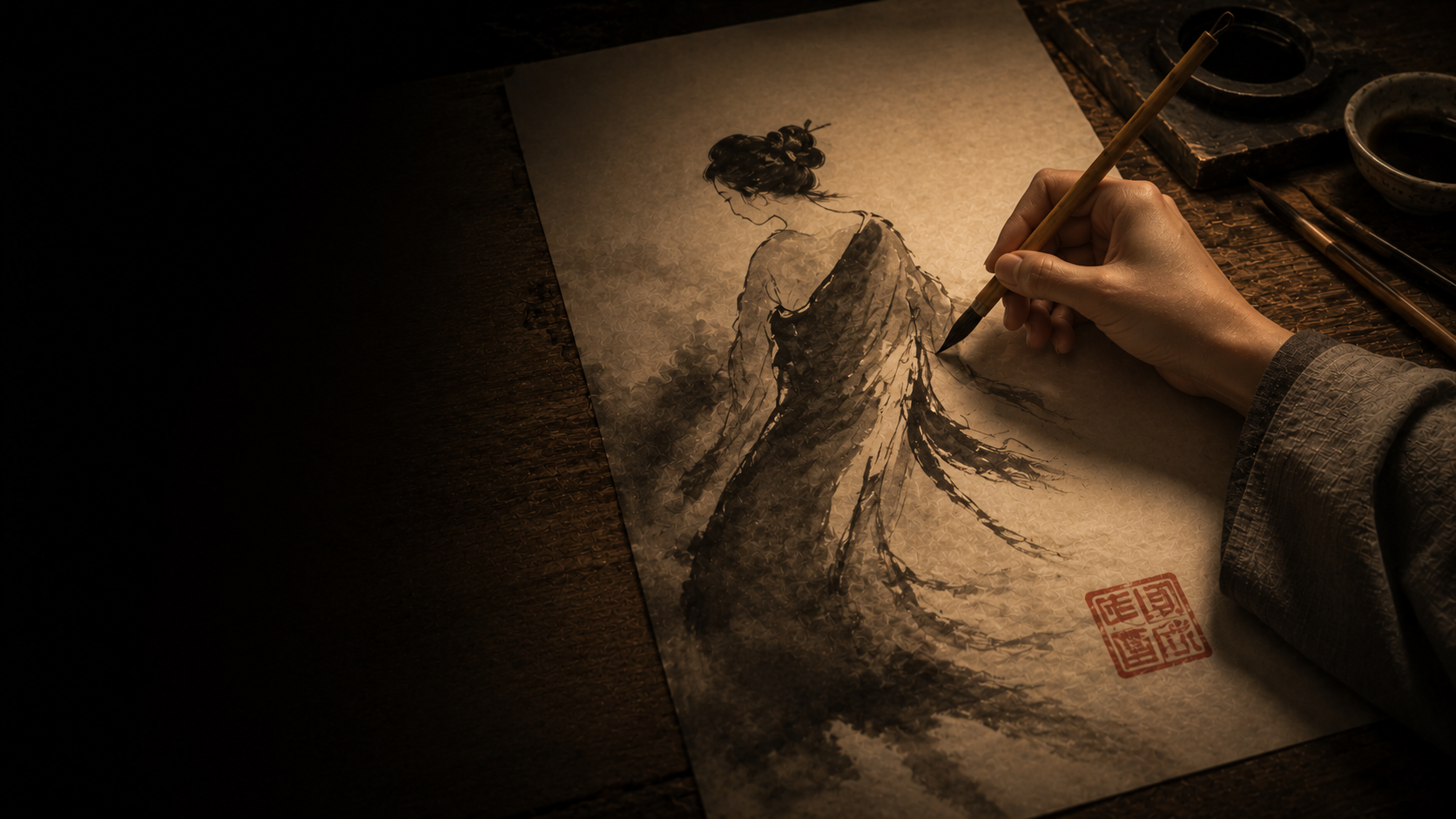
Katsushika Ōi painted like a master. Her father’s seal is the only signature the world kept.
She was born in Edo around 1800, a daughter of the painter the world would learn to call Hokusai.
Her given name was Ei. The name history kept for her, Ōi, was not a name at all. It was the sound of her father calling across the studio — Ōi, ōi, hey, you there — until the summons stuck to her like a signature.
Consider that. A woman spent her life answering to a word her father shouted, and the record took the word for her name.
She married a painter once, a lesser one, and left him. The account that survives says she laughed at his brushwork. She went back to her father’s studio and stayed. She ground his pigments and kept his accounts and drew beside him through the years his own hands began to shake, and when he died in 1849 she was there. She painted on into old age. Then, sometime in her sixties, she walked out of the record altogether — no death date anyone can fix, no grave anyone tended.
She is among the finest painters of nineteenth-century Japan, and we cannot name the year she died.
The work was extraordinary, and it was hers. Ōi painted light the way few artists of her century dared. She built her pictures out of darkness and let a single source — a lantern, a candle, the moon — carve the figures out of the black. In Yoshiwara Night Scene, held today by the Ōta Memorial Museum of Art, lamplight falls through the lattice of a pleasure house and the women glow inside it like figures lit from within. In Night Scene of Foxfires the only light is the cold fire the foxes carry. This was not her father’s manner. It was hers, and it was ahead of its time.
She was, by one account, better than her father at the thing he was most famous for.
Hokusai painted beautiful women; it made his name. And Hokusai said plainly that his daughter surpassed him at it — that when it came to painting beauties, he could not match her hand. A master looked at his own celebrated specialty, looked at his daughter’s version of it, and conceded she was the greater.
That admission survives. What does not survive, in most cases, is her name on the paintings.
Here is the erasure, and it is worth stating precisely, because the truth is stranger than the legend.
Through Hokusai’s last decades — the years his palsy worsened and his output somehow did not — Ōi worked at his side in his style, under his roof, and the paintings that came out of that studio carry his seal. Not hers. His. The art historian Julie Nelson Davis, who has studied the partnership closely, puts it carefully: many of these late works could as easily have come from Ōi’s brush as from her father’s. The studio was a single enterprise with two masters in it, and only one seal. Using the master’s seal was simply good business. A Hokusai sold. A daughter did not.
Resist the temptation the internet reaches for. The honest scandal is not that Ōi secretly painted The Great Wave and a man stole the glory. Scholars do not claim that, and neither will I; the great sealed masterpieces belong to a debate that the evidence cannot settle. The real erasure is quieter and, in its way, worse. The seal did not merely move the credit for one painting. It made the credit unrecoverable for a whole body of work. For much of what that studio produced, no one will ever know which of the two held the brush — because the mark that would have told us was, by design, always the father’s. The seal is not a lie about a single canvas. It is a machine for permanent unknowing.
What we can prove is the handful of works where the seal slipped and Ōi’s name held — roughly ten paintings that scholars attribute to her alone, among them the Yoshiwara Night Scene and Woman Fulling Cloth by Moonlight in the Tokyo National Museum. Ten paintings, out of a working life of sixty years. That is what a career looks like after the seal has done its work: a woman two curators can name, and a vast shadow no one can.
The consequence ran outward, past her, into the history of art itself. Hokusai’s late period is not a footnote to his fame; for much of the world it is his fame. The prints and paintings of his final decades crossed the ocean and lit the imagination of Europe — Monet hung Japanese prints on his walls, Degas and Van Gogh studied them, and an entire movement learned to see differently because of what came out of Edo under the name Hokusai. Ōi was inside that studio, painting at that level, through those years. Some measure of what the West received as “Hokusai” passed through her hands. The influence is real and it is enormous, and her portion of it has no name attached.
The cost to her was total. Not a diminished legacy — an erased one. No fixed dates. No grave. A working life folded into her father’s and sealed shut. She got a sobriquet made from a shout, ten paintings, and silence.
What her case teaches is the hardest lesson in this series, and it belongs at the front of it. Some erasure can be reversed. A file reopens, a scholar digs, a name comes back. But some erasure is built to be permanent, and the seal on a Hokusai is that kind. We do not get to hand Ōi her body of work, because the instrument of her erasure destroyed the evidence that would let us. This is why her signed paintings matter so much — the Yoshiwara Night Scene, the women lit from within. They are not merely beautiful. They are proof. They are the fixed points that tell us what the shadow contained: a master, working in the dark she painted so well, under a name that was not hers.
She answered to a shout her whole life. It is long past time the record answered to her.
Katsushika Ōi did the work. Katsushika Ōi deserves the credit.
* * * * *
Sources: Julie Nelson Davis, whose scholarship on the Hokusai studio establishes Ōi’s role as co-producer of its late output; the Ōta Memorial Museum of Art (Tokyo), which holds Yoshiwara Night Scene; and the Tokyo National Museum, which holds Woman Fulling Cloth by Moonlight among the works attributed to Ōi alone. Attribution of unsigned late studio works bearing Hokusai’s seal remains debated among specialists; this profile claims for Ōi only her established role and her individually attributed paintings.
Next in this series: Siti binti Saad — the singer who took a genre out of a sultan’s palace, and whose voice a 1928 recording saved from the men who claimed her form.
Charles C. Jett is an author, civic educator, and Professional Certified Coach based in Chicago. A graduate of the U.S. Naval Academy (Class of 1964) and Harvard Business School, he served during the Cold War aboard the nuclear submarine USS Ray (SSN 653), where his tactical innovations helped inspire Tom Clancy’s Jack Ryan character. He developed the Field Studies methodology to teach “Critical Skills” and was endorsed by the Department of Labor in 1994. He is the author of six books, including Super Nuke!, hosts three podcasts, and writes across his Critical Skills Blog and Civic Sage platforms on history, leadership, and the health of the American republic. He and his wife, Dr. Nancy Church, co-host the Chicago Salons at Water Tower Residences.




Leave a Reply