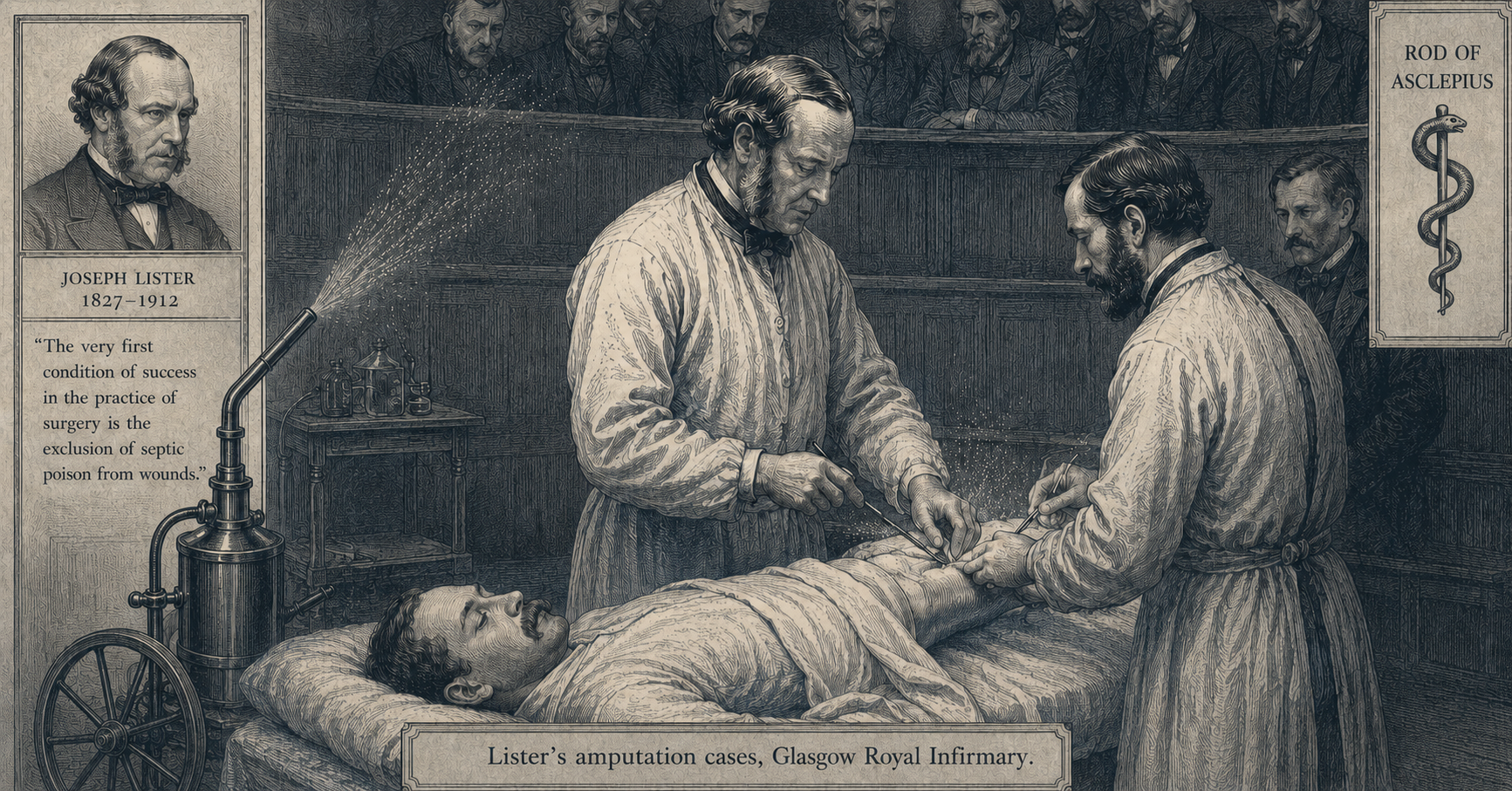
Joseph Lister, Carbolic Acid, and Antiseptic Surgery
In August of 1865, a wagon ran over an eleven-year-old boy named James Greenlees in Glasgow, and the wheel broke his leg. The bone came through the skin. In that year a compound fracture of the leg was, for a boy his age, close to a sentence. The wound would fester. The leg would be taken off, or the boy would die of the poison that came after. Joseph Lister set the bone and did a thing no surgeon in that ward had done. He soaked the dressings in carbolic acid and covered the wound and waited for the smell.
It did not come. The wound did not suppurate. The leg healed and the boy kept it and walked out of the infirmary on two feet. Lister had guessed at the enemy and, that time, he had been right.
To understand what he did you have to know the ward he did it in. The Victorian surgical hospital was a house of death, and everyone who worked there knew it. After an operation the wound was expected to rot. Thick white matter would rise in it, and the surgeons had a name for that matter. They called it laudable pus and they welcomed it. They believed the suppuration was the body healing itself, a natural stage a wound had to pass through. A man could survive the knife and the saw and die three weeks later of the corruption that followed, and no one thought the corruption strange. It was simply what wounds did. The wards carried a smell the staff stopped noticing, sweet and sick, the smell of flesh going bad, and it hung in the halls the way coal smoke hung over the city. To lie down on the operating table was to flip a coin against gangrene, and the odds were known, and men lay down anyway because the alternative was worse.
Lister had read Louis Pasteur. Pasteur had shown that fermentation and putrefaction were not spontaneous, not something that arose from the meat itself, but the work of living organisms too small to see, carried in the air. Lister made the leap that the great Frenchman had not made. If invisible living things spoiled wine and rotted meat, then invisible living things spoiled wounds. The corruption was not the body healing. It was the body invaded. And if you could keep the organisms out, or kill the ones that reached the wound, the wound need not rot at all.
He chose carbolic acid because it was already used to sweeten the town’s sewage, and if it could stop the stink of decay in a drain it might stop it in a man. He built a method around it. Dressings soaked in carbolic, laid over the wound. Instruments and hands and sutures washed in a carbolic solution. And, from 1871, a spray, a heavy pump that hissed a fine mist of carbolic into the very air of the theater, on the theory that the germs floated there and had to be met before they landed.
In 1867 he published what he had found. Six papers in The Lancet through the spring and summer, and in August a lecture before the British Medical Association in Dublin, on the antiseptic principle in the practice of surgery. He put numbers to it. In his amputation cases at the Glasgow Royal Infirmary, the deaths fell from something near forty-five in a hundred before his method to something near fifteen after. A two-thirds cut in the dying.
The numbers deserve a careful eye, and Lister, to his credit, knew it. His series was small, and he said so plainly, that it was too small for a satisfactory statistical comparison. Later historians have pressed harder. Some argue there was never a sudden revolution at all, that the Listerians built that story after the fact. Some found that the good years and the bad years of the old surgery overlapped with his more than his charts let on, and that Glasgow in those decades was also getting cleaner, better fed, and freer of the fevers that swept its wards in cycles. The decline was real. How much of it belonged to the carbolic and how much to bread and drains and luck is a question that has never fully closed. It is enough to say the method worked, and that it did not work the way the tidy version tells it.
The men of the old surgery did not thank him. They had built their standing on speed and nerve, and they wore their trade on their bodies. A surgeon’s frock coat, stiff and black with the dried blood of old operations, hung by the theater door as a badge of how many times he had cut. To such men Lister’s method was an insult dressed as a courtesy. He was telling them, in effect, that their own hands and their own proud coats were the thing killing their patients. A gentleman’s hands are clean, they said, and went on operating in the coats, and men went on dying, and it took a generation and a great many graves before the profession came around.
Here is the cost, and it is not the one the story usually names. Lister made surgery survivable, and the price of survival was a war without end. The carbolic that saved the boy was itself a poison. It cracked and blistered the surgeons’ hands. It burned the patients’ skin. It seeped into the body and sickened men with a condition they came to call carboluria. The spray choked the theater and stung every eye in it, and Lister himself, by the late 1880s, admitted the air was not the real danger and gave the spray up. His central guess had been half wrong. But the deeper thing he started did not stop. Medicine had entered a fight against an enemy it could not see and could never finally beat, and every advance since, the sterile field, the scrubbed hands, the sealed and single-use world of modern surgery, is another year of that war. The Germans and the Swiss soon carried it past him, from antisepsis, killing the germ with chemicals, to asepsis, keeping it out altogether with heat and steam and a room made clean before the patient ever entered it.
What endures is the clean room and the endless vigilance it demands, and the knowledge, bought with carbolic-burned hands, that the enemy was always there and always would be.
It cannot be undone, and most of us would not undo it. That is the bargain medicine made.
The organisms Lister fought had first to be found, and the man who taught the world to hunt them through a city’s water would draw his map in ink and dots.
* * * * *
Charles C. Jett is an author, civic educator, and Professional Certified Coach based in Chicago. A graduate of the U.S. Naval Academy (Class of 1964) and Harvard Business School, he served during the Cold War aboard the nuclear submarine USS Ray (SSN 653), where his tactical innovations helped inspire Tom Clancy’s Jack Ryan character. He is the author of six books, including Super Nuke!, hosts three podcasts, and writes across his Critical Skills Blog and Civic Sage platforms on history, leadership, and the health of the American republic. He and his wife, Dr. Nancy Church, co-host the Chicago Salons at Water Tower Residences.


Leave a Reply