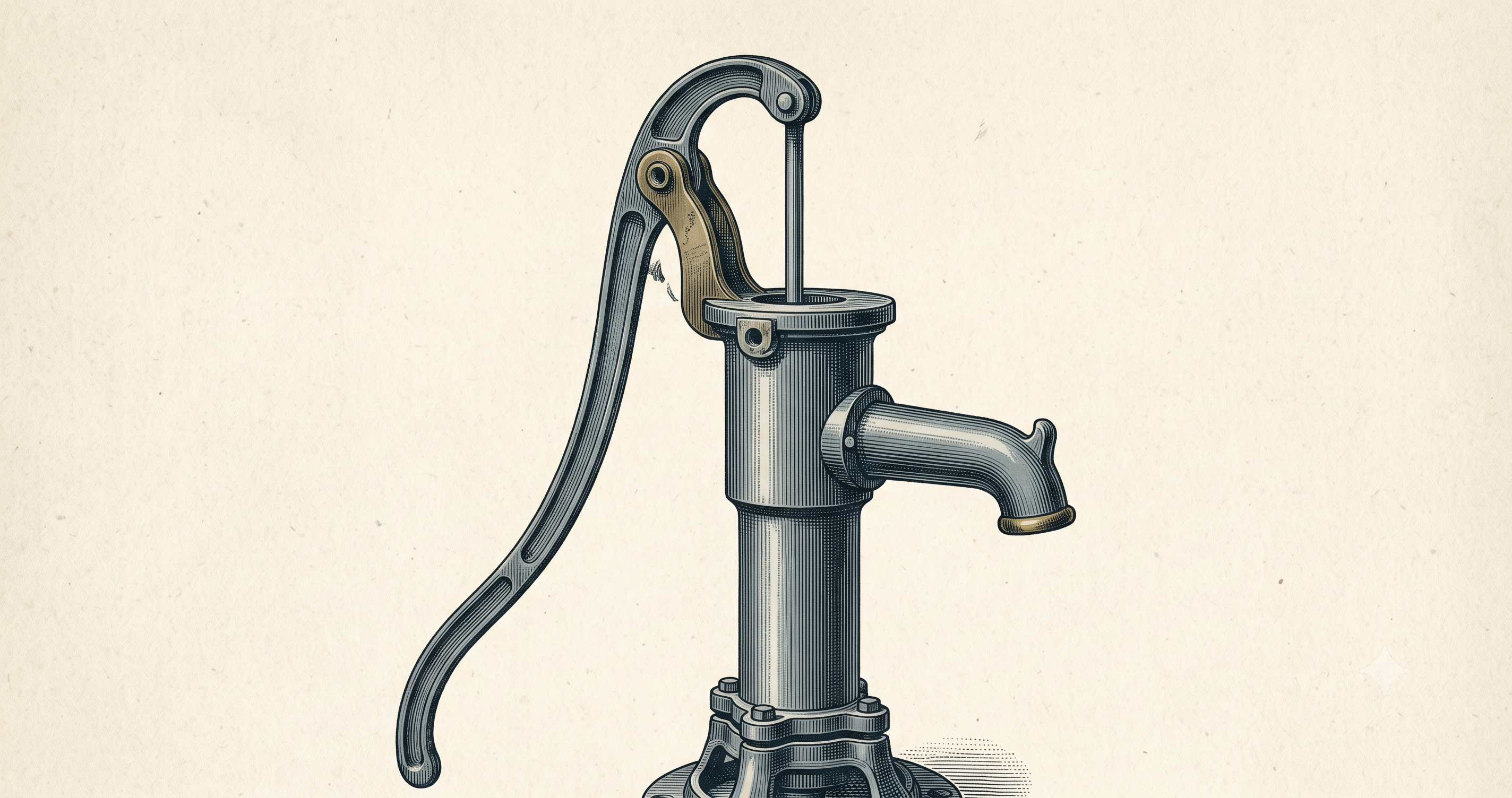
Before germ theory, John Snow found the killer in the water — and invented epidemiology.
In the late summer of 1854 a man walked the streets of Soho with a list of the dead and knocked on the doors of the living. His name was John Snow. He asked each household one question no one else thought to ask.
Where did you get your water?
The organism he was hunting had never been seen and would not be seen and believed for another thirty years. Snow could not lay it under a glass and show a doubter the thing that was killing Soho. He had only the dead, their addresses, and the pumps they drank from, and he believed that if he arranged those facts correctly the cause would show itself in the pattern. He was right. In being right he invented a way of seeing that we have never given back.
To understand what he did you have to stand in the Soho of that August.
Cholera did not kill slowly. A man could be well at breakfast, gripped by cramps by noon, and dead by dark, wrung out and turned the grey-blue that gave the disease its name. They called it the blue death. The city it moved through was drowning in its own filth. The Thames was an open sewer, the cellars held standing waste. The learned explanation was that the smell itself was the killer, that disease rose from foul air, from miasma. It fit what the nose reported and it was wrong. It fit one thing more. If bad air bred in the districts of the poor, then the poor died of their own squalor, and their dying was a verdict on how they lived. Miasma was a comfortable theory for the people who did not have to breathe it.
On the last day of August the disease broke out around Golden Square with a violence that stunned even that hardened parish. In the first three days near a hundred and thirty people died within a few streets of one another. Within ten days the dead passed five hundred, and three of every four who could leave had fled. When the whole outbreak was counted it had killed six hundred and sixteen.
Snow lived nearby, and he already held the theory the establishment mocked. In 1849 he had published his argument that cholera traveled in water, swallowed rather than breathed. Now he had his terrible proof on the paving stones. He took the addresses of the dead from the registrar’s records, walked the district and asked survivors which pump they drew from, and plotted the deaths on a map of the streets, each one a mark, the marks stacking into black bars at the doors where people had died. The bars crowded thickest around one fixture. The public pump on Broad Street.
He did more than draw a cluster. He drew a line around the pump that traced, at every point, the boundary where a second pump became the nearer walk, and showed that the dying stopped almost exactly at that line. Death kept to the ground the Broad Street water served. This was the thing that outlived the outbreak. Not a cure and not a microscope. A method. Infer the unseen cause from the shape the cases make across a population. It is how we later found the harm in tobacco, the danger in a bad drug lot, the source in a tainted food chain. Snow drew the first one in ink while his neighborhood was still burying its dead.
The map alone did not prove it, and Snow knew that better than anyone. The cluster could be coincidence, could be the foul air of one especially rank quarter. What broke the tie was a death miles away, in the clean air of Hampstead, where no miasma could reach. A widow there had once lived in Soho and loved the taste of the Broad Street water so well that she had it carted to her house by the bottle. She drank it in the good air of the heights and died of cholera as surely as the poor of Golden Square. Same water, opposite ends of the city, the same blue death. The air had nothing to do with it.
Now weigh the act that made him famous, because the truth is stranger than the legend.
On the seventh of September Snow carried his evidence to the parish board and asked them to take the handle off the Broad Street pump. They did not believe him. They took it off anyway, out of fear and having nothing better to try, and put it back as soon as the danger passed. Here is the part the story leaves out. By the day the handle came off, the outbreak was already dying on its own. Most who would take the disease had taken it; most who could run had run. Snow himself admitted the attacks had fallen away before the water was ever stopped. The most famous gesture in the history of public health saved few if any lives that day and did nothing measurable against the three thousand the wider epidemic killed across London that year. The handle is a monument to a thing that mostly did not happen.
His real proof was quieter and larger. South of the river, two companies sold water to the same streets, sometimes to houses side by side. One drew from a filthy stretch of the Thames, the other from cleaner water upstream. No one had arranged it, yet some three hundred thousand Londoners had been sorted, house by house, into two groups differing in one thing only, the water they drank. Snow counted the cholera deaths in each. In the houses on the dirty water, people died at many times the rate of their neighbors across the property line. Nothing that large could be coincidence.
That was the science.
The pump was the story.
The establishment held its ground. London’s chief medical officer called Snow’s idea peculiar. The Board of Health, after it was over, wrote the outbreak up as a case of bad air. Snow died in 1858 with the argument unwon, and only decades later, after Koch, did the world agree that a living thing in the water had done it all along.
Here is the cost, and it is not the one the story tells.
Snow invented the power to see a population as a pattern, and that gaze, once opened, never closed. To find the cause he had to turn the dying into data. The widow in Hampstead and the child in Soho became marks on a chart, and only as marks did they give up the secret that saved the living. This is the bargain at the root of public health, and we still pay it. The same logic that maps an outbreak also maps a people. Contact tracing, mandatory reporting, a city’s wastewater watched for the signature of a virus, the closure ordered on the strength of a curve, all of it descends from a man counting the dead by which pump they drank from. The gaze that guards the many reduces the one, and we have never learned to keep the first without accepting the second. We saw the argument fought again, in our own decade, over masks and mandates and whose freedom a number may override. Snow started that fight. He did not finish it.
What endures is the method and the ledger it required, the discovery that a people can be read like a patient, and the unhealed question of who holds the pen.
It cannot be undone, and most of us would not undo it.
That is the bargain medicine made.
Snow learned to trace the killer through the water; the next advance would arm the body to beat it before it arrived.
* * * * *
Charles C. Jett is an author, civic educator, and Professional Certified Coach based in Chicago. A graduate of the U.S. Naval Academy (Class of 1964) and Harvard Business School, he served during the Cold War aboard the nuclear submarine USS Ray (SSN 653), where his tactical innovations helped inspire Tom Clancy’s Jack Ryan character. He is the author of six books, including Super Nuke!, hosts four podcasts, and writes across his Critical Skills Blog platform on history, leadership, and the health of the American republic. In his writing he employs AI tools in a limited, supporting role for research, occasional image creation, and editing, while the prose and judgment remain entirely his own. He and his wife, Dr. Nancy Church, live and co-host the Chicago Salons at Water Tower Residences.

Leave a Reply