She wrote from inside the Sahara and died at twenty-seven. Her editor rebuilt her ruined pages with his own prose and put his name on the title page beside hers.
This is the next installment of Uncredited Women — a series about women whose work changed outcomes and whose names were written out of the credit. Isabelle Eberhardt did the work. Isabelle Eberhardt deserves the credit.
THE PERSON
Her mother died in Bône a few months after the two of them arrived, in 1897, and was buried in the Muslim cemetery there. Isabelle Eberhardt was twenty. She stayed.
She had been born in Meyrin, outside Geneva, in 1877, the illegitimate daughter of a Russian noblewoman who had walked out on her husband, a general, and come to Switzerland with the children’s tutor, an anarchist. He taught her Russian, French, German, Italian and Turkish. Arabic she taught herself. She cut her hair short and wore men’s clothes, because a man could go where he liked and a woman could not go anywhere alone.
She was publishing stories under a man’s name before she was twenty.
The house she grew up in was strange and the childhood was not a happy one. What she carried out of it was six languages and a conviction that the part of the world worth seeing was somewhere else.
THE WORK
In Algeria she became Si Mahmoud Saadi. She converted to Islam, was received into the Qadiriyya, and rode the Sahara and the Tunisian south on horseback, sleeping in zawiyas and in cheap rooms, usually without money.
She wrote the entire time. Notes, stories, journals, letters, and from 1902 regular reportage for L’Akhbar, the Algiers paper Victor Barrucand had bought and rebuilt as the colony’s first bilingual French-Arabic title. In 1903 she went into the Sud-Oranais as a war correspondent and filed from the Moroccan frontier.
The administration decided she was a spy, or an agitator, or both. At Behima in January 1901 a man came at her with a sabre and nearly took her arm off. She testified at his trial and asked the court for leniency. That autumn she was expelled from Algeria. She married Slimène Ehnni, a spahi non-commissioned officer and a French citizen, and the marriage got her back in.
\What she produced is an unusually close first-hand record of Algerian and Saharan life by a European-born convert: the hardship, the colonial abuses, the garrison towns, the mystics, the prostitutes, the frontier war. She wrote about the people the colony did not photograph, and she wrote about them from inside their rooms. “I will be in love all my life,” she wrote, “with changing horizons, with distances still unexplored.”
THE ERASURE
On 21 October 1904 the oued at Aïn Séfra came down in flood and took the town’s lower quarter. Her house was dried clay. It collapsed on her. She was twenty-seven. Her body was not recovered until the 27th.
Lyautey knew her, and ordered his soldiers to dig for her papers.
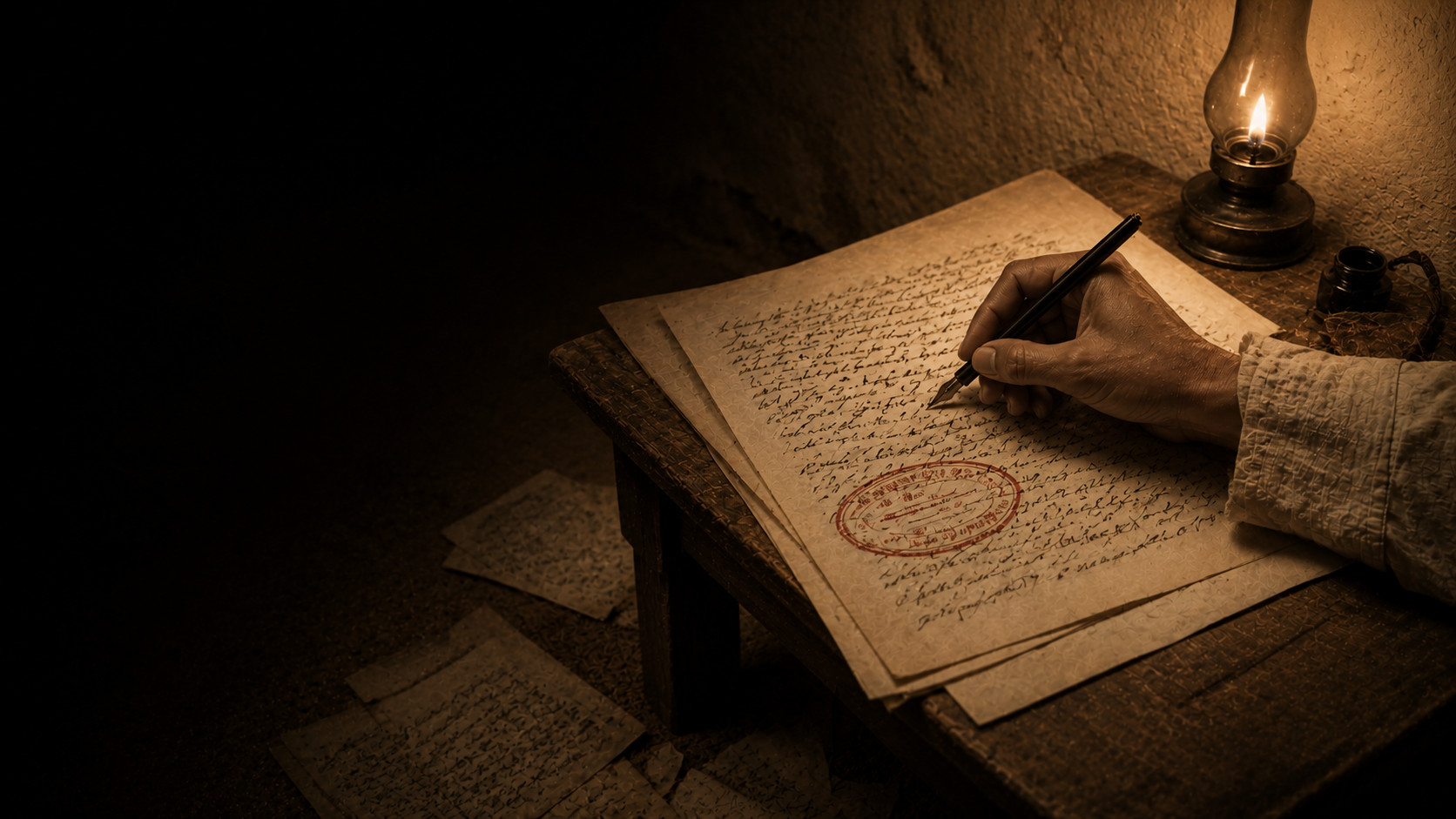
Near her body, almost under her hand, they found the manuscript of her unfinished novel Trimardeur — or rather, as Barrucand described it afterward, a dossier: two different versions of the same book, unequally advanced, and a sheaf of variants. Two attempts, and the alternatives she had not yet chosen between. That is what a writer’s desk looks like when the writer is interrupted mid-thought — a set of open options, every one of them still hers to close. The mud had them for six days. Slimène Ehnni gathered up what there was, handed it to Barrucand, and asked him on his wife’s behalf to make an ending out of it.
He did. He made several.
Barrucand’s account of the state of the pages is consistent and grim: they had lain for weeks in wet earth, they were friable, they had lost any continuous sequence. Of another manuscript he wrote in 1908 that its last hundred pages were variously damaged, illegible, destroyed and disordered. To reconnect the fragments, he said, he had to undertake a reworking of the entire composition. He filled the gaps with material from her notebooks and her correspondence — and with passages, in his own phrase, freely inspired by their conversations. Then he merged his interpretation of her psychology into her text. In 1920 he called the finished thing a heroic legend. In 1921 he acknowledged the liberties he had taken.
He wrote all of that down himself, in the front matter, where anyone could read it. Nobody had to catch him.
What he never did was mark the text. No brackets, no footnotes, no apparatus, nothing anywhere on the page that tells a reader where Isabelle Eberhardt stops and Victor Barrucand begins.
The seam was meant to be invisible.
It is.
In 1906 Charpentier et Fasquelle published Dans l’ombre chaude de l’Islam in Paris. The title page carries two names. Hers, and his.
The objection came fast. On 8 May 1909 Les Annales africaines accused the publisher of installing himself as co-author to pay himself for the work of annotation.
There is one question underneath all of this that I cannot get to close. Barrucand’s entire defense rests on the condition of those pages: they were ruined, therefore they had to be rebuilt. Robert Randau later reported that people who had seen the manuscript considered it nearly intact and largely legible. If that is right, then the necessity was manufactured, and every sentence he added was a choice and not a repair. But Randau’s report comes out of a literary quarrel rather than a conservator’s assessment, and a quarrel is not evidence. I have gone back and forth on it and I cannot get past this: we know he rewrote her, we do not know whether he had to, and the only man who could settle it is the man whose account is in question.
The mechanism is not the flood. The mechanism is what happens when one person takes sole custody of another person’s unfinished work, decides alone what it says, and puts his name beside hers on the result.
The flood was weather.
The rest was a decision, and decisions like it are still being made.
THE CONSEQUENCE
The book worked. Dans l’ombre chaude de l’Islam sold and was praised. Randau wrote later that its success established her name; by 1921 it was being advertised in its eighth thousand. Eberhardt stopped being a scandal in the colonial press and became a writer people read. Streets in Algiers and Béchar carry her name now.
None of that happens without Barrucand, and the entry belongs in the ledger. He was the first person to see what she was. He published her while she was alive, unknown and broke. René-Louis Doyon, who spent years trying to undo the edits, still concluded that Barrucand had worked in good faith and for her glory — that he had built her a marble statue owing more to the Beaux-Arts than to the disordered, inspired Russian she actually was — but that at least he had made her visible. Without Victor Barrucand there is probably no Isabelle Eberhardt at all.
And the cost is that nobody can read her. Not cleanly. Every page of the posthumous books carries a doubt that cannot be settled from the page. Edmonde Charles-Roux, who wrote two volumes on her, charged him with correcting, adding, and sanitizing — softening her appetites and her fervor for Islam. Doyon published her journals in 1923 and tried to pull the voices apart. Eglal Errera went back to the manuscripts in 1987. Marie-Odile Delacour and Jean-René Huleu built Écrits sur le sable out of the archives in 1988 and 1990, collating manuscripts against first editions against newspapers against letters.
They got a long way. They could not finish. Where Barrucand wrote over her in ink, and where the mud had already taken the ink underneath, the boundary is gone permanently. There is still no critical edition of her complete work. There is not likely to be one.
THE MEANING
Everything you have ever read by someone dead reached you through somebody’s hands. An editor chose the order. Someone decided which draft was the real one, which passage was too much, which sentence the author would have fixed if she had lived to fix it. Usually that work is invisible, and usually it is honest. It is never neutral. The only question is whether the person doing it tells you.
Barrucand half-told. He disclosed his method in general and concealed it in particular, and the second cancels the first, because a reader holding the book cannot use a general admission to locate a specific seam. That is the whole transaction: a name added to a title page, and a boundary deliberately left unmarked beneath it. You have quoted a dead writer at some point. You did not stop to ask whose sentence it was. Neither did I.
The Archives nationales d’outre-mer hold what survived, at Aix-en-Provence, under GGA 23X. Anyone can register and go and look. The catalogue entry for Dans l’ombre chaude de l’Islam still lists both authors, hers first and then his — which is precisely correct as bibliography and precisely wrong as history. That part of the record cannot be corrected now. What it can do is say plainly which of the two names belongs to the writer, and stop treating the other one as an author.
She chose the language she wrote in, the country she wrote about, and the name she wrote under.
The one thing she did not choose was who would hold the pen last.
* * * * *
Next in this series: Efunroye Tinubu — the Lagos merchant the colonial record could not write down as a principal, and deported for refusing to be written down as anything less.
Sources: Eberhardt’s surviving manuscripts, correspondence and route maps are held by the Archives nationales d’outre-mer, Aix-en-Provence (fonds GGA 23X); the joint title page of Dans l’ombre chaude de l’Islam (Charpentier et Fasquelle, 1906) and Barrucand’s own prefaces of 1908, 1920 and 1921 are the primary record of his intervention, and the contemporary objection appeared in Les Annales africaines, 8 May 1909. The modern recovery of her text is the work of René-Louis Doyon (Mes journaliers, 1923), Eglal Errera (Lettres et journaliers, Actes Sud, 1987), and Marie-Odile Delacour and Jean-René Huleu, whose archive-based Écrits sur le sable (Grasset, 1988 and 1990) collated the manuscripts against the published editions. Also drawn on: Edmonde Charles-Roux, Un désir d’Orient and Nomade j’étais (Grasset); Annette Kobak, Isabelle: The Life of Isabelle Eberhardt (1988); and Céline Keller Brousse’s doctoral study of Barrucand (EHESS, 2010).
* * * * *
Charles C. Jett is an author, civic educator, and Professional Certified Coach based in Chicago. A graduate of the U.S. Naval Academy (Class of 1964) and Harvard Business School, he served during the Cold War aboard the nuclear submarine USS Ray (SSN 653), where his tactical innovations helped inspire Tom Clancy’s Jack Ryan character. He is the author of six books, including Super Nuke!, hosts four podcasts, and writes across his Critical Skills Blog platform on history, leadership, and the health of the American republic. In his writing he employs AI tools in a limited, supporting role for research, occasional image creation, and editing, while the prose and judgment remain entirely his own. He and his wife, Dr. Nancy Church, live and co-host the Chicago Salons at Water Tower Residences.

Leave a Reply