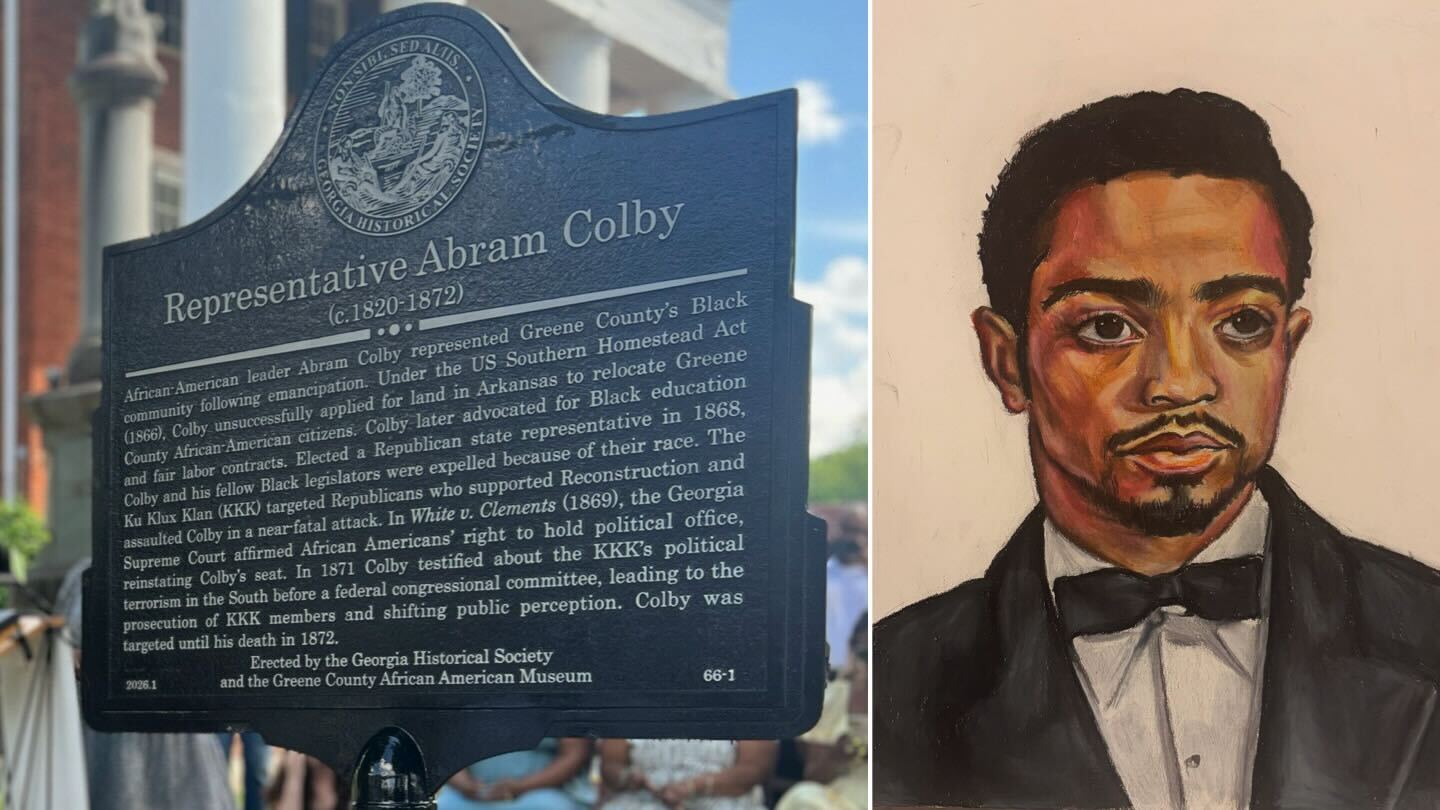
A Georgia legislator refused a bribe, survived sixty-five men and a whipping, and put every word of it into the permanent record of the United States
This is the next installment of Courage and Consequence — a series about relatively unknown individuals in history who made courageous decisions under extraordinary pressure, and had to live with what followed. Abram Colby needs to be remembered.
* * * * *
THE PERSON
In the summer of 1850 a man from Connecticut lay dying in Greene County, Georgia, and wrote a will the law would not let him mean.
John Colby held a plantation house called the Poplars and about a thousand acres around it. He also held an enslaved woman named Mary, and he had fathered seven children on her, and one of them was Abram. Georgia forbade a man to free his slaves by will. So Colby handed them to a friend instead. He gave Mary and her children to William L. Strain, a lawyer and the postmaster at Greensboro, requesting and trusting that he would treat them with kindness and humanity.
Strain took the charge seriously. From that day Mary and her children lived in the house as free people. No paper anywhere said they were.
Twenty-one years later, under oath in Atlanta, Abram Colby was asked whether he had been a slave before the war. He said yes — he was raised by his father and was his father’s slave. A few minutes later he said his father left him free when he died, about twenty years ago. Both answers sit in the printed record from the same afternoon, and they contradict each other. He wasn’t confused. He was describing how he lived. The title to him was somewhere else, in a document he could not read, in the hands of a white lawyer downtown. A man can know exactly what his life is and still not know what the law says he is. There is no manumission paper to go find. That is the whole point of the arrangement.
He was fifty-two years old. He cut hair in Greensboro and he preached. He could not read a word.
THE CONTEXT
When the war ended he tried to move a thousand people out.
The Southern Homestead Act of 1866 opened federal land, and Colby went looking for it in Arkansas on behalf of the Black families of Greene County. He came home with nothing. So he changed his method and ran for the government that had failed him.
In 1868, roughly twelve hundred of the county’s fifteen hundred eligible Black voters turned out and sent him to the Georgia House. That September the legislature expelled its thirty-three Black members for being Black. The Georgia Supreme Court ruled the following June, in White v. Clements, that they were entitled to hold office. Colby did not get his seat back until January of 1870.
They came for him in the gap between the ruling and the restoration.
THE DECISION
Two days before, they had offered him money. Five thousand dollars to change parties. Twenty-five hundred simply to give up the seat and let another man take it. He was not a poor man being offered a fortune he could not imagine — he lived in a plantation house on a thousand acres. He knew exactly what the money was worth.
He said no.
On the night of October 29, 1869, sixty-five men broke his door open and took him out of his bed. About twenty-five of them did the whipping, as he understood it afterward. They carried him to the woods and worked on him for three hours or more and left him there for dead. Some of them were first-class men in town. One was a lawyer. One was a doctor. Some were farmers.
They asked him whether he would ever vote another damned Radical ticket.
He said he would not tell them a lie. They told him not to tell a lie. He said that if there was an election tomorrow, he would vote the Radical ticket. They set in and whipped him a thousand licks more, he supposed.
That is the famous part. The decision that matters came two years later.
On October 27, 1871, the congressional sub-committee investigating the Klan sat in Atlanta, and Abram Colby was sworn and examined. He testified that day and the next. He named twelve men on the first day and two more on the second.
He told the committee they had broken something inside him and that a doctor had been attending him for more than a year. Some days he could not get himself up and down off his bed. And his left hand was not of much use to him.
Think about that. This was a man who had never signed his own name. In the legislature he kept his son William beside him to read the bills and write what needed writing — William, who had turned twenty-one on the eighth of that same month, and who had been born in October of 1850, four months after the will. The father could not hold a pen. So he brought the committee the only document he had ever been able to make himself. He held it up and it did not work anymore, and they wrote that down too.
THE AFTERMATH
His little daughter had been in the room. She came out and begged them not to carry him away and one of them raised a gun at her. She had never been sick a day. She lived about a year. Asked how long, he gave the number flatly; asked whether she had ever been ill before, he said no, and that this was the part that grieved him the most about the whole thing.
He was not living at home by then. They came to the house every time he went back, so he stayed one night there the whole of that year and slept in the woods the rest. In March they had shot into the house and he had returned fire. There were tracks around it a week before he testified.
A federal grand jury had sat in Greensboro the week prior and he had not gone to it. He explained why. He knew it was no use trying to get Ku-Klux condemned by Ku-Klux. A Mr. Saunders on that grand jury was the father of one of the very men who whipped him.
Here is the hard part that doesn’t get rescued.
Nobody was ever punished for what was done to Abram Colby. He said so under oath, in one word. The attack came in October 1869, before the first Enforcement Act existed, so no federal charge could reach it. The prosecutions that did come, and there were hundreds, came in South Carolina and North Carolina and Mississippi. In the fiscal year after the hearings, the Attorney General recorded seven Enforcement Act cases in the whole state of Georgia and four convictions. Governor Bullock’s five-thousand-dollar reward produced no arrest. Colby testified for two days, in detail, under his own name, and the men who whipped him went on being farmers and lawyers and doctors in Greensboro.
He won re-election in December 1870 anyway, by his own count seven or eight hundred votes. In September 1872 he boarded a night train from Atlanta toward Greensboro and died on the cars. Greer Brigham, who went through the county records, found the Poplars sold out from under the family within days.
In 1941 the county historian, Thaddeus Rice, wrote down what Greene County remembered: that after his defeat Colby took to drink, insulted a lady on the street, was thrashed and put on an outgoing train, and no one ever saw him again. It was published in 1961 and reprinted in 1979. Every element of it is false, including the defeat.
That story was already old. Lieutenant George Hoyt, the Army officer who came out the night of the whipping and saw the wounds, testified in November 1871 that he had heard people in the county say there was a feeling against Colby for how he was living. Asked whether he had looked into it, Hoyt said he had not — that he did not consider any fault of the man a justification for that outrage.
A lieutenant refused to carry the rumor in 1871. The county historian carried it in 1941.
THE MEANING
The record was never lost.
Colby’s testimony has sat in volume seven of the 1872 congressional report, pages 695 through 707, in hundreds of libraries, for a hundred and fifty-four years. In 1990 a doctoral student named Jonathan Bryant went to Greene County and found almost nobody who had heard of Abram Colby, and had to go to the documents to satisfy himself the man had existed. Nothing had burned. Nothing had been suppressed. It had simply not been read.
What was read was a summary. The excerpt that runs in American classrooms — on PBS, at MIT, in a hundred document-based questions — is a condensation, and it stops at she never got over it until she died. The very next question in the record is how long she lived, and the answer is about a year. The condensation also cuts the exchange where he says sixty-five men came. So the version of Abram Colby that a student meets today gets his daughter’s death wrong and loses the number of his attackers, and it does so not by lying but by ending a paragraph early.
Every attempt to honor him has introduced some fresh small error. The monument raised on the Georgia Capitol grounds in 1978 to the expelled thirty-three carries his name as ABRAHAM COLBY. The marker unveiled at the Greene County Courthouse on April 26, 2026 — the first in that county for an African American, fought for by Mamie Hillman and her museum, and a genuine achievement — says his testimony led to the prosecution of Klan members.
In Georgia, it did not.
Three days after that marker was unveiled, on April 29, 2026, the Supreme Court decided Louisiana v. Callais, six to three, and made claims under Section 2 of the Voting Rights Act substantially harder to bring.
There is no photograph of Abram Colby. No engraving, no likeness taken from life. A man who could not write left behind twelve pages of his own words in the permanent record of the United States, and not his face. He put down the one thing he had that could not be taken and could not be edited, and then people edited it anyway, and it is still there, and it still says what he said.
* * * * *
Sources: Testimony Taken by the Joint Select Committee to Inquire into the Condition of Affairs in the Late Insurrectionary States, Georgia, vol. VII (Government Printing Office, 1872), pp. 695–707 (Colby) and pp. 1113–15 (Lt. George S. Hoyt); White v. Clements, 39 Ga. 232 (1869); Jonathan M. Bryant, How Curious a Land: Conflict and Change in Greene County, Georgia, 1850–1885 (University of North Carolina Press, 1996), and his essay in John C. Inscoe, ed., Georgia in Black and White (1994); Annual Report of the Attorney General, FY1873; Thaddeus B. Rice, History of Greene County Georgia (1961); Greer Brigham in Scalawag (2025, 2026); the Georgia Historical Society marker to Representative Abram Colby, dedicated April 26, 2026.
Next in this series: Adelbert Ames — His own people begged him to arm the militia. He understood that doing so meant slaughter — and chose to fall instead.
* * * * *
Charles C. Jett is an author, civic educator, and Professional Certified Coach based in Chicago. A graduate of the U.S. Naval Academy (Class of 1964) and Harvard Business School, he served during the Cold War aboard the nuclear submarine USS Ray (SSN 653), where his tactical innovations helped inspire Tom Clancy’s Jack Ryan character. He is the author of six books, including Super Nuke!, hosts four podcasts, and writes across his Critical Skills Blog platform on history, leadership, and the health of the American republic. In his writing he employs AI tools in a limited, supporting role for research, occasional image creation, and editing, while the prose and judgment remain entirely his own. He and his wife, Dr. Nancy Church, live and co-host the Chicago Salons at Water Tower Residences.



Leave a Reply