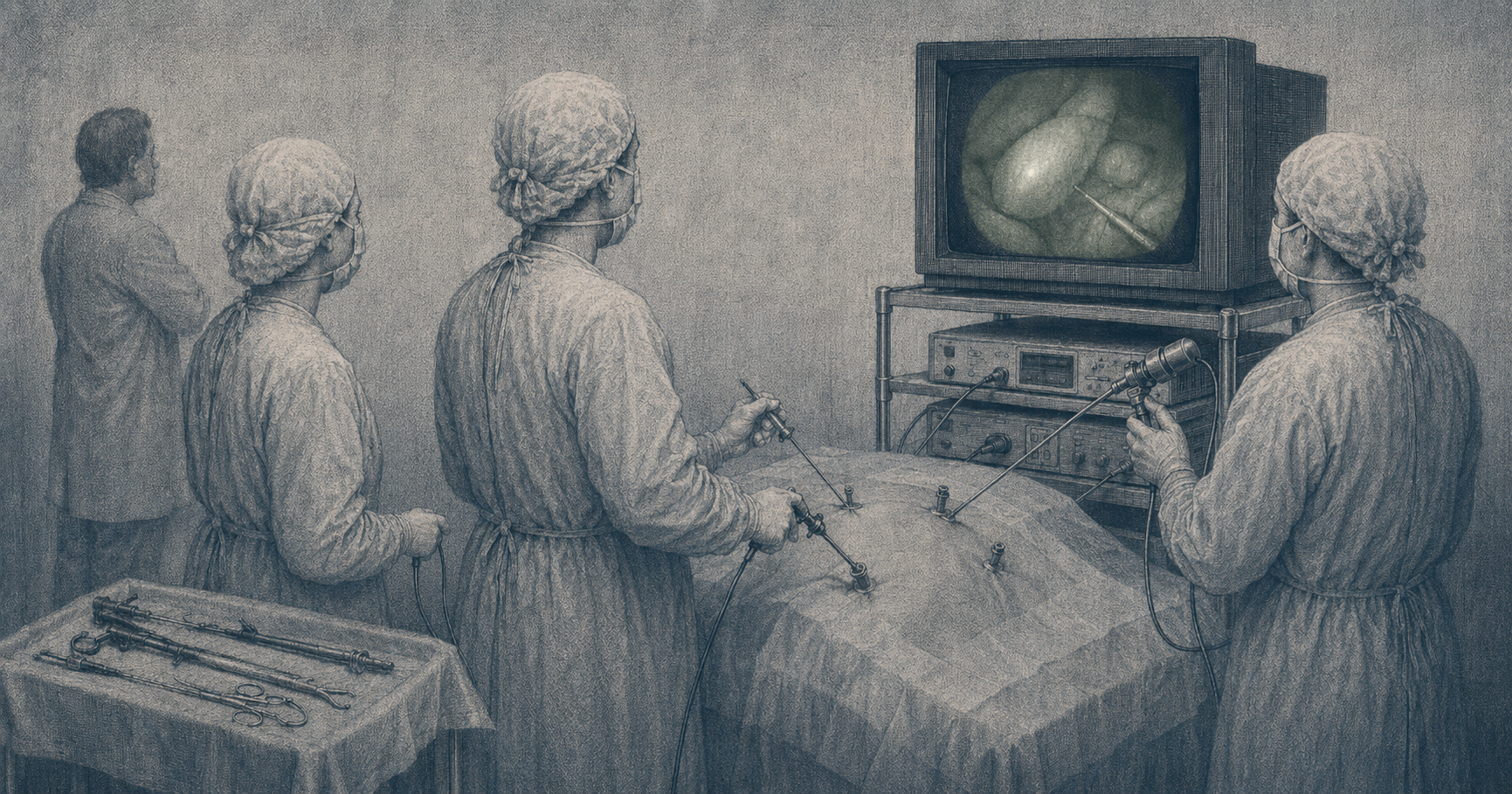
The Minimally Invasive Turn
He is thirty-one minutes in and he has cut the wrong tube.
It looked right. On the monitor it ran where the cystic duct should run. He clipped it twice, divided it, and the gallbladder came away clean. The patient went home the next morning and came back yellow eleven days later.
What he divided was the common bile duct, the channel that drains the liver, about the width of a drinking straw. Repairing it means opening the abdomen he was hired not to open, cutting a loop of small bowel and sewing it to the stump.
The operation being replaced was a hundred and nine years old and it worked. Carl Langenbuch took out the first gallbladder in Berlin in 1882, and what he did there was what surgeons still did in 1988. An incision under the right ribs, eight to ten centimetres, through skin and fat and fascia, the muscle divided. Then you put your hands in.
Everything followed from that opening. The fingers read the tissue: the density of a mass, the heat of inflammation, the pulse of a vessel nobody could see. Big surgeons made big incisions and said it as a virtue. The patient paid for the access: two to six days in the bed, weeks before she could lift a child, a scar she kept.
Kurt Semm was a gynecologist in Kiel who had built an automatic carbon-dioxide insufflator in 1963. In 1970 his colleagues asked him to submit to a scan of his head, on the theory that only brain damage explained the work. On 13 September 1980 he took out an appendix through a laparoscope. The American Journal of Obstetrics and Gynecology rejected the paper as unethical. The president of the German Surgical Society wrote to the gynaecologists proposing he be suspended from practice.
Erich Mühe heard about it and built a scope he called the Galloscope. On 12 September 1985, in Böblingen, he took out a gallbladder through it. He brought forty-two slides to the German Surgical Society that April and was told it was Mickey Mouse surgery. Small brain, small incision. The lecture never entered the proceedings; a one-page abstract did.
Then it moved. Two surgeons in Marietta, Georgia, did the first American case in June 1988. At the American College of Surgeons meeting in October 1989 the videotapes played, courses were announced, and every place was taken.
The instruments came from somewhere. United States Surgical made ninety-one million dollars on laparoscopic equipment in 1991 and passed a billion in revenue the next year, half of it from laparoscopy.
Surgeons learned it in weekend courses and went home and did it. By June 1992 New York State had counted seven deaths and a hundred and eighty-five severe complications across ninety-nine of its hospitals, reports arriving three and four a week, and required fifteen supervised cases before a hospital could turn a surgeon loose. The National Institutes of Health blessed the procedure that September. Four gallbladders in five were already coming out that way.
Dr. Nancy Church operated all three ways. She was a welded-metal sculptor before she became a gynecologic surgeon – laparoscopic and robotic – which is to say she had trained hands before she had trained hands.
In the open operation, she says, everything is done with your hands in the middle of everything. Laparoscopically the hands come up into the air and work backward, the instrument going one way as the hand goes the other, and the pressure that told you everything is gone. With the robot the hands leave the table. You can see it. You know it is there. You cannot feel it, and over a long time you learn to imagine the pressure you are putting on a living thing.
What she got in exchange: a woman on the table in the morning and home that afternoon, five or ten cubic centimetres of blood lost where the open operation lost three hundred. She would come home and say so. Her patients walked the same day, and walking is how you keep from throwing a clot out of a still leg.
Maryland kept records. Adjusted for everything measurable, the odds of dying in gallbladder surgery fell nearly eighty per cent between 1989 and 1992. In 1989, sixty-two people died. In 1992, fifty-six did. The operation had become roughly four times safer and almost exactly as many people were dead, because twenty-eight per cent more of them had it done. The state’s rate had been flat for years. It rose the month the wound got small.
The ducts were the other bill, and that accounting is contested. The first large American series found injury in one case in two hundred, and two point two per cent inside each surgeon’s first thirteen operations against a tenth of a per cent after. That is a learning curve and it is real. But a national survey found a third of surgeons reporting an injury placed it past their two-hundredth case — and that paper concedes the rate beyond that point cannot be calculated: nobody counted the operations that went right. The discussant at the American Surgical Association told the author his data could not carry the conclusion. The author disagreed. I think the discussant had the better of it, and that the honest answer is we do not know.
What is not contested is what happened after. Eighty-five per cent of reconstructions were done in the hospital where the injury occurred, by the surgeon who caused it. Repair in those hands succeeded about a quarter of the time. At a specialist centre, about four times in five.
Underneath all of it is a harder thing. Surgeons were already shrinking the wound before the camera arrived; Dubois published cholecystectomy through a minimal incision in 1982. When the two were finally compared, across thirteen trials and two thousand patients, there was no significant difference in deaths, in complications, in days in hospital, or in how soon people returned to work. The small incision was quicker and cost less. Measured end to end, the scars were the same length.
The trial that would have settled it was never run. By 1992 a third of surveyed British surgeons thought running one would be unethical. Of forty ethics committees handed a hypothetical application, three called it unethical and twelve declined to comment. The profession did not fail to gather the evidence. It concluded that gathering it would be wrong, because it already knew.
Two things have kept it open. To take a large uterus out through a small hole you must cut it up inside the body, and a power morcellator does that. In October 2013 Amy Reed, an anesthesiologist and mother of six, had a hysterectomy at the Brigham, and the device scattered a sarcoma nobody had diagnosed through her abdomen. She filed the first adverse-event report on the whole class of devices herself. Twenty-five had been cleared since 1991, each because it resembled something already sold. She died in 2017, at forty-four.
And in 2018 a randomized trial of radical hysterectomy for early cervical cancer was halted and published. Disease-free survival at four and a half years was eighty-six per cent for the minimally invasive operation against ninety-six and a half for the open. Nineteen deaths against three. Thirty years on, in one cancer, the small wound lost.
What endures is that a woman can have an organ taken out of her in the morning and sleep in her own bed that night, and that the surgeon who took it never touched it.
It cannot be undone, and most of us would not undo it. That is the bargain medicine made.
The next change would ask nothing of a surgeon’s hands at all. It came in a bottle, it cost pennies, and it taught an industry how to sell.
* * * * *
Charles C. Jett is an author, civic educator, and Professional Certified Coach based in Chicago. A graduate of the U.S. Naval Academy (Class of 1964) and Harvard Business School, he served during the Cold War aboard the nuclear submarine USS Ray (SSN 653), where his tactical innovations helped inspire Tom Clancy’s Jack Ryan character. He is the author of six books, including Super Nuke!, hosts four podcasts, and writes across his Critical Skills Blog platform on history, leadership, and the health of the American republic. In his writing he employs AI tools in a limited, supporting role for research, occasional image creation, and editing, while the prose and judgment remain entirely his own. He and his wife, Dr. Nancy Church, live and co-host the Chicago Salons at Water Tower Residences.

Leave a Reply