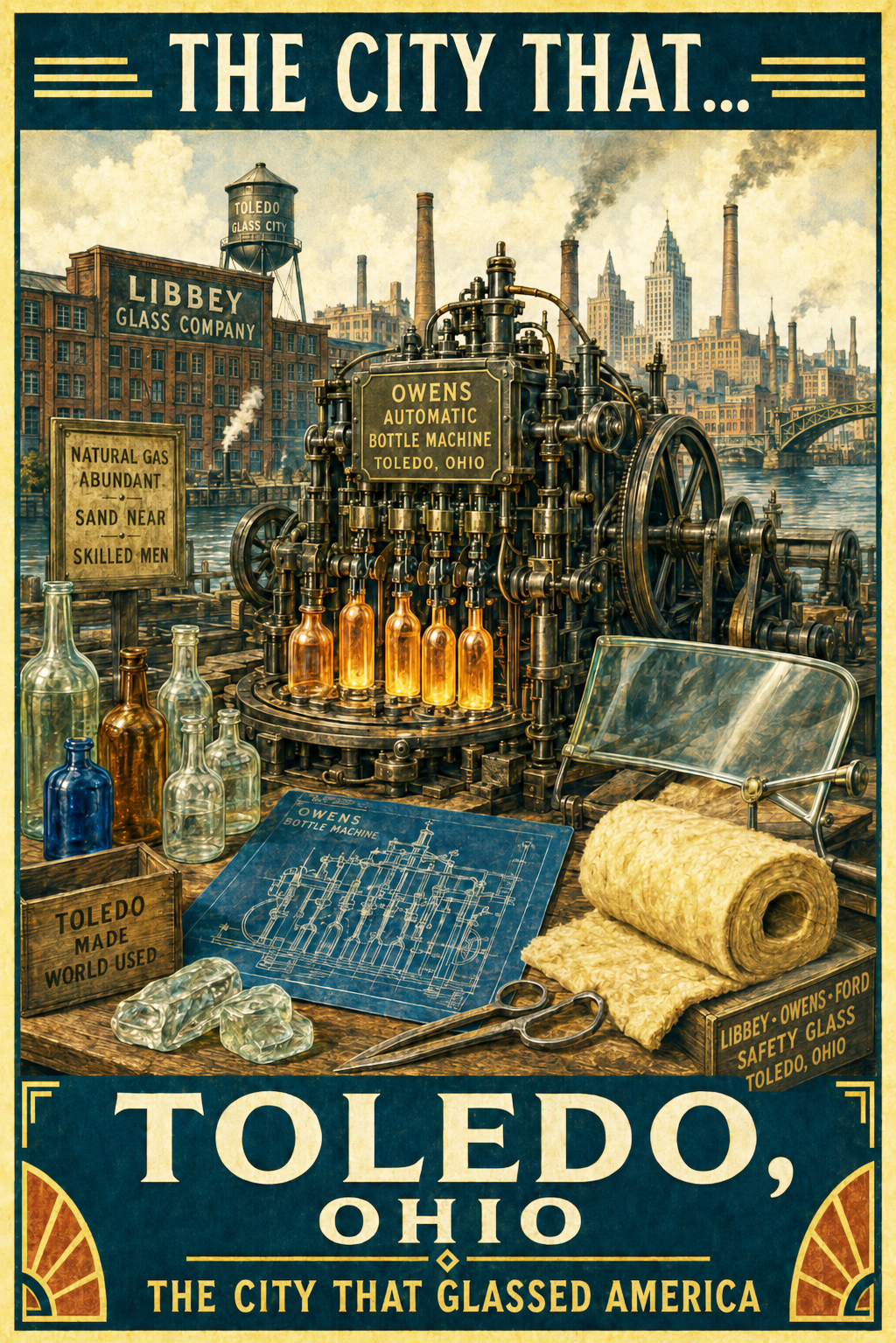
It did not just make the glass. It made the machine that made the glass.
This is the fourteenth profile in The City That…, a series about American cities that invented an industry, led the world in it, and then watched the center move on. We tell their stories plainly and with affection — what they made, what it cost, and what they still are.
The Founding
The Toledo Daily Blade announced it on February 18, 1888, under a headline that was then a hope: “Glass is King.” A committee of businessmen had gone after Edward Drummond Libbey of East Cambridge, Massachusetts, whose New England Glass Company was losing money and losing patience with its unions. They closed him with four thousand dollars, four acres, and fifty building lots.
The pull was gas. Findlay had struck it in 1884, and for a few years northwest Ohio was the cheapest place in America to keep a furnace hot. The sand was near as well. On August 17, 1888, the first trainload of East Cambridge glassworkers arrived — a hundred and fifteen of them. Four days later the furnaces were in production, in a district the city began calling Glassboro.
That explains why a man moved a glasshouse five hundred miles west. It does not explain why he stayed. Libbey had his furnaces built to burn gas, oil, or coal. He did not entirely trust the thing he had come for, and he was right not to: field output began falling in 1890, the works lost money for two years, and by 1890 he was threatening to close if gas prices rose. And Findlay, sitting on the same gas field, called itself the Glass Capital of the World in 1888. Findlay is not the Glass City.
What saved him was a light-bulb contract from Edison General Electric in 1890, won because a strike had shut a competitor’s furnaces in Corning, New York. Then, and mostly, one man he had hired almost by accident.
The Height
Michael Joseph Owens was the son of Irish immigrants and had gone into a Wheeling glass house at ten. He was a blower at fifteen. Libbey recruited him in West Virginia, and he came to Toledo in August 1888, the month the plant opened. Three months later he was a supervisor. He had almost no schooling and he could not abide waste.
Understand what he was looking at. In a hand shop the blower gathered molten glass on the end of an iron pipe and blew it into an iron mold, and the mold was opened and closed by a boy. The boys were nine, ten, eleven. They worked the night turn in front of furnaces running past two thousand degrees, in heat that dried a man out by the middle of a shift, and the whole of the job was to be quick enough that the blower never had to wait. Seven men and boys together could put out thirty-five hundred bottles in a day. Owens had been one of those boys. Thirty years later he was still thinking about the waiting.
Machine Number Four ran in 1902. It gathered the glass itself, by suction — the problem that had defeated every other man who tried — and it did not wait on anybody. The first commercial model turned out nine bottles a minute, thirteen thousand a day, two men to a shift, and a gross of bottles fell from a dollar eighty to ten cents. The University of Toledo, which keeps the company’s records, calls it the most significant advance in the production of glass in two thousand years.
Libbey-Owens made the first laminated automotive safety glass in 1928; by then automobiles took sixty-three percent of American plate glass. One Toledo company made forty percent of the nation’s bottles in 1933 and two-thirds of its beer bottles by 1936. Owens-Corning Fiberglas was created in 1938, and America began insulating its walls with spun glass. By 1959 the three companies carrying Michael Owens’s name had sales above a billion dollars and fifty-five thousand people on the payroll.
The Turn
Nothing dramatic ended it. Ownership moved, one transaction at a time. Libbey-Owens-Ford sold its glass business to Britain’s Pilkington in March 1986 — thirteen plants, seventy-four hundred employees. Then the bills came due for the insulation the city had been proudest of, and Owens Corning filed for bankruptcy in October 2000. Pilkington passed to Japan’s NSG in 2006, and Owens-Illinois left downtown the same year for Perrysburg, five miles across the river. China now accounts for something near half the world’s glass output.
What Was Lost
Owens-Illinois employed fifty-six hundred people in Toledo in 1980 and three hundred forty by 2003. Rossford went from about eight thousand workers to three hundred twenty-five. The city peaked at 383,818 people in 1970 and has been shrinking since.
But the hardest loss happened at the height, and Toledo did it on purpose. Hand blowers were the aristocracy of American labor: nine or ten dollars a day, two and three times what other industrial workers earned. Men who had commanded that wage were working for twenty-five cents an hour. Their union moved its headquarters to Toledo in 1904, into the city whose machine was dismantling the trade it existed to protect. In April 1910 its president, T. W. Rowe, who had worked alongside Owens at the Libbey plant, told the membership to stop consoling themselves that the machine would go away.
And the trade was finished on arithmetic. More than sixty percent of the cost of a bottle was skilled labor doing work a machine did nine times faster for a tenth of the price. No tariff and no contract was going to hold that line. The craft was not taken from those men by anybody’s malice. It was priced out of existence, and there is no version of the twentieth century in which it comes back.
The children are a separate fact and not a justification. Under-sixteens in American glassmaking fell from seven thousand in 1899 to fourteen hundred by 1919 — mechanization and legislation and enforcement working at once, and the record does not let anyone say which mattered most. Owens had been a holding-in boy at ten, and the machine he built took the boys out of the bottle shops and the trade out from under the men in a single motion. He does not appear to have regretted either.
What Remains
More than the ledger suggests. Owens Corning is still headquartered in Toledo, ten billion dollars a year. Owens-Illinois — one of the leading glass container makers in the world, nineteen thousand people in eighteen countries — sits at an address in Perrysburg called One Michael Owens Way. Libbey still makes glass in Toledo under a union contract signed in February 2026, after a strike that ran five months. Pilkington runs two float lines at Rossford, and since March 2025 one has made the coated glass that goes into solar panels, which is why First Solar came to Wood County for the supply chain of the Glass Capital of the World.
And then the smaller thing, which matters more.
In March 1962 a ceramics professor named Harvey Littleton set up a furnace in a converted garage on the grounds of the Toledo Museum of Art, meaning to prove that one artist working alone could handle molten glass, which nobody had seriously attempted since the factories took the material over. His furnace, built of low-fire brick, would not melt the batch. Dominick Labino, a research director in Johns-Manville’s fiberglass division, rebuilt it and brought marbles of a glass formulated to melt at a temperature a studio could reach. About nine people were in the room. One of them was Harvey Leafgreen, a retired glassblower from the Libbey plant, and what Leafgreen did there was show the artists how to gather glass on the end of a pipe.
Consider what that required. Toledo built the machine that ended hand blowing in America, and sixty years later, when a professor and a chemist wanted the craft back, they had to send for a retired factory hand to teach it. It had not survived in the industry that invented it. It survived in one man’s hands until somebody thought to ask. Littleton’s students went out from that garage: Chihuly, Lipofsky, Dreisbach, Herman.
The museum Edward and Florence Libbey founded in 1901 built a pavilion in 2006 to hold the glass, seventy-four thousand square feet of curved wall, fabricated in China. Roughly seven hundred times a year someone stands in that building and gathers a glowing lump on the end of an iron pipe and turns it in front of a crowd: the way Leafgreen did for nine people in a garage, the way Owens did at fifteen, before he spent his life making it unnecessary. The bottles went out of here by the hundred million, and the windshields, and the insulation, and the tumblers on the kitchen table. What still turns in Toledo is a pipe in a man’s hands.
Toledo glassed America, and that is worth remembering.
Why Toledo? It did not just make glass; it made the machine that made the glass, and for most of a century the country drank, drove, and insulated behind what Toledo produced.
* * * * *
Charles Cranston Jett is an author, civic educator, and Professional Certified Coach based in Chicago. A graduate of the U.S. Naval Academy (Class of 1964) and Harvard Business School, he served during the Cold War aboard the nuclear submarine USS Ray (SSN 653), where his tactical innovations helped inspire Tom Clancy’s Jack Ryan character. He is the author of six books, including Super Nuke!, hosts four podcasts, and writes across his Critical Skills Blog platform on history, leadership, and the health of the American republic. In his writing he employs AI tools in a limited, supporting role for research, occasional image creation, and editing, while the prose and judgment remain entirely his own. He and his wife, Dr. Nancy Church, live and co-host the Chicago Salons at Water Tower Residences.



Leave a Reply