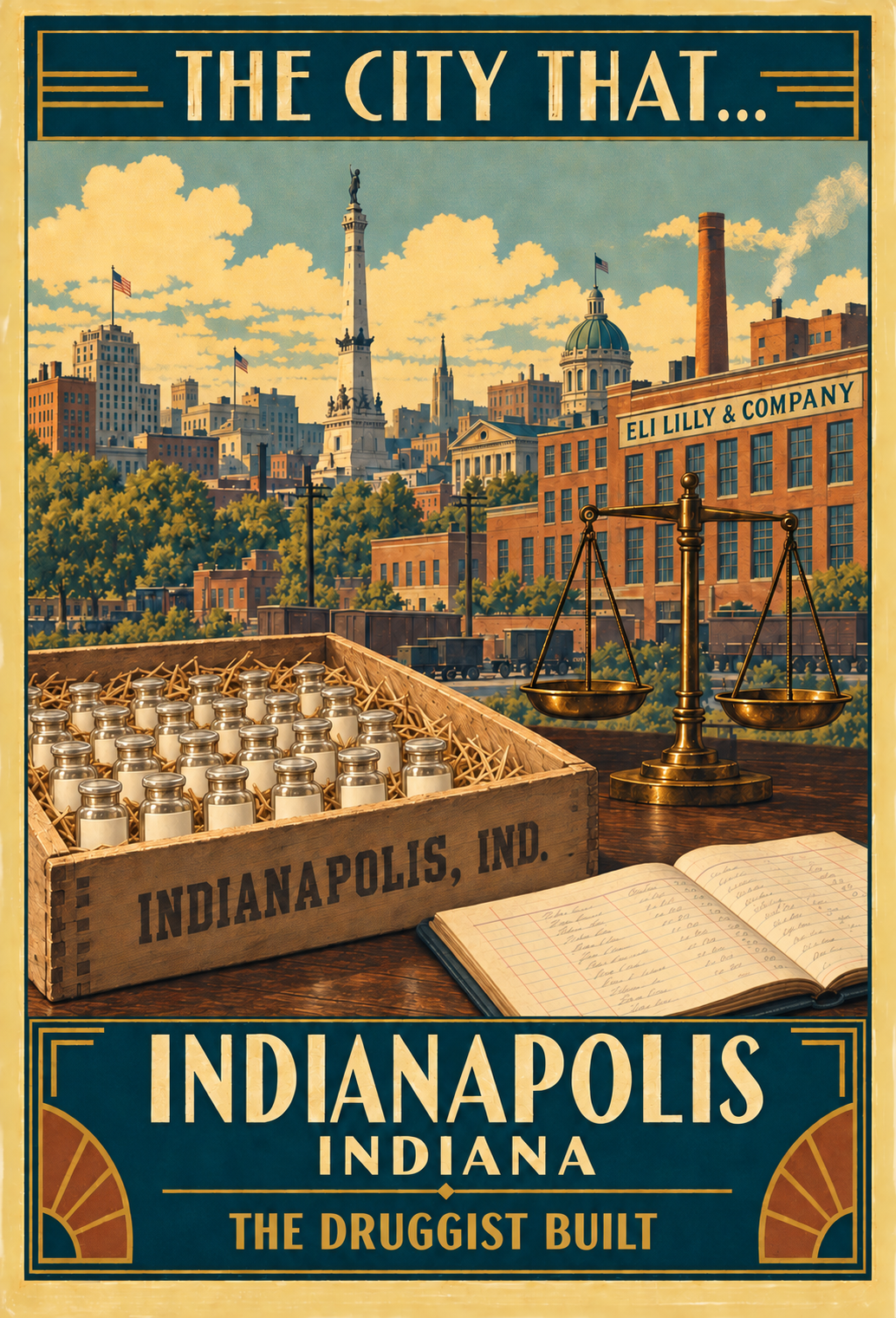
Medicine money built the streets, the skyline, and the company that stayed.
This is the twentieth profile in The City That…, a series about American cities that were made by an industry, and about what happened when the center of that industry moved on. It follows three Michigan cities – Battle Creek, Grand Rapids, and Kalamazoo. Indianapolis is one of the few where the center stayed. We tell their stories plainly and with affection — what they made, what it cost, and what they still are.
The Founding
Indianapolis was a city before the druggist got there. It was the state capital and a railroad town. By 1880 it held about 75,000 people, and nearly 700 manufacturing shops, and its biggest work was meat packing and the metal trades.
So Indianapolis pharmaceutical history begins in a going city, with a man who needed a second start.
Colonel Eli Lilly had come home from the Civil War, failed at a cotton plantation in Mississippi, buried his first wife, and gone bankrupt. On May 10, 1876, he opened a small laboratory on Pearl Street. By the late 1880s he had about 100 people working for him in a plant on McCarty Street, on the industrial south side.
His life as a businessman is told in the companion profile, The Brand That Made Medicine Reliable.
Here is what the city got from him.
In 1890 Lilly was the main founder of the Commercial Club of Indianapolis, and he was its president until 1895. The club staged a Street Paving Exposition. It pressed the city for sewers and for elevated railroad crossings. The city’s Board of Public Works let the contracts and property owners paid the assessments. The club did the pushing. In the depression of 1893 he led the relief for men out of work.
He had a daughter named Eleanor. She died of diphtheria in 1884, before there was a diphtheria antitoxin. In 1895 he bought the Gresham house at Capitol Avenue and Ninth Street and gave it for a children’s hospital in her memory, the Eleanor Home. It was a forerunner of Riley Hospital for Children. He died in 1898. Without him the Eleanor Home slipped. It ran until 1909, then closed for lack of money, its hygiene failing.
That was the first building.
The Height: Eli Lilly, Insulin, and Indianapolis
In May 1922 the University of Toronto chose Lilly to make its new pancreas extract, insulin, in quantity. The work fell to three chemists, George Walden, Jasper Scott, and Harley Rhodehamel. That summer they ran the process around the clock. “Every available person was put to work on Insulin,” Rhodehamel remembered. Walden was sent on a vacation before he collapsed. Scott collapsed and had to take time off.
The raw material came from the slaughterhouse, and the slaughterhouse was close. Indianapolis was one of the country’s leading meat-packing cities. Its biggest packer, Kingan and Company, had pioneered ice and artificial refrigeration so it could kill and pack the year round. Kingan’s main plant stood one mile from Lilly’s factories.
A hog’s pancreas weighs about three ounces. Inside it the insulin sits beside enzymes that will destroy it unless the gland is kept cold, and kept cold without a break. Lilly’s purchasing director, Austin Brown, taught the packers how to take the glands, handle them, and hold them. Kingan sent them. So did Armour and Swift in Chicago, and in time packers across the country. The glands came in by rail, frozen one by one, to be inspected and ground. The cold that let Kingan pack pork in summer was the same cold insulin needed.
Iletin, Lilly’s insulin, went on general sale on October 15, 1923. The Colonel’s son, J.K. Lilly, wrote that insulin “revolutionized our place in the industry.”
It also carried Lilly’s own people through the Depression. The company’s history records that insulin and the new products after it let Lilly get through the 1930s without laying off a single employee. Between 1932 and 1948, through the Depression and the war, sales rose from $13 million to $117 million.
The Turn: Naptown
The company held. Downtown did not.
Suburban shopping centers had been pulling at downtown since the 1950s. When Interstate 465 closed its loop in the early 1970s, the pull got stronger. Castleton Square opened on the far northeast side in 1972 and Washington Square on the east side in 1974. By 1976, the city’s own encyclopedia says, the malls had “drained the downtown area of its retail business.” People called the place Naptown, a jazz-age nickname turned into a joke, and India-No-Place. When the Super Bowl came to town in 2012, one story looked back on the decades when there was no reason to stay downtown after dark.
The family’s money had been gathering for a long time. In 1937 the Colonel’s son and grandsons set up the Lilly Endowment with gifts of company stock. The largest of its first grants, that December, was $10,500 to the Indianapolis Community Fund. In the early 1970s it paid to renovate the old City Market and saved it from the wrecker. By its own history, it gave about $300 million to large undertakings in and around Indianapolis between 1975 and 1987. In 1981 it pledged $25 million toward a bigger convention center and a domed stadium. The city built the Hoosier Dome with no team to play in it. The Baltimore Colts came in 1984.
That was the second building, and I cannot tell you how much of it was Lilly’s. Mayor William Hudnut gets most of the credit, and most of it is earned. The voters paid too, through a county tax on meals and drinks that helped pay for the convention center and the dome. By the city’s own bond records, it issued $293 million in tax-increment bonds for the Circle Centre mall in 1992. My reading is that the Endowment’s money was the private money most willing to go first. The record does not settle how much of the rest followed it.
What Was Lost: Little Valley
The third building was the company’s own, and it had a cost.
Southwest of downtown, along Kentucky Avenue, Lilly’s manufacturing campus grew into a small neighborhood of frame houses called Little Valley. Many people called it Lilly Valley, the Indianapolis Business Journal reported in 2006. A Lilly expansion in 1990 took 50 homes and several businesses and closed part of Kentucky Avenue, and the residents were angry at what they saw as being left out. Later the company cleared homes along Nordyke Avenue for a biotechnology expansion of nearly $500 million. In 2006 it asked to close most of Silver Avenue and Bridge Street for parking and offered the remaining owners 105 percent of appraised value. About thirty houses and a small park would be left, with industry on every side.
City planners noted that the rezoning did not fit the neighborhood’s own plan. They recommended it anyway, since Lilly already owned the land.
Relations had improved since 1990. Lilly had put volunteers and money into the neighborhood, and most of the parking-lot land was sold when the owners called Lilly first. Jeff Gearhart ran the West Indianapolis Development Corporation. “Is everybody happy? No,” he said. “But in the end, it’s working out as good as it can.”
What Remains
Lilly is still here, a hundred and fifty years after Pearl Street. Kalamazoo lost its drug house to mergers – primarily to Pfizer; Indianapolis kept its own. Its headquarters stands on the south edge of downtown and it counts more than twelve thousand employees in Indianapolis. Elanco, the animal-health business that began inside Lilly, moved its global headquarters from Greenfield to downtown Indianapolis in 2025. The Endowment held nearly $106 billion at the end of 2025.
The newest building is going up somewhere else. Lilly is spending as much as $1.8 billion over several years to upgrade and expand its Indianapolis plants. At Lebanon, in Boone County, 28 miles northwest of headquarters, it has announced about $18 billion for three new ones. The Indianapolis water system is being extended north to Lebanon in stages, to serve that district and the growth around it, up to 25 million gallons a day by 2031. Indianapolis keeps the headquarters and the old plants. The new ones are going up in another county, on the city’s water.
Start with a bronze plaque on Meridian Street, a few steps from where the laboratory stood. A street-paving exposition. A children’s hospital in a dead girl’s name that lasted fourteen years. A three-ounce gland that had to be kept cold. A dome built before there was a team. About thirty frame houses left in Little Valley. Water promised north to Lebanon.
The druggist’s name runs through much of it, alongside a mayor’s, the voters’, and a neighborhood’s.
Indianapolis is the city the druggist built, and that is worth remembering.
* * * * *
Why Indianapolis? The country knows Indianapolis for a race, not a medicine. It is here because one company and one family’s fortune shaped it from its 1890s streets to its 1980s skyline — and because, unlike most cities in this series, the company never left.
* * * * *
Charles Cranston Jett is an author, civic educator, and Professional Certified Coach based in Chicago. A graduate of the U.S. Naval Academy (Class of 1964) and Harvard Business School, he served aboard nuclear submarines during the Cold War. He is the author of six books, including Super Nuke!, hosts four podcasts, and writes across his Critical Skills Blog platform on history, leadership, and the health of the American republic. In his writing he uses AI tools for research, editing, and occasional image creation; the arguments, the voice, and the final judgment are his. He and his wife, Dr. Nancy Church, live at Water Tower Residences, where they co-host the Chicago Salons.

Leave a Reply