
Idaho, 1955 — the vaccine that worked, the batch that didn’t, and the bargain a country made in a single spring
The doctors noticed it in the arms.
A child came in paralyzed, and the paralysis had begun in the left arm. The shot had gone into the left arm. Another child: right arm, right arm. The Poliomyelitis Surveillance Unit eventually accepted sixty-one paralytic cases among children who had been vaccinated, and in forty of them the first paralysis appeared in the limb that had taken the needle.
They knew what it meant because of monkeys. David Bodian had injected live poliovirus into the right calf of thirty-two macaques and recorded where the paralysis started. In twenty-three of them it started in the right leg. The children were matching the animals.
The vaccine was supposed to contain no living virus. In some lots it did.
Idaho got the worst lots. Four people there died. By the time the surveillance unit closed its tally that October, eleven were dead. The vaccine had been declared safe, effective and potent on the twelfth of April, to church bells.
The summer disease
Polio came in summer. Parents learned to read the calendar the way sailors read weather. Pools closed. Movie houses emptied. Children were kept off the street and away from cousins, and much of it did nothing, because the virus moved through people who never got sick at all.
In 1952 the United States reported 57,628 cases. Of those, 3,145 died and 21,269 were reported as paralytic. It was the worst year the country ever had.
The disease did its worst work quietly. The virus entered through the mouth, multiplied in the throat and the gut, and in most people went no further. In a small share it reached the nervous system and destroyed motor neurons, and where it took the muscles of the chest, the patient could not breathe.
For those, there was the machine.
The iron lung was a sealed metal cylinder with the patient’s whole body inside it and only the head out, a rubber collar at the neck holding the air in. Bellows pulled the pressure down and the chest expanded; the pressure came back and the chest emptied. By 1939 there were about a thousand of them in American hospitals. In the bad years the wards ran out.
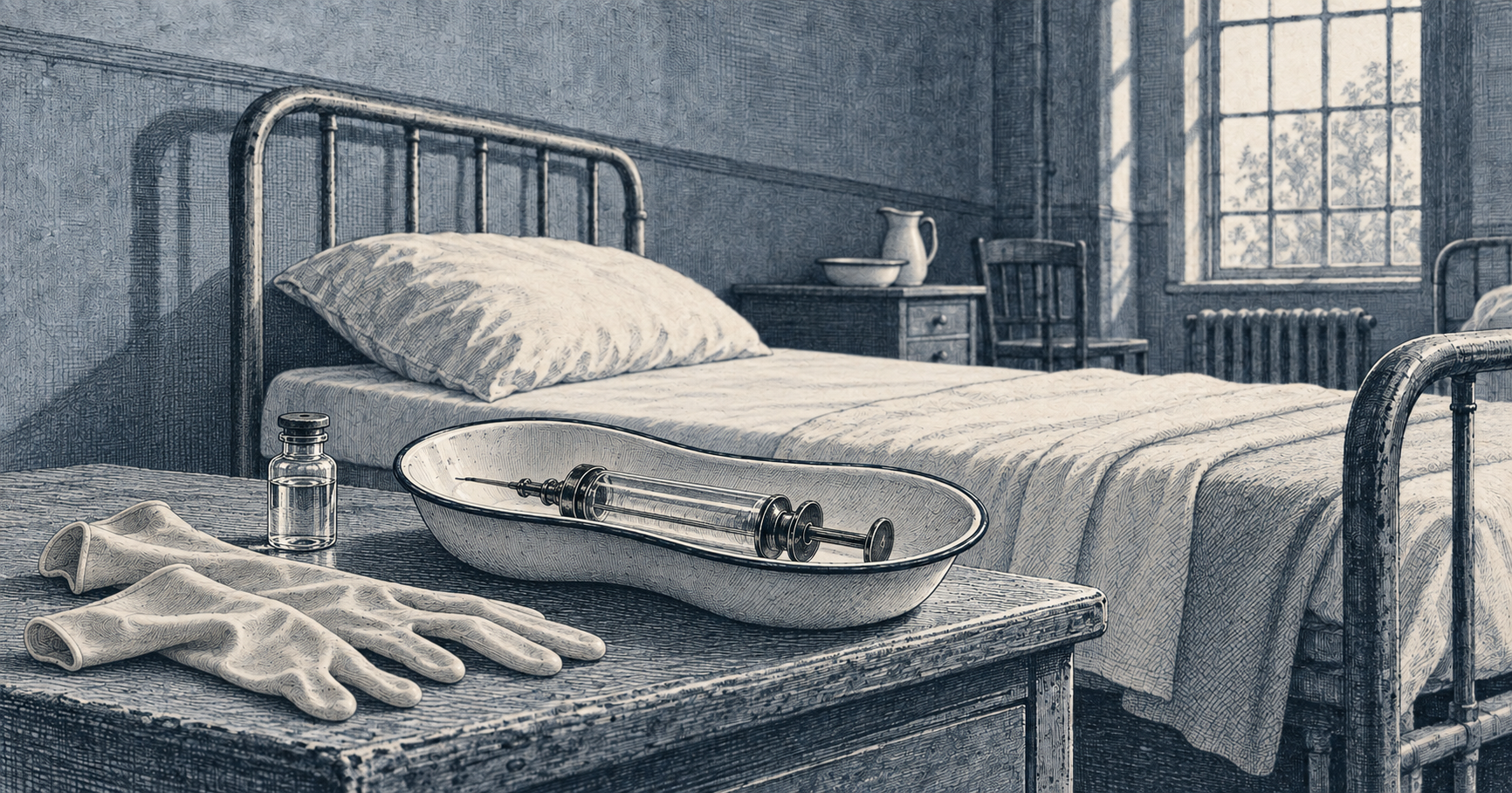
Most of the rest was done through portholes in the side: washing, catheters, bedpans, an itch scratched. When the portholes would not serve, the work waited for the few minutes a patient could breathe outside the tank. A mirror was mounted on a bracket above the head so the patient could see the room behind them, which is how a child in a tank watched the ward. At one English hospital they used dolls in model iron lungs to show children what was about to happen to them.
Getting out was harder than going in. Therapists extended the time outside the cabinet a little at a time until the muscles could carry a day. Kenneth Kingery, who did it, said he would “strain my every fibre for a breath of air”, and that there was always the fear they would not close the tank again in time.
This is what the vaccine walked into.
Not a public-health abstraction.
A room with a mirror in it.
What made it possible
What made a vaccine possible was a laboratory technique. Poliovirus had been grown in human nervous tissue since the 1930s. In January 1949 John Enders, Thomas Weller and Frederick Robbins published a method for growing it in ordinary non-nervous tissue, which meant virus could be made in quantity without a colony of monkeys behind every experiment.
The Nobel Prize in 1954 went to those three men. It never went to Jonas Salk, and it never went to Albert Sabin.
The money was American and it was small and it came from everywhere. The National Foundation for Infantile Paralysis raised it a dime at a time and paid for the trial out of it. The “March of Dimes.” I remember. Movie theaters played a short video – with the song from Carosel – “You’ll Never Walk Alone.”
The trial began on April 26, 1954, and it was not one trial. In 84 areas across eleven states, children in the first three grades got vaccine or a placebo under a blinded design, in which neither the families nor the physicians knew who had received which. In 127 areas across 33 states, second-graders were vaccinated and first- and third-graders were simply watched. The second design was cheaper, faster, and badly flawed: the two groups differed in age, and one group’s parents had consented to an injection while the other’s had not. K. A. Brownlee, reviewing the trial for the Journal of the American Statistical Association in 1955, called that half of it worthless.
Thomas Francis Jr. of Michigan ran the evaluation, not Salk. That separation was the trial’s best feature. On April 12, 1955, in Rackham Auditorium in Ann Arbor, Francis gave the result to a room of physicians and reporters and a country listening on the radio.
In the blinded areas, among children who completed the vaccine series, thirty-three got paralytic polio out of 200,745. Among those who completed the placebo series, one hundred and fifteen out of 201,229.
The bells rang that afternoon. Factory whistles went off and schools let children out early.
That evening Edward R. Murrow asked Salk who owned the patent. Salk said the people owned it, and then: “There is no patent. Could you patent the sun?”
That sentence has outlived everything else said that day, and it is incomplete. Jane Smith’s archival work on the Foundation’s papers found that its lawyers had already examined whether the vaccine could be patented and concluded that it could not, for want of novelty. I have not read that memorandum. What can be said is that the question had been asked and answered before Murrow asked it on television.
Thirteen days
Six manufacturers were licensed that same afternoon, by the count in the government’s own technical report, and the vaccine went out in boxes.
On April 25 and 26 the first reports came in of children paralyzed after a shot. On the 27th the Surgeon General asked Cutter Laboratories of Berkeley to withdraw its product, and the company notified its distributors in under an hour. On the 28th, one day later, the Surgeon General created a national surveillance program and put it in Atlanta, at what was then the Communicable Disease Center. Forty-two officers were pulled onto polio duty. Reports began going out to every state health officer on May 1.
On May 7 the Surgeon General recommended suspending the vaccination program entirely. By then more than four million inoculations had already been given.
The epidemiology came together fast. Investigators looked at the interval between shot and symptom, at which manufacturer and which lot, at the background rate of polio in the same county, at cases in families of vaccinated children — and at that correlation between where the needle went and where the paralysis started. Two lots, numbers 6039 and 6058, went into forty-four thousand inoculations and were associated with sixty-seven cases: twenty-one among the vaccinated children, forty-one in their families, five in the community.
Through October 28, 1955, the surveillance unit accepted 204 cases associated with Cutter vaccine, with eleven deaths. Seventy-nine were the vaccinated children themselves. One hundred and five were people in their families. Twenty were community contacts, who had not been vaccinated themselves. Three-quarters of the cases were paralytic.
One lot of Wyeth vaccine used in Maryland drew the same suspicion, from cases in vaccinated children and in their families and neighbors. It was tested at the National Institutes of Health and by outside laboratories. No poliovirus was isolated from it. The record leaves that one open.
Here the record stops cooperating.
Three published tallies of the Cutter incident do not agree, and have not agreed since the first of them was printed. The contemporary surveillance count is the one above: 204 cases, 11 deaths. Nathanson and Langmuir’s retrospective analysis, published in 1963, is generally cited at 260 cases — 94 among recipients, 126 among family contacts, 40 in the community. Paul Offit’s book gives a different frame again: roughly 40,000 cases of abortive polio among children who got the vaccine, with fifty-one children permanently paralyzed and five dead, and a further 113 paralyzed and five dead among the people they infected.
They do not reconcile, and I cannot reconcile them. The first counts cases the surveillance unit accepted inside defined windows. The second attributes cases by exposure and by lot, after the follow-up had closed. The third reaches down into illness that never touched the nervous system at all. Even the death figures differ, and differ by amounts that the inclusion rules do not obviously explain. My reading is that the disagreement is the most useful thing about them, because it shows how hard it is to fix the size of a harm even when a government is trying to, in the same season, with the whole country watching. Anyone who gives you a single clean number for Cutter has chosen one and not told you.
What came next
Vaccine came back in stages. Parke-Davis material already released was recleared on May 13, Lilly’s on May 15. Revised safety requirements were agreed on May 25 and endorsed by the manufacturers two days later. In June the department created a new Division of Biologics Standards at NIH, replacing the small laboratory that had cleared Cutter’s product in the first place.
On August 12, four months after the disaster, the Poliomyelitis Vaccination Assistance Act became law, putting federal money behind vaccinating children and expectant mothers.
And that summer, in the middle of it, the vaccine was shown to work. Because the shots had gone mostly to first- and second-graders, the surveillance unit compared the age curve of paralytic polio in 1955 against 1952 and found a sharp dip at ages seven and eight, and nowhere else. In upstate New York, paralytic polio ran at 4.0 per hundred thousand among vaccinated children and 20.9 among the unvaccinated.
The courts closed the other half of it. In Gottsdanker v. Cutter Laboratories, the jury put its finding in writing: Cutter, it said, “was not negligent either directly or by inference”. Then it found the company liable anyway, for breach of an implied warranty that the product was what it said it was. Two children collected, and the California appellate court affirmed in July 1960. Liability without fault had older roots, in food cases. Gottsdanker was the moment it reached a vaccine.
Albert Sabin’s oral vaccine came afterward, licensed in the United States in 1961 and 1962 and as a trivalent drop in 1963. It was live virus, weakened, given on a sugar cube. It did something Salk’s did less well: it replicated in the gut, so a vaccinated child was far less likely to carry the virus onward. That is the property that eradicates a disease rather than merely protecting the person in front of you.
It also had a cost, and the cost fell on children who would never have met the wild virus at all.
The only polio left
Between 1980 and 1999, the United States reported 162 confirmed cases of paralytic polio. Six were wild virus brought in from abroad. Two were never resolved. The other 154 — ninety-five percent of them — were caused by the vaccine.
That was published, counted every year, and accepted, because the alternative was worse. But for a generation of American parents, the honest sentence about polio was this: the likeliest source of the disease for their child was the vaccine given to prevent it. By 1973, vaccine-caused cases already outnumbered wild ones. The last case of locally acquired wild polio in this country was in 1979. The vaccine went on paralyzing about eight people a year — recipients, and sometimes the adults who cared for them — through the two decades after the disease it prevented had stopped circulating here. A sequential schedule adopted in 1997 brought the number down before the oral vaccine was dropped altogether.
In 1999 the Advisory Committee on Immunization Practices recommended dropping the oral vaccine from the routine childhood schedule. From January 2000 American children have received the killed vaccine only — Salk’s, refined.
The same logic has been applied elsewhere. A group of vaccine-safety researchers writing in 2015 set it out plainly: as a program matures and coverage stays high, the disease it targets nearly disappears, and the vaccine’s own adverse events grow more prominent precisely because the disease no longer is. They point out that the United States and Britain stopped routine smallpox vaccination in 1971, eight years before smallpox eradication was certified in 1979, because the vaccine’s risk had come to outweigh the risk of an imported case. And they say the same reasoning drove the American switch away from oral polio vaccine.
That reasoning runs forward as well as back. A vaccine that works perfectly makes the thing it prevents unimaginable, and once the disease is unimaginable, the vaccine’s own harms are the ones left to picture.
2026
Wild poliovirus type 1 is still endemic in Afghanistan and Pakistan and nowhere else. Elsewhere the outbreaks come from the oral vaccine itself — virus that circulated long enough in under-immunized communities to regain what it had lost.
In the United States, 92.4 percent of children entering kindergarten in the 2025-26 school year had their polio vaccinations. Exemptions from one or more required vaccines reached 4.2 percent, a record for the fourth year running, and coverage fell in more than half the states.
In 1954, some 1.8 million children were enrolled in the trial and about 620,000 of them took a full course of vaccine or placebo on the strength of a promise. The following spring, after eleven people died of one company’s version of that vaccine, the shots resumed within weeks and the age curve for 1955 shows a dip at exactly the ages that got them. Whether what those parents had was trust in institutions or simply a clear memory of the ward with the mirrors, I do not know, and the evidence does not settle it.
The children who rolled up their sleeves in the spring of 1954 are in their late seventies and early eighties now. The disease they were enrolled against has not circulated in this country since 1979. That was the point.
It cannot be undone, and most of us would not undo it. That is the bargain medicine made.
The year before Sabin’s drops were licensed here, a different pill came to market. It was prescribed to healthy women who had nothing wrong with them, taken every morning by choice, and it divided the country in ways no virus ever managed.
* * * * *
CHARLES CRANSTON JETT is an author, civic educator, and Professional Certified Coach based in Chicago. A graduate of the U.S. Naval Academy (Class of 1964) and Harvard Business School, he served during the Cold War as an officer aboard nuclear submarines. He is the author of six books, including Super Nuke!, hosts four podcasts, and writes across his Critical Skills Blog platform on history, leadership, and the health of the American republic. In his writing he employs AI tools in a limited, supporting role for research, occasional image creation, and editing, while the prose and judgment remain entirely his own. He and his wife, Dr. Nancy Church, live and co-host the Chicago Salons at Water Tower Residences.

Leave a Reply