
A pill you could crush with your thumb — and the town that built a century on it.
This is the nineteenth profile in The City That…, a series about American cities that invented an industry, led the world in it, and then watched the center move on. We tell their stories plainly and with affection — what they made, what it cost, and what they still are.
The Founding
The trouble was that the medicine did not always work.
A pill in the 1880s could be pressed so hard and packed so dense that it passed through a patient whole. The dose was right. The diagnosis was right. The pill came out the far end unchanged. A country doctor in Hastings, forty miles east of Kalamazoo, had spent ten years watching his own prescriptions fail for reasons that had nothing to do with medicine. William Erastus Upjohn set out to fix it.
He filed his patent from Hastings on October 14, 1884, and it was granted the following February. The title is worth reading exactly as printed: “Process of Making Pills.” Not a pill. A way of making one.
Start with a particle. Turn it in a revolving pan, wetting it with a spray, sifting powdered medicine over it, wetting and sifting again, so the pill grows outward in layers the way a snowball grows rolling downhill. The patent claims what that buys: a pill “less compact, and hence more soluble, and capable of being easily crushed and powdered.”
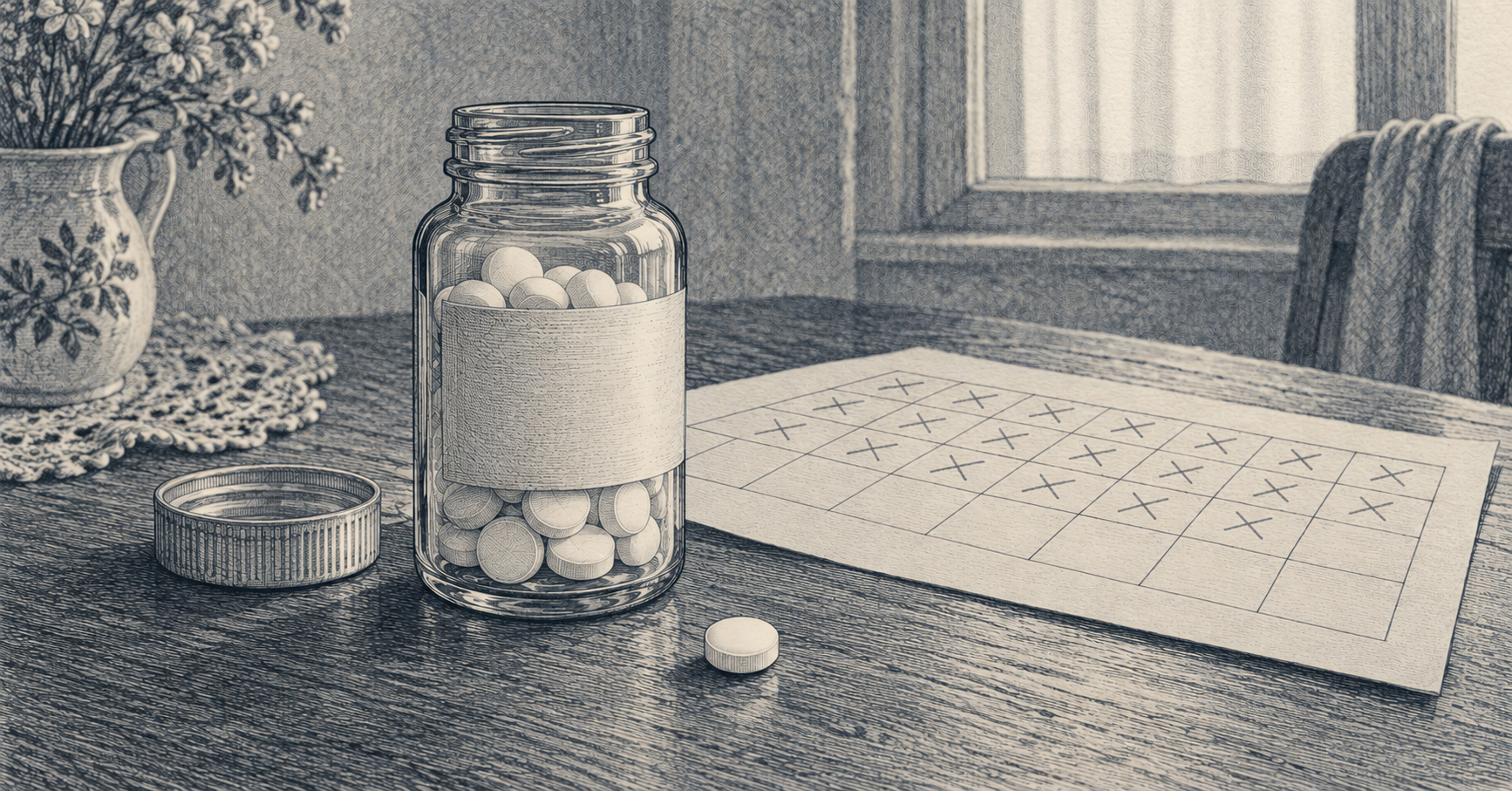
Crushed and powdered. That was the whole argument, and it could be settled at a druggist’s counter in four seconds. A man set the pill on the wood, leaned his thumb on it, and lifted his hand. If there was powder on the counter, the medicine would dissolve inside a person too.
Upjohn’s Friable Pills, the trademark read, can be Reduced to a Powder under the Thumb. The company mailed demonstration boards to physicians by the tens of thousands. It had borrowed the idea from a New York druggist. It was also true, which is rare in advertising.
Kalamazoo did not get the business for its water or its soil. It got it because it had money. Upjohn moved there in 1885 wanting better transportation, better labor, and “above all sound financial backing.” Kalamazoo had twenty thousand people. Hastings had two thousand. In 1886 the firm was established as The Upjohn Pill and Granule Company, and a city that grew celery and made paper began, quietly, to make medicine.
The Height
The first catalog listed 186 formulas compounded from fifty-six raw drugs. Quinine alone once ran past forty percent of sales. A good pill house, and it might have stayed one.
Then Kalamazoo did something that changed medicine everywhere.
After the war, cortisone arrived as a wonder against inflammation and arrived nearly unmakeable — dozens of steps, each losing material, ending in a substance measured out by the gram. The company’s president said what he wanted and how fast: “We want cortisone, don’t spare the horses.”
What his people found was not a better synthesis. In 1950 the biochemist Durey Peterson and the microbiologist Herbert Murray discovered that a common mold could do the hardest step by itself — reach into a molecule of progesterone and set an oxygen atom on the eleventh carbon, which no chemist could do cheaply. They published in 1952. A fermentation tank now did overnight what a laboratory had done over weeks, and did it in bulk. One of the chemists put it in a line: within a decade the Upjohn process was turning out tons of steroid intermediates.
Tons. Of a thing that had been sold by the gram.
By 1990 no company in the world made more steroid medicine than the one in Kalamazoo. The city never became a household word for medicine the way Battle Creek became one for cereal. It became the place the industry itself depended on — a quieter kind of fame, and a heavier one.
Employment in Kalamazoo County peaked at 8,417 in 1988. An Upjohn badge was a mortgage. The founder had built Bronson Hospital in 1904, given the city a park in 1919, served as its first mayor, and started the community foundation in 1925 with a thousand dollars. Six weeks before he died in 1932 he set up a trust to study unemployment. When he was buried, the flags came down to half-staff and the schools and the stores closed for the hour.
The Turn
Here is the part Kalamazoo does not enjoy hearing.
Upjohn was not taken. Upjohn agreed.
By the early 1990s the company was mid-sized and running short of new products. It booked record sales of $3.6 billion in 1993 and a $216 million restructuring charge the same year, cutting eight percent of its workforce. It ranked nineteenth or twentieth in the world. It went looking for a partner, and in August 1995 announced a merger of equals with Pharmacia of Sweden. Upjohn’s own chief executive ran the combined company. London got the headquarters because neither side would accept the other’s hometown. The Kalamazoo Gazette gave the news three sections. After 109 years, there was no more Upjohn Company.
The shareholders got their equality. The city got something else, and a federal court wrote it down: the old firm became a wholly owned subsidiary of a parent whose offices were in London, and that December a Merger Employee Transition Assistance program took effect, among whose stated purposes was identifying redundant positions.
More than a thousand local jobs went in the first two years. In 1997 a new chief executive moved the headquarters to New Jersey with six hundred administrative and marketing positions. Pfizer bought the whole thing in 2003 and began winding down human-health discovery research downtown — not one closure but a five-year subtraction, finished in 2008. Published counts run from a thousand to sixteen hundred jobs, and nobody has reconciled them. On January 22, 2007, Pfizer announced the closing of three American research sites. All three were in Michigan.
What Was Lost
The 1961 headquarters that Kalamazoo called the Taj Mahal came down by the end of 2007. The site became a parking lot. The marble went to Western Michigan University.
A man named Kenneth Visscher lost his research job in the closure and found another at Eli Lilly in Indianapolis. He took it. He drove home to Kalamazoo on weekends for seven years, waiting for his house to sell.
When two laid-off chemists started a small company downtown and posted two jobs, they received 341 applications.
And it was not only the medicine. Checker built its last cab in 1982, Gibson closed the guitar plant in 1984, General Motors shut the stamping plant in 1999 and let four thousand people go, and the paper mills went out one by one. From 2001 through 2010, manufacturing here lost an average of twelve hundred jobs a year, every year, without one good year in the run.
What Remains
Ask whether Kalamazoo lost its industry and the numbers will not settle it. Federal data counts a factory as a factory and a laboratory as something else, so you cannot line up today’s figure against the old company’s payroll and get an answer. The county makes more medicine now than it did in 2018. It also drove a man to Indianapolis for seven years. Both are true, and I have stopped trying to make them cancel.
What is certain is narrower and sadder. The corporation ended, the headquarters ended, and the discovery of human medicine in Kalamazoo ended. The making never did.
Pfizer’s Portage site, opened in 1948, is the largest plant in the company’s global network — thirteen hundred acres turning out twelve hundred metric tons of active ingredient a year for 113 countries. On December 13, 2020, the first COVID-19 vaccine doses in the United States left its docks under escort. Kalamazoo had not invented that vaccine. Kalamazoo built it into a dose, filled it, inspected it, packed it and froze it — the same trade the town has practiced since 1886. The boom did not hold. Pfizer stopped a $750 million expansion after the shell was up and cut two hundred jobs there in 2023.
An old Upjohn research building on Portage Street houses the global research headquarters of Zoetis, which makes medicine for animals. Stryker, founded here in 1941, employs about four thousand people, and pharmaceutical work still pays better here than anything else.
And the displaced keep buying the buildings. Gibson’s luthiers came back in 1985 and started Heritage Guitars in the plant Gibson abandoned; they are still on Parsons Street. Pharmacia’s chemists did the same in 2003. The same stubborn instinct, eighteen years apart: if they will not employ you here, make something here anyway.
A pharmaceutical company’s research building is a medical school now, given by the founder’s great-grandson.
A park, a hospital and a foundation still run on one family’s money a century on.
The trust a dying man set up in 1932 to study unemployment became an institute that has spent eighty years studying what happened to this town.
The mold is still in the tanks.
The pills still come off the line by the ton and go out to a hundred and thirteen countries, and almost nobody who swallows one will ever read the name of the place they were made.
Kalamazoo doctored the nation, and that is worth remembering.
Why Kalamazoo? Twice it changed how medicine is made — first the pill that would actually dissolve, then the 1952 fermentation route that let the world produce steroid medicine by the ton — and from the 1950s to 1990 no company anywhere made more of it than the one in Kalamazoo.
* * * * *
Charles C. Jett is an author, civic educator, and Professional Certified Coach based in Chicago. A graduate of the U.S. Naval Academy (Class of 1964) and Harvard Business School, he served during the Cold War aboard the nuclear submarine USS Ray (SSN 653), where his tactical innovations helped inspire Tom Clancy’s Jack Ryan character. He is the author of six books, including Super Nuke!, hosts four podcasts, and writes across his Critical Skills Blog platform on history, leadership, and the health of the American republic. In his writing he employs AI tools in a limited, supporting role for research, occasional image creation, and editing, while the prose and judgment remain entirely his own. He and his wife, Dr. Nancy Church, live and co-host the Chicago Salons at Water Tower Residences.

Leave a Reply