Río Piedras, 1956 — a drug that cured nothing, taken by women who were well, and the counting it asked of them
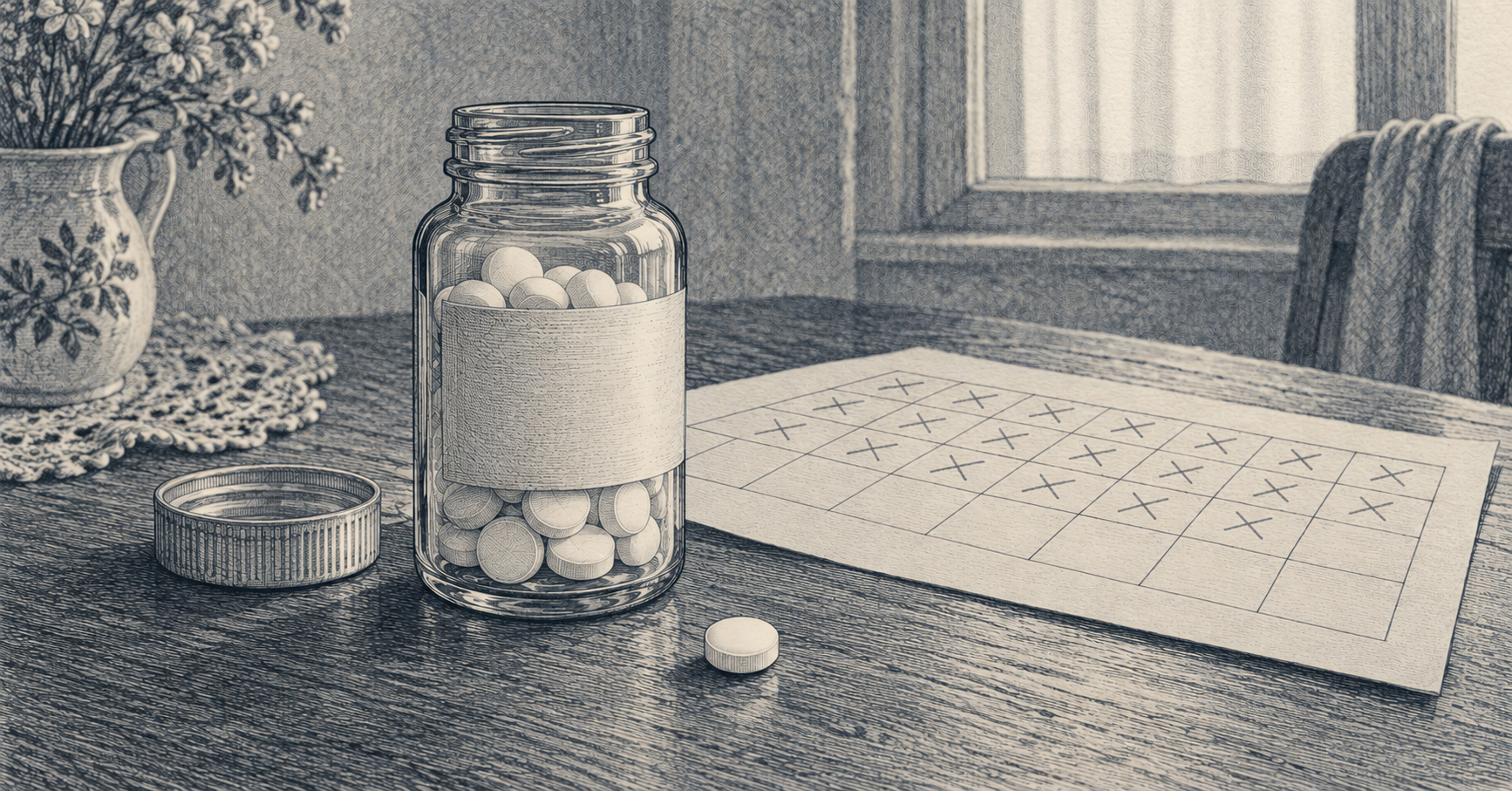
In April of 1956, in a housing project outside San Juan built on the ground of a slum called El Fangito, a woman was handed a bottle of tablets. She was to start on the fifth day of her period and take one a day through the twenty-fourth. Then she stopped, and bled, and began again on day five. That was the whole of it.
The 1958 report of the trial states the regimen in those words: day 5 through day 24.
She was told the tablets would keep her from getting pregnant. By the accounts that survive, she was not told the drug was experimental, or that she was in a trial.
The tablet was Enovid: ten milligrams of a synthetic progestin called norethynodrel, and a small, measured amount of estrogen that had begun as a manufacturing contaminant and stayed because the purer batches caused bleeding between periods.
It was a large dose, and it was given to women who were well. It worked. In the 1958 report, no woman who followed the schedule faithfully conceived.
What the bottle replaced
The bottle makes no sense without the world it walked into. The Comstock Act of 1873 made it a federal crime to mail contraceptive information or devices. Massachusetts, where the drug’s developers lived and worked, forbade the distribution of contraceptives outright, which is why the trial went to Puerto Rico, where birth control had been legal since 1937. Margaret Sanger had opened a clinic in Brooklyn on October 16, 1916, and been arrested for it. What a woman had in 1950 was the condom, the diaphragm, the calendar, withdrawal, and abortion. In Puerto Rico, by surveys of the mid-1950s, about one woman of childbearing age in six had been sterilized.
Sanger was in her seventies when she sat down to dinner in New York, in the winter of 1950 and 1951, with Gregory Pincus, a reproductive biologist at the Worcester Foundation in Massachusetts. She wanted a pill. What she brought Pincus was a patron rather than a laboratory: Katharine Dexter McCormick, a biology graduate of MIT in 1904, who had inherited a fortune in 1947. She visited Worcester in June 1953 and wrote a check for $40,000. Her total over the years is usually put at about two million dollars. Neither national government wanted its name on the work. Britain’s Medical Research Council refused to monitor the drug as too morally sensitive to handle, and when the contraceptive application reached Washington in 1959, with an election coming and a Catholic candidate, neither party wanted to be near it.
The pill was built largely on a widow’s money.
The chemistry came from farther away. On October 15, 1951, in Mexico City, a young chemist named Luis Miramontes, working under George Rosenkranz and Carl Djerassi at a small firm called Syntex, finished the synthesis of norethindrone, a progestin that worked by mouth. In Chicago, at G. D. Searle, Frank Colton made a near relative, norethynodrel, in 1952 and filed a patent in August 1953. Djerassi argued ever after that Searle’s compound turns into his in the stomach, and that Searle’s claim to have worked independently was a misrepresentation. At Worcester, Pincus and his colleague Min-Chueh Chang screened close to two hundred compounds in rabbits and rats and settled on Colton’s. The pill was made in Mexico City and Chicago, and Pincus chose it at Worcester.
The clinician was John Rock, a Harvard gynecologist in his sixties and a devout Catholic. In 1954 he gave oral progestins to fifty women in his Brookline infertility practice, on a theory that resting the ovaries for a few months would let them start again in earnest. Some of those women went on to conceive after they stopped, and the effect got a name, the Rock Rebound. What Rock also found was that ten milligrams of the progestin, or more, stopped ovulation without breakthrough bleeding. That is the dose that went to Puerto Rico.
The count
Río Piedras was run day to day by Edris Rice-Wray, medical director of the Puerto Rico Family Planning Association. The women were married and poor. After a year Rice-Wray reported to Pincus that the pill was fully effective when taken as directed, and that seventeen percent of the women complained of nausea, dizziness, headache, and vomiting. She wrote that the ten-milligram dose produced too many side reactions to be generally acceptable. The trial went on at ten milligrams. Three women in the trials died, by the accounts historians rely on, and no autopsies were done; whether the drug had anything to do with the deaths was never known.
When Pincus, Rock, Rice-Wray and their colleagues published the trial in the American Journal of Obstetrics and Gynecology in 1958, they were honest about the dropouts. They had calculated that troublesome symptoms would drive off about twenty-seven percent of the women over eighteen cycles; eighteen percent had actually quit. They reported that among the women given an antacid, eighty-two percent said their reactions went away. In the file the FDA assembled over the next two years, American physicians reported that at least a fifth of their patients had nausea, that it did not necessarily go away, and that antacids were worthless. Both were said to the same agency within two years of each other. Different women, different doctors, different questions asked, and I have no way to reconcile them; I note only that one report came from the drug’s investigators and the other from physicians with no stake in it.
By then the drug was already on the market. The FDA had approved Enovid on June 10, 1957, for menstrual disorders and infertility. Searle’s application did not mention contraception; a letter to physicians the following month noted that the drug would inhibit ovulation. Searle’s early advertisement showed Andromeda freed from her chains. McCormick called the menstrual indication a stepping stone and thought it a very happy course of procedure. By 1959 more than 500,000 American women had taken Enovid for their periods.
The contraceptive application went in that autumn, twenty volumes of data, the largest the agency had ever received. The FDA had three full-time physicians to review all new drugs. The reviewer assigned to Enovid, a Dr. DeFelice, was an obstetrician still finishing his residency. He sent a questionnaire to seventy-five gynecologists at the medical schools and interviewed Edward Tyler of Planned Parenthood in Los Angeles, who had reported serious reservations in 1958 and now said they were laid to rest. The application rested on 897 women, 801.6 woman-years, 10,427 cycles. The FDA judged the drug approvable on May 9, 1960, and signed the approval on June 23. The date most histories give is the announcement. The labeling limited a prescription to two consecutive years, as a safeguard while longer studies ran, and physicians were free to ignore it, and women switched doctors and brands to get around it.
One decision in that file had a cost of its own. Searle had asked to approve three strengths at once: ten, five, and two and a half milligrams. The FDA, worried that the lower doses caused breakthrough bleeding and might not be suppressing ovulation, required the ten-milligram dose to be approved first and the others to follow. The five-milligram pill did not reach American women as a contraceptive until 1961. Britain, which had no premarket approval for new drugs and a Family Planning Association that ran its own trials, went the other way: it released the five-milligram Conovid first, and the ten-milligram tablet was never prescribed there for contraception at all. American women took twice the dose for a year, partly because of the order in which the applications were filed and partly because the agency was not yet sure the lower dose worked.
The price in 1960 was fifty to fifty-five cents a tablet, ten or eleven dollars a month. By the end of 1964 more than four million American women had used Searle’s pill, and by 1965 some 6.5 million were on one pill or another. The Supreme Court did not strike down Connecticut’s ban on contraception for married couples until June 7, 1965, and unmarried women waited for Eisenstadt v. Baird in March 1972, years after most of them had already found a doctor who would write the prescription.
Blood
In November 1961, in the Lancet, a British physician described a nurse in her forties taking twenty milligrams of Enavid a day for endometriosis who had thrown clots to both lungs. The authors put it down to dehydration. In December the FDA’s Los Angeles office called Washington about two deaths. In January 1962 DeFelice wrote that he was inclined to agree with the company that the deaths had occurred in women who only happened to be taking Enovid. By August the agency had twenty-six reports of clots, six of them fatal. In September Searle convened a conference; the count was 132 cases and nine deaths. On November 29 an FDA physician named Heino Trees wrote to the commissioner that the rising deaths among healthy women in their early twenties had confirmed his opinion that the drug was a cause. By then thalidomide had broken, and for a time the pill was a footnote to the worse story.
I have read the summary of the 1958 trial report more than once, and there is a line in it I keep returning to. Under “Blood Studies,” between the hemoglobin and the side effects, the authors record that bleeding time was significantly shorter in the medicated women than in controls, and that clotting time in the women after medication was significantly less than in either group. It is stated and, in the summary, not remarked on. My reading — and it is a reading — is that the authors recorded it because it was there and left it because they had no use for it, and that nobody in the trial was set up to find out what it meant. I cannot show that anyone looked at that line and looked away. I can show that the line is there, and that the first published report of a death from a clot in a woman on the drug came three years later.
The FDA’s ad hoc committee in 1963 found twelve thromboembolic deaths per million users against 8.4 expected and called the difference not significant. The agency’s advisory committee in 1966 found no basis for withdrawal. The answer came from Britain. A preliminary report from the Medical Research Council pointed the way in 1967. On April 27, 1968, the British Medical Journal published two papers. Inman and Vessey traced the deaths; Vessey and Doll matched women hospitalized with clots against controls and concluded that oral contraceptives were a cause of the disease. In their follow-up the next year, of eighty-four women admitted with venous thrombosis or pulmonary embolism, forty-two had used the pill in the month before, against twenty-three of 168 controls. The British committee’s estimate of the cost was about 1.3 deaths per 100,000 users a year at ages twenty to thirty-four, and 3.4 at thirty-five to forty-four. In 1970 Inman’s group showed that the risk rose with the estrogen dose. Britain had already advised, in December 1969, that doctors should normally prescribe pills with no more than fifty micrograms of it. The FDA recommended the lowest effective dose from 1970, and most American prescriptions had moved below that line by the mid-1970s, but the products above it were still being sold in 1988. About 400,000 American women were taking them that spring, when the makers agreed to stop shipping them after October 31.
The hearings
Barbara Seaman’s The Doctors’ Case Against the Pill came out in 1969. Some of its claims rested on anecdote; its central claim, that women were not being told, rested on the record. On September 23 she wrote to Senator Gaylord Nelson of Wisconsin. Nelson opened hearings on January 14, 1970, and they ran into March. Every witness in the first round was a man. No woman who took the pill was on the agenda. Of everyone who testified, four were women, and the first, Dr. Elizabeth Connell, did not appear until February. On January 23, during the testimony of Philip Corfman of the National Institutes of Health, Alice Wolfson and the women of DC Women’s Liberation stood up in the gallery and asked why. Nelson cleared the room. Outside, the placards said to feed the pill to the guinea pigs at the FDA and not to living women. A Gallup poll taken while the hearings ran found that two-thirds of pill users said their doctor had never told them of any risk, and that about a fifth had stopped.
What the hearings produced was a piece of paper. On June 11, 1970, the FDA required that a warning go into every package of oral contraceptives. Elizabeth Siegel Watkins, the historian of the insert, calls the proposal revolutionary because it made the drug speak to the patient rather than the physician: since 1938 the doctor had controlled how much a patient understood about her own treatment, and now a leaflet went around him. By the accounts that draw on Watkins, the first draft ran about six hundred words and named the conditions that should keep a woman off the pill; the American Medical Association objected that it would undermine the relationship between doctor and patient, the drug makers objected, and the card that shipped that year was seven sentences long, about half of them telling the woman she could ask her doctor for the longer version.
Here is the case the women in the gallery began to make in 1970, carried forward with what has been learned since, and it should be allowed to stand. The drug was tested on poor women in a colony who were not told they were in an experiment. It was approved on data presented in cycles and woman-years, which made the trials look larger to the public than the count of women would have; the historians call that an increase of scale and decline to call it a distortion. It was sold for a year at twice the dose its maker thought sufficient, because of a filing order. A shortened clotting time, in women who had stopped the drug, was recorded in the first trial report. The dead were reported in 1961, the association was shown in 1968, the estrogen dose came down in Britain in 1969, and the makers of the last high-estrogen products in America did not stop shipping them until 1988. The people who approved it, sold it, and ruled on it were men, and so, with a handful of exceptions, were the people who prescribed it and testified about it. None of them bled. Junod and Marks, who read the whole FDA file, conclude that the approval was as stringent as the standards of its day allowed, and that the lawsuits against Searle failed. Both are true. An evaluation can be correct by every measure of its time and still be an experiment on the people who were never properly asked.
Rome
The hearings were the country’s argument with the drug. The Church’s had been running longer. John Rock had a different hope for the drug. He was a Catholic who took his religion seriously, and in 1963 he published The Time Has Come, arguing that the pill was a licit variant of the rhythm method the Church already permitted: it used the body’s own hormones to put the ovaries to rest, as pregnancy itself does. Pope John XXIII had appointed a commission on birth control; Paul VI enlarged it. In 1966 the commission’s majority recommended that the teaching change, and in April 1967 the National Catholic Reporter printed the report. On July 25, 1968, Humanae Vitae answered no. Within the week several dozen theologians led by Charles Curran at the Catholic University of America signed a public dissent, and hundreds more within a month; in Washington, Cardinal O’Boyle disciplined some forty priests who told their parishioners to follow their consciences, nineteen of whom fought their suspensions. Rock died on December 4, 1984, at ninety-four. He had spent years arguing that his Church could accept the drug, and it did not accept it.
Whether the pill caused the sexual revolution is the question everyone asks and nobody can answer. Watkins, whose book is the standard account of the drug’s first twenty years, argues that it did not: that the change in conduct was under way already and the press fused the two. I find her persuasive. The question is open. What the record does show is smaller and stranger. Before 1960 most contraception in America was bought, not prescribed. After 1960 the most effective method was prescribed, and only prescribed. A healthy woman who wanted that method now needed a physician’s permission and a return visit every few months, and the physician now held the information about what the drug was doing to her. That is the medicalization the critics mean, and it was real, and it is one of the places the women’s health movement came from.
What remains
What remains is the count. Sixty-six years on, by the United Nations’ count in 2019, some 150 million women in the world take a tablet each day, and count. The bottle became a pack, the doses came down to a fraction of the first, the risk of a clot is now stated on the paper inside, and a 2017 Danish study put the excess in breast cancer among current or recent users of hormonal contraception at about thirteen cases a year in every 100,000. Women still bear the risk. They also still choose it.
It cannot be undone, and most of us would not undo it. That is the bargain medicine made.
The next drug in this series began as a poison off a battlefield. It was given on purpose, and some of the first who received it were children.
* * * * *
CHARLES CRANSTON JETT is an author, civic educator, and Professional Certified Coach based in Chicago. A graduate of the U.S. Naval Academy (Class of 1964) and Harvard Business School, he served during the Cold War as an officer aboard nuclear submarines. He is the author of six books, including Super Nuke!, hosts four podcasts, and writes across his Critical Skills Blog platform on history, leadership, and the health of the American republic. In his writing he employs AI tools in a limited, supporting role for research, occasional image creation, and editing, while the prose and judgment remain entirely his own. He and his wife, Dr. Nancy Church, live and co-host the Chicago Salons at Water Tower Residences.



Leave a Reply