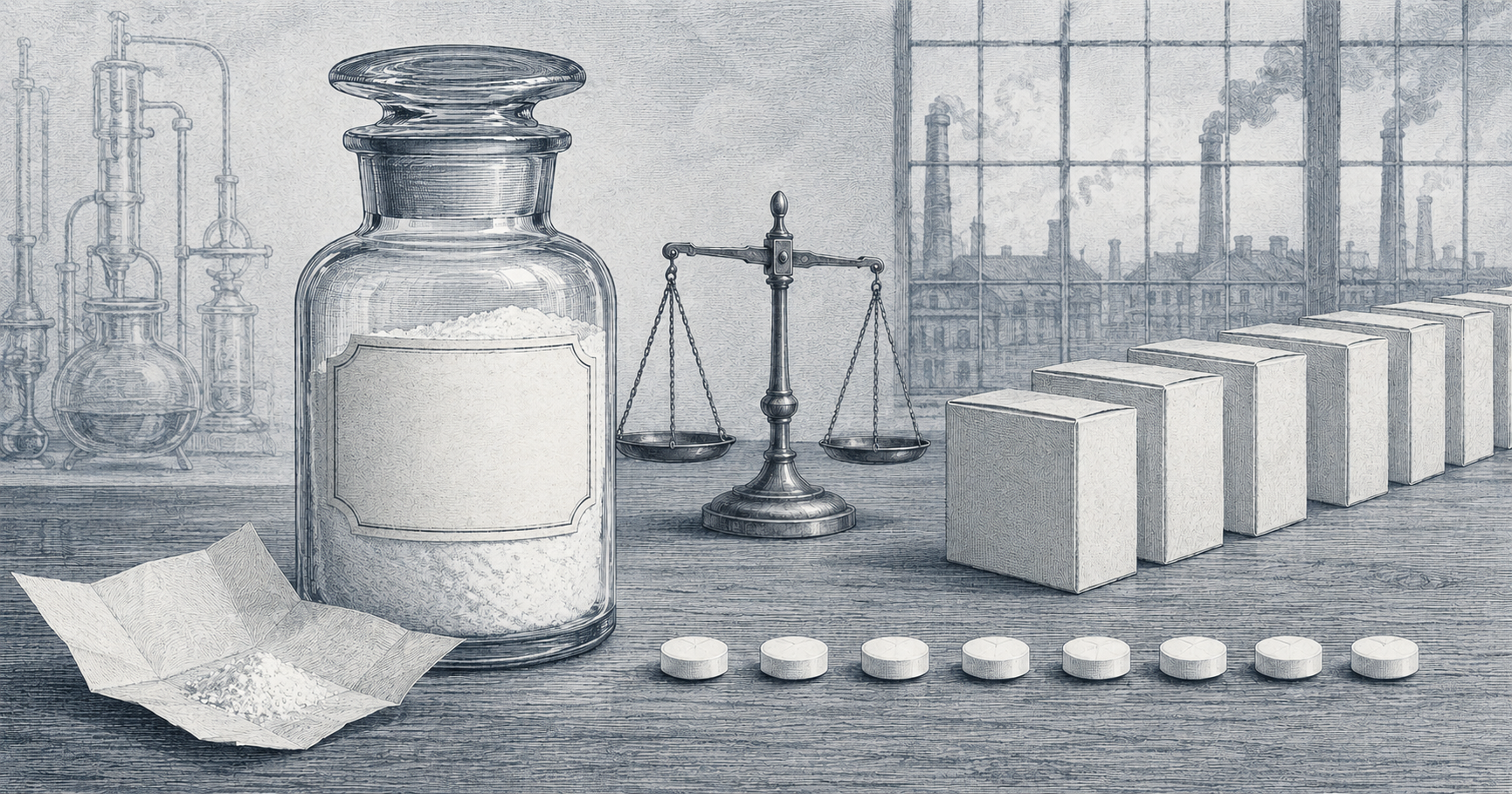
The branding worked so well that Bayer lost the word.
Elberfeld, 1897 — the two weeks that made the pharmaceutical industry.
In a single fortnight in the summer of 1897, a chemist at the Bayer works in Elberfeld acetylated two molecules.
One was salicylic acid.
The other was morphine.
The first became aspirin. The second became heroin, and Bayer registered that trademark first — nine and a half months ahead of the other one. Both came off the same bench, by the same method, in the same fortnight, from a laboratory screening five or six hundred compounds a year for something to sell.
That is this story in miniature. The industry being invented in that room would give the world its most useful drug and its most destructive one, and it had no way of telling them apart.
The salicylic acid came first.
On August 10 the notebook records pure, stable acetylsalicylic acid, and the closing line of the entry is almost apologetic: the new compound has an acid taste but no corrosive action, and is being examined with that in mind. That was the entire advance. It was enough.
Willow bark had eased fever since antiquity, and by the 1870s a factory at Radebeul was turning out salicylic acid by the ton — the first industrially produced drug in the world, twenty-five years before aspirin. The chemistry was solved. The problem was the patient. Sodium salicylate worked on rheumatism and burned the stomach, rang in the ears, and tasted foul enough that physicians watched patients decide the rheumatism was preferable. Hanging an acetyl group on the molecule fixed the taste and spared the gut. Nothing about the disease changed. What changed was whether a person could stand the cure.
Nobody at Bayer was sure it mattered. Heinrich Dreser, who ran the pharmacological laboratory and drew royalties on German sales of the drugs he approved, tested it and rejected it, holding that it weakened the heart. The compound sat on a shelf for more than a year, rescued only because Carl Duisberg raised it again at a division meeting in November 1898 and ordered an independent check. The most consequential painkiller in the history of medicine was very nearly shelved by the man paid to judge it, on a physiological objection that was simply wrong.
Then there is the question of who made it, which has not been settled and probably cannot be.
Bayer’s account names Felix Hoffmann, working to relieve his rheumatic father. That story first appears in print in 1934, in a footnote to a history of chemical engineering written by Albrecht Schmidt, a chemist newly retired from I.G. Farben. No document before that date attests to the father’s illness. In 1949 Arthur Eichengrün, who had joined Bayer in 1896 and whose job was to originate products, published his own account: that he had directed the synthesis, that Hoffmann executed his chemical instructions without at first knowing their object, that he took the compound himself when Dreser rejected it and arranged clandestine clinical testing through a physician in Berlin. He died that December. In 2000 Walter Sneader reviewed the record in the BMJ and judged Eichengrün’s version the more reasonable one. Bayer rejects it still.
What strikes me about both cases is that each side holds a piece the other cannot dislodge.
Bayer’s is the paper. Hoffmann’s laboratory journal is in the archive at Leverkusen in his own hand, and the American patent granted in 1900 names him sole inventor — thirty-four years before Schmidt’s footnote. Bayer adds that the two men were colleagues of equal rank, which if true removes the foundation of the claim, and that Eichengrün said nothing for fifty years. That is the strongest point against him: he lectured on Bayer’s chemistry in 1912 and wrote a chapter for the company’s jubilee volume in 1918, and in neither did he claim the drug.
Eichengrün’s piece is the dates. The Daily Mail named him as aspirin’s inventor in December 1910 — a quarter-century before Schmidt, and thirty-nine years before he made the claim himself, by a paper he had no hand in. And his account does not begin in 1949. It exists in a typed letter written in 1944 and preserved in Bayer’s own archive, composed when he was seventy-six and interned at Theresienstadt, where he had been sent for failing to sign a document with the middle name the state required Jewish men to use. In that letter he describes visiting the Deutsches Museum in Munich and finding a showcase crediting aspirin to Dreser and Hoffmann, beside a sign forbidding entry to non-Aryans.
So the silence Bayer holds against him has an explanation, and the explanation is 1934.
Whomever conceived it, I do not know. Historians who have worked the archive are split; the Bavarian state biography suggests it may have been joint work. What can be said is narrower and still damning: the account the world believed for sixty-six years entered the record in the year German institutions were purging Jews from their own histories, written by a man who had just retired from the firm, in a footnote, about an illness for which no evidence exists.
The name came in January 1899, by internal circular — a for the acetyl group, spir for Spiraea, the meadowsweet. In March it went into the trademark register in Berlin. It did not go into the patent register: the Imperial Patent Office refused a German patent on the grounds that the step beyond what Gerhardt and Kraut had already done was not big enough. In its home market Bayer therefore owned the name and not the molecule, which turned out to be a lesson about where value lives.
The drug went out as powder, to physicians and druggists. That mattered enormously at the time. Ethical drugs were sold to the profession; proprietary medicines were hawked to the public, and the difference was the difference between medicine and quackery. Bayer’s launch was conspicuously the former.
That held until October 1915, sixteen months before the American patent ran out. Then the company began selling to the public under its own name, and the labels read Bayer — Tablets of Aspirin.
A woman with a headache could walk into a store, buy a tin, and know whose factory it came from. She had a relationship with a manufacturer she would never see and would trust for the rest of her life. Everything the pharmaceutical industry does now rests on that relationship.
It cost them the word.
The patent expired in February 1917 and more than two hundred tons of competitors’ acetylsalicylic acid entered the American market as aspirin. Bayer sued. Then the war took the company: its American assets were seized under the Trading with the Enemy Act, and in December 1918 the plant, the name, the cross, and the trademarks were auctioned at Rensselaer for five and a third million dollars to Sterling Products — which is why the German firm could not use its own name in America for seventy-six years. The popular account credits the Treaty of Versailles. Versailles made the seizures permanent; it did not kill the trademark. That happened in a courtroom.
Judge Learned Hand decided it in April 1921, and he divided the question by market in a way that reads like a verdict on advertising itself. Chemists, physicians, and druggists had always known that Aspirin meant Bayer’s manufacture, and against them the mark held. Consumers had known no such thing. From 1904, when tablets first reached them, until 1915, they had bought the drug under one word only, with no other name available for the thing in their hands. They had been taught it as the name of a drug, and among the general public, Hand wrote, the name had gone into the public domain.
The branding had worked too well. It taught a hundred million people a word, and the word walked away.
For seventy-four years no one knew what the drug did. Then in 1971 John Vane showed that aspirin blocks the synthesis of prostaglandins, and a folk remedy became a mechanism; he took the Nobel in 1982. The same mechanism at lower dose keeps platelets from clumping, and platelets, lacking a nucleus, cannot undo it. In January 1988 the Physicians’ Health Study was stopped early: among twenty-two thousand doctors, those taking 325 milligrams every other day were having 44 percent fewer first heart attacks. A powder sold for headaches since McKinley was president had become a cardiac drug.
Then the accounting, in two instalments.
The first was the children. Aspirin had lived in the pediatric medicine cabinet for three generations when case-control studies in Ohio and Michigan found salicylates in nearly every child who developed Reye’s syndrome. At the Surgeon General’s advisory in 1982 the burden was put at six hundred to twelve hundred cases a year, and between a fifth and a third of those children died. The warning label was required in 1986. Cases fell to thirty-six the next year, and twenty the year after. There is no comfort in the arithmetic: the harm had run for decades in plain sight, inside a product every mother trusted, and it stopped almost the moment anyone was told.
The second instalment came for the adults. In 2018 three trials reported within months of one another that in people without established heart disease the benefit was small or absent and largely cancelled by bleeding — and in the oldest cohort, those on aspirin died at a slightly higher rate than those who were not. In 2022 the Preventive Services Task Force advised against starting it after sixty. Millions of people who had taken a tablet every morning for twenty years, on their doctors’ advice, learned the advice had been withdrawn.
The drug never changed. Statins, blood-pressure control, and the long retreat of the cigarette lowered the baseline risk until aspirin’s small benefit no longer cleared its unchanged cost. Medicine improved around it.
That is the least satisfying kind of reversal, because no one was wrong and the bottle still has to come off the shelf.
A tablet costs a penny and carries a cross pressed into its face. Behind it stands an industry of laboratories and patents and marketing departments, called into being by a dye works in Elberfeld on the day it decided the patient, and not only the physician, was its customer. That decision put a reliable painkiller in every house on earth. It also built the apparatus that would price insulin out of reach and sell OxyContin as barely addictive. The same reach did all of it, and it always could.
It cannot be undone, and most of us would not undo it. That is the bargain medicine made.
Thirty years after the Bayer Cross was first pressed into a tablet, a Scot came back from holiday to a dish he had forgotten to clean.
That’s the next one . . . #13. See you then.
* * * * *
Charles Cranston Jett is an author, civic educator, and Professional Certified Coach based in Chicago. A graduate of the U.S. Naval Academy (Class of 1964) and Harvard Business School, he served during the Cold War aboard nuclear submarines. He is the author of six books, including Super Nuke!, hosts four podcasts, and writes across his Critical Skills Blog platform on history, leadership, and the health of the American republic. In his writing he employs AI tools in a limited, supporting role for research, occasional image creation, and editing, while the prose and judgment remain entirely his own. He and his wife, Dr. Nancy Church, live and co-host the Chicago Salons at Water Tower Residences.

Leave a Reply