London, 1928 — the drug nobody could make, and the warning nobody heard
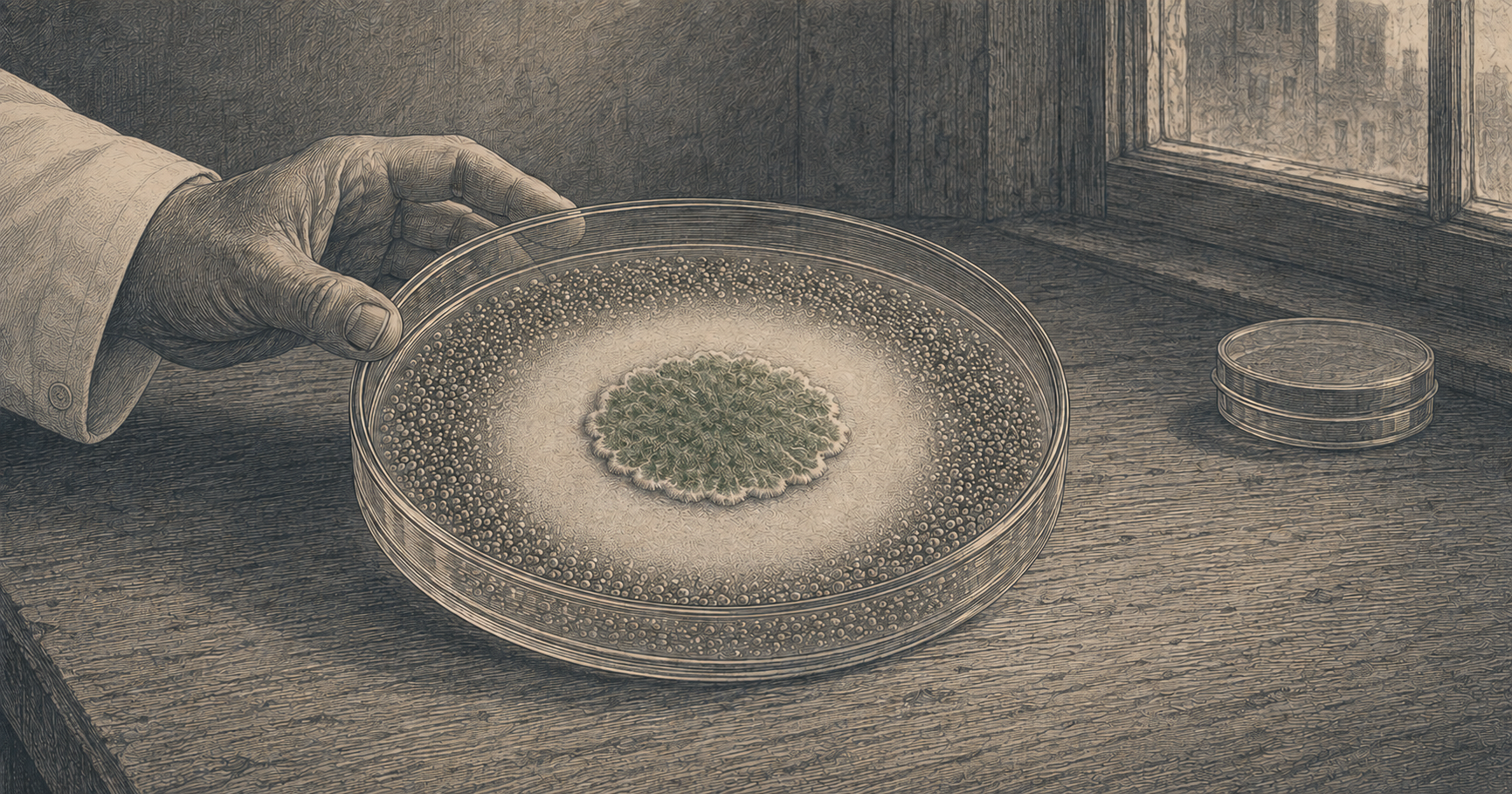
The story is that a Scot came back from holiday in September 1928, found a culture plate he had left unwashed, and saw that a blue-green mould had killed the staphylococci around it. He saw it. He wrote it down. Then, for ten years, it went nowhere.
The ten years are the story. Everything we believe about discovery — that the seeing is the hard part, the rest detail — dies in them.
Before penicillin, a cut was a wager. Staphylococcus in the blood killed about four people in five. Endocarditis killed all of them. Meningococcal meningitis, before serum therapy, killed six in ten. Osler, in the textbook that trained a generation, called pneumonia a self-limited disease whose course was uninfluenced in any way by medicine.
He was not being modest. He was being accurate.
What a physician did was watch. Take the temperature and chart it, change the compress, sit with the family, and wait to see whether the body would win. The bedside manner we remember as the soul of old medicine was in large part the etiquette of helplessness. It was what you had when you had nothing.
Something did work, a little. The sulphonamides came out of German dye chemistry in the mid-thirties and pulled the death rate down in pneumonia and childbed fever, and Gerhard Domagk took the Nobel Prize for them in 1939, six years before Fleming — his government forbade him to accept it. But the sulphonamides were built in a factory. Penicillin was made by a fungus, out of chemistry nobody had designed, and when a word for the class had to be coined it was defined by origin: a substance made by one microbe and destructive to another.
Fleming named the substance in March 1929 and published that June.
Then he hit the wall he never got past. He could not purify it. It came apart in the flask. Harold Raistrick, a leading industrial biochemist, tried and gave it up as almost impossible to produce for therapy. Fleming never tested penicillin in an infected animal, and never argued for using it on anything deep-seated. In his own paper the use he emphasised was clearing unwanted bacteria off a plate so you could isolate the ones you wanted. He told a colleague it was too unstable, that it needed purifying, and that he could not do it alone.
He was right. That was as far as he took it.
Someone else did not. In Sheffield in the winter of 1930, a young pathologist named Cecil Paine got a sample of the mould from Fleming, who had taught him, and dripped the crude filtrate into the eyes of two newborns with infections that would have blinded them. Both cleared. Of five eye cases he treated, four came right; three infected beards failed. He published none of it. The case notes sat in a Yorkshire records room until two historians went looking in 1986 and found the earliest surviving clinical record of penicillin therapy.
Oxford picked it up in 1938. Howard Florey ran the Dunn School; Ernst Chain read the 1929 paper and saw a chemistry problem where Fleming had seen a dead end. Norman Heatley built the machinery — an assay to measure what they had, and a rig to keep it. On 25 May 1940 they gave eight mice a lethal dose of streptococci and treated four of them. Heatley stayed until half past three in the morning. The four untreated mice were dead. The four treated mice were well.
They had to make it in a country under bombardment, out of whatever was to hand — baths, milk churns, food tins, and finally ceramic vessels Heatley modelled on the Radcliffe Infirmary’s bedpans. Six young women tended the cultures for two pounds a week. Two thousand litres of broth treated one patient, and the powder was under one percent pure.
The first case of the kind the drug had been built for was Albert Alexander, a police constable of forty-three whose face had been laid open in a German air raid that November and who was dying of the infection in it. They gave him two hundred Oxford units on 12 February 1941. His fever broke within a day. His appetite came back. The abscesses began to close. Then the supply ran out. They collected his urine and pulled the drug back out of it to stretch what was left, and it was not enough. He relapsed and died on 15 March, and the post-mortem found staphylococci throughout him. Penicillin brought him back and then let go of him, for no reason except that there was not enough of it.
A year later and an ocean away, Anne Miller lay dying of streptococcal blood poisoning at Yale after a miscarriage, and a large share of the American supply was flown to New Haven. Her fever fell within two days. She lived another fifty-seven years and died in 1999.
She got enough of it.
Albert Alexander did not.
I have to say something about the dish, because the more I read the less I believe the version I was taught. The traditional date is 3 September. Fleming himself once gave 28 September. The earliest firm entry in the notebook is 30 October, and that entry does not describe an accident — it describes an experiment built on purpose, the mould grown first and the bacteria streaked toward it. Ronald Hare later worked out that the effect reproduces only if the plate was contaminated before seeding and then held cool for days; he checked the London weather and put the seeding at the end of July. The pages that would settle it are missing. My reading is that a real observation was made in an untidy room and was afterward smoothed into a parable, by people who wanted the parable more than they wanted the record.
The parable had its uses. In August 1942 a patient of Fleming’s recovered from meningitis on Oxford’s penicillin , and The Times reported the cure without naming anyone. Almroth Wright wrote on 31 August to say the credit belonged to Fleming, and reporters were waiting at St Mary’s the morning it ran, tipped off in advance; the scholarship implicates the dean, Charles Wilson, later Lord Moran. Florey had forbidden his team to speak to journalists, and the vacuum filled without him. In June 1944 he complained to Edward Mellanby of a deliberate and clever campaign, and laid it at Moran’s door. By then Fleming was on the cover of Time. He called his own fame the Fleming Myth. Heatley got no Nobel — the statutes cap it at three — and Oxford gave him an honorary doctorate fifty years after the mice.
The scale of it was American. Florey and Heatley flew to the United States in July 1941 with the mould in a suitcase, and a government laboratory in Peoria, Illinois broke the yield problem in four months. Corn steep liquor, a waste product of the local starch mills, raised the yield tenfold. Deep tanks, stirred and aerated, made it industrial. The best strain the survey found was growing on a cantaloupe in a Peoria market. American output went from twenty-one billion units in 1943 to more than sixteen hundred billion in 1944, and the price of a dose fell from twenty dollars in 1943 to fifty-five cents by 1946. By the Normandy landings there was enough.
Oxford patented none of it. Chain wanted to; he had been trained in Germany, where the science and the industry occupied the same building, and saw no virtue in giving it away. Florey held that a medicine should belong to everyone; Sir Henry Dale came from London to call patenting it unethical, and Mellanby at the Medical Research Council closed the argument. The Americans patented the processes instead — the growth medium, the tanks, the strain — and after the war British firms paid royalties to American ones to make a British discovery at scale. Fleming asked in public why something given free to humanity should become a profit-making monopoly in another country. Chain, twenty years on, said flatly that without a pharmaceutical industry there are no new drugs.
Both of them were right.
The war also handed penicillin the venereal diseases, and that made trouble the laboratory had not anticipated. Syphilis had been treated with arsenic since 1910 and with bismuth alongside it from the twenties, a course running a year or more that poisoned the patient along the way; in 1943 four men were cured of it in eight days. Wartime posters promised gonorrhoea gone in four hours. Churchmen and some physicians objected that removing the consequence would remove the restraint, and that a disease which had always passed a verdict on the man who caught it would now pass none. They were describing something real. It is also an argument for leaving a man his infection, and it was made.
In the last days of 1940, six weeks before penicillin was first put into a human vein, Abraham and Chain published a note in Nature describing a bacterial enzyme that destroyed it. Penicillinase. A way out was in print before the first injection was given. Nobody concealed it. It troubled no one enough to slow anything down, and on the evidence of 1940 it should not have.
Fleming was troubled by it. The day after accepting the Nobel Prize, in his lecture of 11 December 1945, he told the hall that the danger lay in giving too little — that microbes are easily taught to resist penicillin by doses too weak to kill them, that the day would come when a man could buy it across a shop counter, dose himself lightly, breed a resistant strain, and pass it to his wife, who would die of a treatable disease. He named the mechanism, the market and the corpse, in the year of the triumph, to a hall that had come to applaud.
Penicillin was sold over the counter in the United States until 1951. Penicillin-resistant Staphylococcus aureus was rare in hospitals in 1944; within six years it was a quarter of hospital strains, and by the mid-sixties it was the great majority of hospital blood isolates.
What endures is everything standing on top of it. Surgery, transplantation, chemotherapy, the ordinary childhood that no longer ends in a fever — all of it assumes a bacterial infection is a thing that can be stopped. A man cuts his hand and goes home.
It cannot be undone, and most of us would not undo it. That is the bargain medicine made.
Fleming’s Mr. X bought his penicillin, dosed himself lightly, and went home.
He has been doing it for eighty years.
* * * * *
CHARLES CRANSTON JETT is an author, civic educator, and Professional Certified Coach based in Chicago. A graduate of the U.S. Naval Academy (Class of 1964) and Harvard Business School, he served during the Cold War as an officer aboard nuclear submarines. He is the author of six books, including Super Nuke!, hosts four podcasts, and writes across his Critical Skills Blog platform on history, leadership, and the health of the American republic. In his writing he employs AI tools in a limited, supporting role for research, occasional image creation, and editing, while the prose and judgment remain entirely his own. He and his wife, Dr. Nancy Church, live and co-host the Chicago Salons at Water Tower Residences.


Leave a Reply