
Two rivals, one town, and the morning of a whole country.
This is the seventeenth profile in The City That…, a series about American cities that invented an industry, led the world in it, and then watched the center move on. We tell their stories plainly and with affection — what they made, what it cost, and what they still are.
The Founding: Advent Town and the Flake
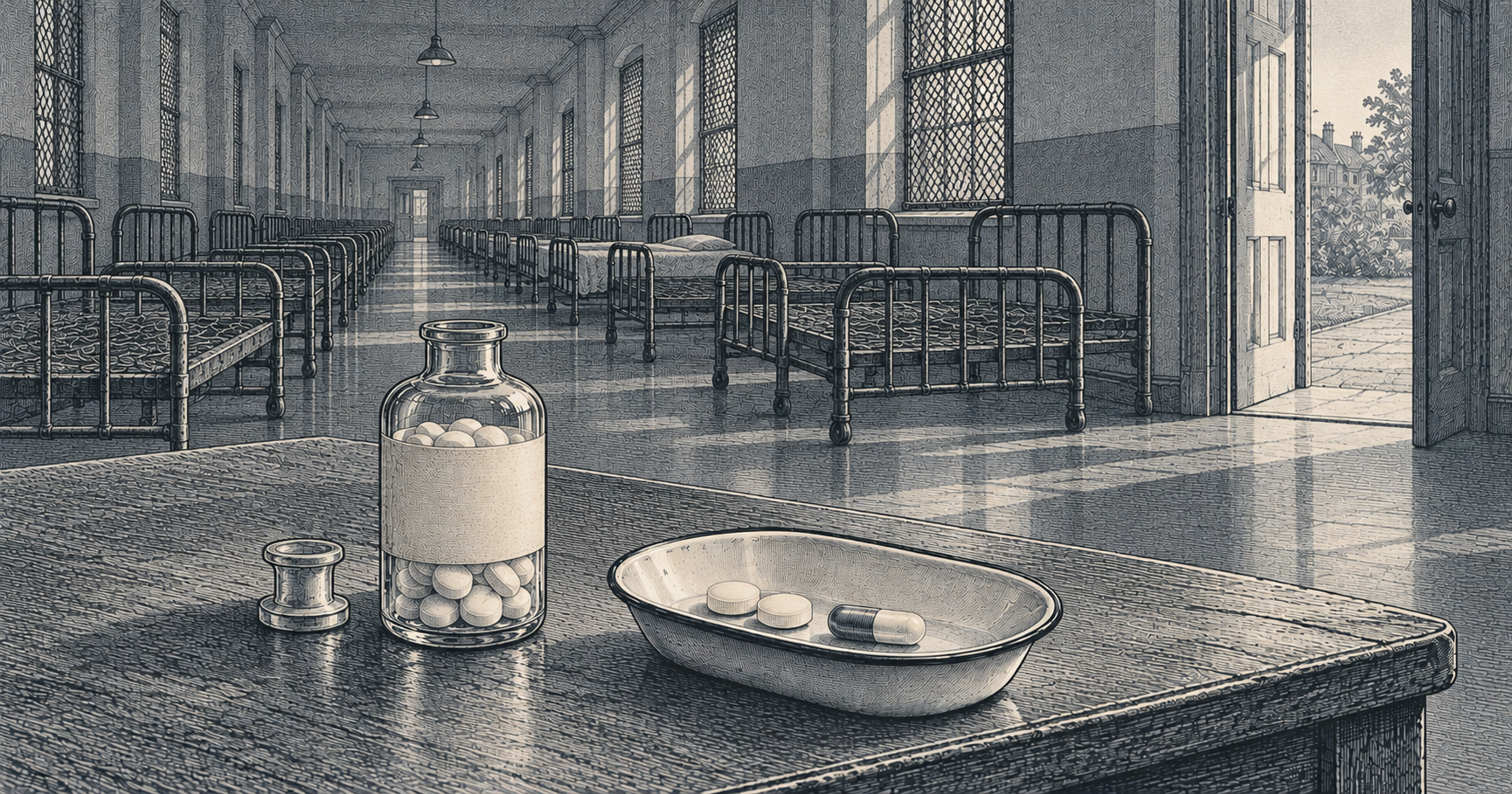
The Adventists got there first. They organized their church in Battle Creek in May 1863 and people called the place Advent Town. In 1866 they opened a health institute on eight acres: two physicians, one bath attendant, one patient. In July 1876 they handed it to a young doctor fresh from Bellevue. John Harvey Kellogg renamed it the Sanitarium and ran it for the rest of his working life. The town already made threshers and steam pumps, so a cereal factory would be a short walk from a thresher shop.
The Sanitarium fed its patients grain, and the grain was hard to eat. In 1894, in the experiment kitchen, a batch of cooked wheat stood longer than anyone intended and came through the rollers as separate flakes instead of a smear. Toasted, they were crisp. They called it Granose.
Kellogg filed for a patent that May; 558,393 issued the following April: Flaked Cereals and Process of Preparing Same.
That patent is the founding document of the American breakfast, and it is worth saying what it does and does not establish.
It names one inventor, John Harvey Kellogg. His brother Will, who managed the institution and worked its kitchen, is not on it. And the story the country knows — the batch forgotten over a weekend, the answer arriving in a dream — appears in no document from the 1890s. No notebook, no laboratory log, no diary. The version everyone quotes was printed in 1925, thirty years late, relayed by a friendly writer in a national magazine. Gerald Carson, working the company files and the court testimony, found four different people credited with turning the rollers that morning.
The process is documented. The scene is not. The only account given under oath is Will’s, in his brother’s 1916 lawsuit, and it says merely that they were in it together.
The rival was already inside the building. In February 1891 a broken Illinois businessman named Charles William Post arrived in a wheelchair, paying his bills for months with blankets salvaged from a failed Texas mill. He got well. On the first day of 1895 he brewed a grain coffee substitute in a white barn and painted the date on the wall. He called it Postum, and Grape-Nuts followed within three years.
The Height: One Town, Two National Breakfasts
Will bought the corn flake business out from under his brother’s institution and incorporated in February 1906 with $225,000 in capital stock and $35,000 in actual cash. The first plant made thirty-three cases a day. It burned down on the Fourth of July, 1907. Will called it an old fire trap and had the replacement running by January at four thousand two hundred.
What followed was a rush, and the tally depends on what you count. Forty firms were manufacturing at the 1902 peak; eighty names were registered across the boom; by 1911 there were a hundred and eight brands of corn flakes alone. Vim, Korn-Krisp, Per-Fo, Malta-Vita, Egg-O-See. Most lasted about as long as it takes to read them.
Then consider two billboards. Kellogg’s said it was the largest manufacturer of ready-to-eat cereals in the world. Postum’s said it was the largest producer of ready-to-eat cereals in the world. They stood in the same town at the same time, where a man walking to his shift could read both in a single morning. Neither sued. Neither corrected the other. A manufacturer and a producer are the same thing everywhere on earth except on those two boards, where the difference was worth exactly one word, and the town went on making both companies’ cereal and reading both claims and declining to settle which was true. That is the whole rivalry, standing at the roadside, arguing over a noun.
The scale was real. The Federal Trade Commission found that every ready-to-eat cereal General Foods sold in America was made in Battle Creek, and that Kellogg made it nowhere else until 1939. Two national breakfasts, one town. As late as 1977 more than half the cold cereal in the country came from three plants there.
The town’s most remarkable invention was not a cereal. On 1 December 1930 Will Kellogg replaced three eight-hour shifts with four six-hour ones, to put paychecks in the hands of three hundred more families. Workers went home at three in a decade when nobody went home at three, and they gardened, canned, kept up with their children’s schools, hunted, fished, played ball. It was not free. Daily pay fell about fifteen percent, and a Women’s Bureau study of the payroll books found seventy-seven percent of workers sampled taking home less each week. The hours were a gift and the workers paid for much of them. Management dropped the schedule after the war; those who fought longest to keep it, into the 1980s, were women.
The Turn: Consolidation, Ultimatum, and Sale
The boom collapsed nearly as fast as it rose. Twenty cereal companies incorporated in 1901; eighteen dissolved by 1906. Kellogg and Post are the pair everyone remembers, and they earned it, but a third producer lasted ninety-two years: Ralston Purina bought the Armor Grain plant in 1927 and made Chex there until 2019.
Post’s exit was quiet. C. W. Post died by his own hand in May 1914, and by 1929 the company had bought so many other brands that it renamed itself General Foods and answered to New York. Kellogg’s was slower and louder. In May 1982 the chairman gathered Battle Creek’s elected officials and told them to merge the city with the surrounding township or the company would take its headquarters elsewhere. Opponents called it corporate blackmail. Voters approved it that November.
Then the retrenchment. Eight hundred jobs gone in 1995. The Porter Street South Plant, called the largest cereal plant in the world when it closed, shut in 1999, the work going to Mexico. A seventy-seven-day strike across all four American plants in 2021. In 2023 the company split in half, snacks to Chicago and cereal staying home, because snacks outsold cereal nearly five to one. Then in fifteen weeks both halves went abroad: cereal to Ferrero of Italy in September 2025, snacks to Mars in December.
What Was Lost
The union roll is the cleanest measure. Local 3G had 3,455 members at the plant in 1970 and about 385 in 2015. The factory tours ended in 1986 after seventy-four years and six million visitors, and the museum built downtown to replace them projected four hundred thousand visitors a year, averaged eighty-six thousand, closed abruptly in 2007, and left the city eight hundred and seventy-five thousand dollars in debt. A cereal museum could not fill itself in Cereal City. There is no consoling way to read that.
What Remains
Here the story resists a clean ending. The easy sentence is that the work stayed and only the ownership left. That sentence is too kind — and the numbers people reach for to attack it do not measure the same thing. Four thousand in 1973 and three hundred ninety in 2021 count one plant. The fourteen hundred cited today adds two employers across a whole city. Line them up and you can get whichever conclusion you walked in wanting.
What can be said honestly is narrower and stranger. The plant runs two of three lines and Ferrero has been investing in it. Cereal is still headquartered there, Kellanova keeps its research operation in town, Post still makes cereal on Cliff Street. But the promise to stay is only a promise: the merger filing binds nobody to the headquarters, the plant, or a single job. The largest employer in Battle Creek today is Denso, a Japanese auto-electronics maker. The Sanitarium became an Army hospital in 1942 and is a federal office now, which makes the birthplace of the corn flake the fifth-largest employer in town.
Sojourner Truth lived out her last decades in Battle Creek and died there in 1883. She is buried at Oak Hill, and so is C. W. Post, and so are both Kellogg brothers, who never spoke again and lie a short distance apart. John Harvey wrote to Will in 1941 trying to make peace. The letter was not delivered until 1948, five years after he was dead.
Every June the town still sets tables on McCamly Street and gives away free cereal, as it has since 1956, and in 1986 nearly twenty-six thousand people sat down together. The cereal is donated now by a subsidiary of an Italian confectioner and a subsidiary of a Missouri holding company. On the right wind you can still smell it over the streets, and people who grew up there will tell you which product it is. That is what a hundred and thirty years comes to: a patent naming the wrong brother, two billboards arguing over a word, a workday nobody else was brave enough to try, a grave with four famous names in it, and a whole country that still starts the morning the way one small Michigan town taught it to.
Battle Creek poured the nation’s breakfast bowl, and that is worth remembering.
Why Battle Creek? Because a health institution industrialized its own patients’ diet, and the two men who carried it out of that kitchen — one a brother, one a former patient — built the American ready-to-eat cereal industry between them, in one town, from the 1890s into the 1970s, when three plants there still made more than half the cold cereal in the country.
* * * * *
Charles C. Jett is an author, civic educator, and Professional Certified Coach based in Chicago. A graduate of the U.S. Naval Academy (Class of 1964) and Harvard Business School, he served during the Cold War aboard the nuclear submarine USS Ray (SSN 653), where his tactical innovations helped inspire Tom Clancy’s Jack Ryan character. He is the author of six books, including Super Nuke!, hosts four podcasts, and writes across his Critical Skills Blog platform on history, leadership, and the health of the American republic. In his writing he employs AI tools in a limited, supporting role for research, occasional image creation, and editing, while the prose and judgment remain entirely his own. He and his wife, Dr. Nancy Church, live and co-host the Chicago Salons at Water Tower Residences.

Leave a Reply