
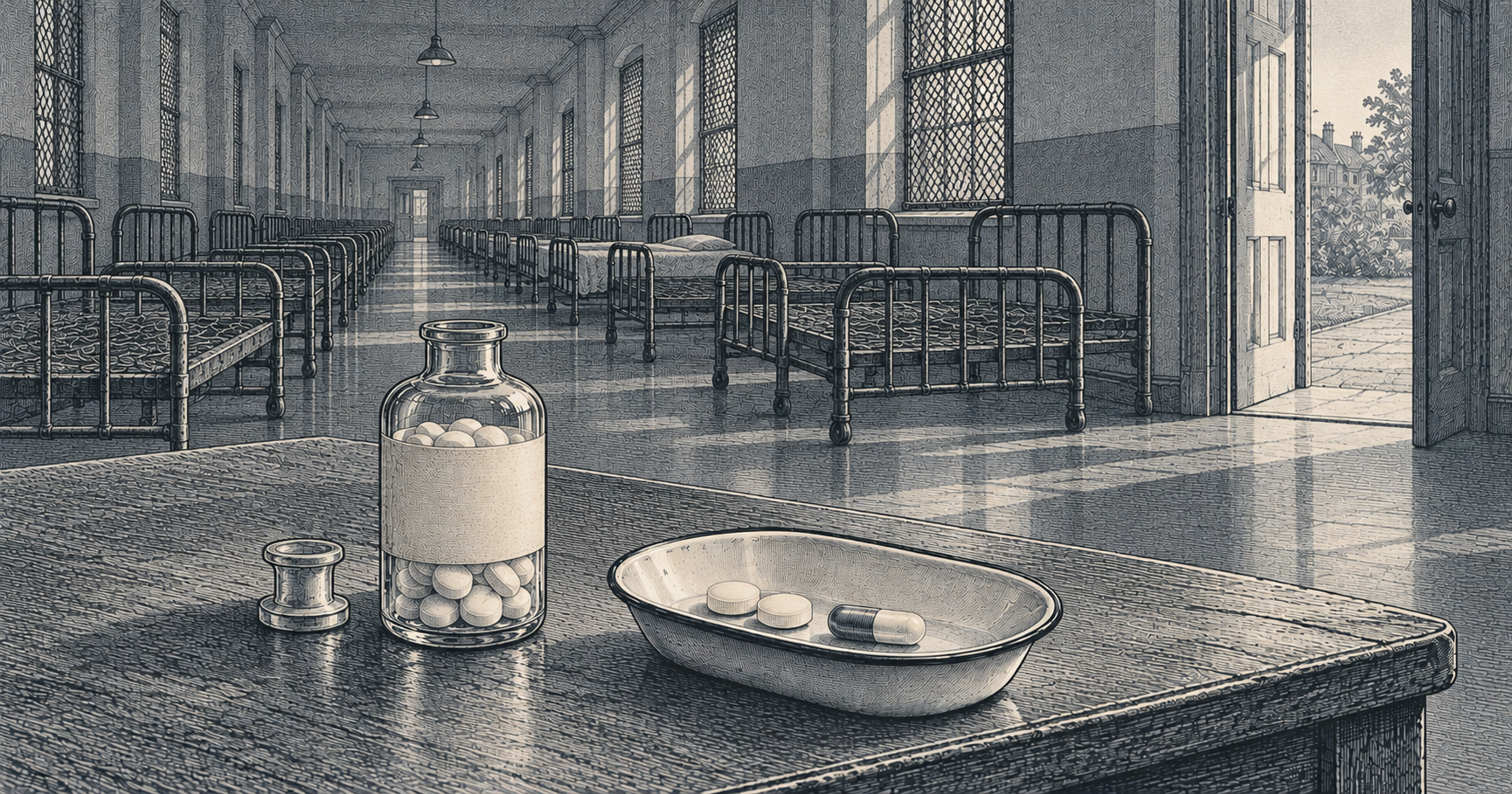
A pill, a short stay, and an open door. What the drugs gave the mentally ill, and what came after.
At ten in the morning on January 19, 1952, in the military hospital of Val-de-Grâce in Paris, a doctor put fifty milligrams of a new compound into the vein of a young man who could not be still. He was twenty-four and manic. The record gives his name as Jacques Lh.
The calm came at once and lasted a few hours. They gave it again, and again. When the needle inflamed his veins they switched to barbiturates or electroshock for a time, then went back to the compound. After twenty days and 855 milligrams, his doctors wrote that he was ready to resume normal life.
The drug had come to them from surgery. Henri Laborit, a French naval surgeon, had been giving it before operations as part of a mixture meant to blunt surgical shock. He noticed that it left his patients awake but strangely indifferent to their surroundings, and he talked the psychiatrists at Val-de-Grâce into trying it.
Across the city, at the Sainte-Anne hospital, Jean Delay and Pierre Deniker heard what was happening and asked the manufacturer, Rhône-Poulenc, to send samples. In late March they began giving it by itself, without the surgical cocktail. At first they packed their patients in ice, believing the drug worked by cooling the body. It did not take long to see that the cooling contributed nothing to the effect, and they dropped it.
The chemist Paul Charpentier had made the compound by December 1950. Simone Courvoisier, the company’s head of pharmacology, tested it on rats trained to climb a rope when a bell rang. After the drug, the rats ignored the bell. In France it was sold as Largactil.
In America it would be called Thorazine.
The wards
In May 1946, Life magazine published Albert Maisel’s report on the nation’s state mental hospitals under the title “Bedlam 1946.” He found thousands of patients held for weeks at a stretch in leather handcuffs and canvas camisoles, and hundreds more in bare rooms without beds, lit by day only through half-inch holes in steel-plated windows.
The hospitals kept filling. Between the start of the 1930s and 1955, the number of resident patients in state and county mental hospitals rose from about 332,000 to 559,000. At the end of 1955 the count stood at 558,922, the highest it would ever reach. In Illinois, a federal count at the end of that year found 37,883. Manteno State Hospital, in the farm country south of Chicago, held more than 8,000 patients in the mid-1950s, and it had a cemetery of its own.
The treatments of the day were insulin coma, electroshock, and the lobotomy. For the long-term patient there was mostly custody. Sedatives could knock a disturbed patient out, and electroshock could cut an episode short. Chlorpromazine would control agitation better than any of the old drugs, and it could also ease delusions and hallucinations.
Philadelphia
In 1952 Smith, Kline and French of Philadelphia bought the American rights and ran clinical trials involving some 2,000 doctors and their patients in the United States and Canada. The Food and Drug Administration approved the drug in 1954 for psychiatric use and for nausea and vomiting. Within eight months of its launch, more than two million patients had been given it. By 1964, some fifty million people around the world had taken it.
For psychiatrists working on the wards, it was a miracle drug. Hospitals could loosen their rules and cut back on restraint, and staff and families began to believe that gentler care was possible. The modern evidence bears out the old enthusiasm. In the 2020 Cochrane review of antipsychotic maintenance, thirty trials with more than four thousand patients with schizophrenia measured relapse at seven to twelve months. About one in four of those kept on the drugs relapsed, against six in ten of those taken off them.
The cost came slowly. In 1957, three years after Thorazine reached American pharmacies, a physician named Schönecker described a syndrome in patients on the new drugs: involuntary movements of the face, the trunk, and the limbs. It usually appeared after long treatment, and it came to be called tardive dyskinesia. In a 2017 analysis of studies published between 2000 and 2015, about thirty percent of patients then taking the older antipsychotics had it.
Melbourne
John Cade had spent three and a half years as a prisoner of the Japanese at Changi. After the war he went to work at the Bundoora Repatriation hospital outside Melbourne, a hospital for returned soldiers. He had a theory that mania might be a kind of poisoning by some substance the body made in excess.
He injected the urine of manic patients into guinea pigs. For one experiment he needed a soluble form of uric acid, so he used a lithium salt, and the lithium seemed to protect the animals. Injected with lithium alone, they became lethargic and unresponsive. Later critics suspected the animals had simply been poisoned. Cade took lithium himself for about two weeks, then gave it to his patients. He was not the first to try it on the mentally ill. William Hammond in New York had reported using lithium bromide for acute mania in 1871, and Carl Lange in Copenhagen prescribed lithium for recurring depression a few years later, but that work had been forgotten.
The first of Cade’s patients was a man the paper would call W.B. He had served in the first war and come home to Australia in 1917 unwell, and he had been psychotic for about thirty years. Cade had already given him electroshock. On March 29, 1948, W.B. began taking lithium. On May 1 Cade wrote that there had been a remarkable improvement. He was sent home on leave.
Cade published in the Medical Journal of Australia in September 1949. It was a bad year for it. In the United States, lithium chloride had just been tried as a substitute for table salt in patients with heart failure, and it had poisoned some of them.
W.B. took his medicine irregularly, and early in 1950 he came back to the hospital with lithium poisoning. In March Cade stopped the drug. His notes weigh the two men he had seen: a carefree, restless manic off lithium, and on it “the dyspeptic, frail little man he looks on adequate lithium.” By May 12 the mania had worsened, and Cade judged it as great a danger to the man’s life as the drug. He started it again. Before the month was out, W.B. was dead. In October the coroner found toxemia from lithium given as treatment. Samuel Gershon, who worked in the 1950s at the hospital Cade later ran, wrote that Cade never publicly admitted the cause and in later accounts portrayed the outcome as a success. Cade largely stopped using lithium.
What rescued it was measurement. In a study published in 1951, Edward Trautner and Charles Noack in Melbourne treated a hundred patients and followed their blood levels with a flame photometer built at the university only the year before. No one died.
In Denmark, Mogens Schou ran a controlled trial of lithium in mania, published in 1954. He later wrote that he never saw the patients; he threw a die to assign them to lithium or placebo and ran the blood tests himself. Then he and Poul Baastrup asked a larger question: whether lithium taken every day could keep the episodes from coming back. In 1967 they reported on 88 patients in a study that ran six and a half years. Comparing each patient’s course before and during lithium, they found that recurrences of mania and depression fell by 87 percent. Forty percent of those patients had tried to kill themselves before treatment.
The design was open to attack, and it was attacked. In 1968 two psychiatrists at London’s Maudsley Hospital, Blackwell and Shepherd, asked in the Lancet whether prophylactic lithium was “another therapeutic myth.” The patients had been chosen for frequent episodes, no one had been blinded, and recurrent illness rises and falls on its own. Baastrup and Schou hesitated to answer with a placebo trial, because it meant taking stable patients off a drug they believed was protecting them. In 1970 they ran one anyway, randomly switching patients already on lithium to placebo or keeping them on the drug, without patients or doctors knowing which. It confirmed the effect. That same year the United States became the fiftieth country to put lithium on the market, twenty-one years after Cade.
The medicine cabinet
The last of the three drugs left the hospital behind. In 1974 a team at Eli Lilly in Indianapolis described a compound that selectively blocked the reuptake of serotonin. It was not the first of its kind. Zimelidine, from Sweden, reached European pharmacies in 1982 and was withdrawn the next year after reports of Guillain-Barré syndrome. Lilly’s compound, fluoxetine, was approved by the FDA on December 29, 1987, as Prozac. In 1993 the psychiatrist Peter Kramer coined a phrase for prescribing such drugs to people with no diagnosis at all: cosmetic psychopharmacology.
In the survey years 2015 to 2018, 13.2 percent of American adults reported taking an antidepressant in the past month, and nearly eighteen percent of women.
How well these drugs work is still argued. In 2008 Irving Kirsch and his colleagues analyzed the trial data submitted to the FDA for four newer antidepressants, Prozac among them. Patients on the drugs improved by 9.6 points on the standard Hamilton depression scale, patients on placebo by 7.8. The difference of 1.8 points fell short of the three points that Britain’s National Institute for Health and Clinical Excellence had used as its test of clinical significance, except at the upper end of very severe depression. A later reanalysis of the same data found a somewhat larger difference. In 2018 Andrea Cipriani and colleagues pooled 522 trials of acute treatment for major depression, in more than 116,000 adults, with response measured at about eight weeks. Every one of 21 antidepressants did better than placebo, with effects the authors themselves called modest. The two findings sit together more easily than the headlines did. In short-term treatment of major depression, the drugs beat placebo. The dispute is over how much that margin means for the average patient, for how long, and at what cost in side effects.
The door
The first of the three drugs had already changed what the country believed it could do with its hospitals. On February 5, 1963, President Kennedy sent Congress the first message a president had devoted to mental illness. He had a personal stake. His sister Rosemary had been lobotomized and lived the rest of her life in institutions. He wrote that under his plan, “reliance on the cold mercy of custodial isolation will be supplanted by the open warmth of community concern and capability.” The same day he set a target: to cut the number of patients under custodial care by half or more within a decade or two, and to bring them back to their communities and homes “without hardship or danger.”
He signed the Community Mental Health Centers Act that October. Federal money was meant to stimulate state, local, and private action for a limited time. About 1,500 centers were projected as necessary for national coverage. By 1980 a little over 700 had been funded.
The census tells the rest. Through the first decade of Thorazine it fell slowly, by less than two percent a year, to 475,202 at the end of 1965. Hospitals were more ready to discharge patients, the health-policy scholars David Mechanic and David Rochefort later wrote, but they often had no place to send them.
Then came Medicaid and Medicare, enacted in 1965. Medicaid would pay for former state patients moved into nursing homes, and the states paid no more than half of Medicaid’s costs. The incentive was plain. Between 1965 and 1975 the hospital population fell by an average of 8.6 percent a year. By 1975 it was 193,436. By 1980 it was 132,164. Of the whole decline between 1955 and 1985, more than three quarters came in the fifteen years after 1965.
How much of that belongs to the drug?
E. Fuller Torrey, a psychiatrist and a leading critic of what followed, dates the beginning to chlorpromazine in 1955 and gives Medicaid the major push a decade later. A 1985 study by William Gronfein, summarized by Mechanic and Rochefort, found that the state-by-state declines tracked Medicaid payments to nursing homes, while the spread of the drugs showed no such relationship. Mechanic and Rochefort’s own conclusion is that the drugs and the new ideas moved the system only modestly until money for places to live was joined to them, and that the hospitals emptied quickly after that.
Admissions to state and county hospitals rose from 178,003 in 1955 to 384,511 in 1970, even as the number of residents fell. The average stay shrank from 421 days in 1969 to 143 in 1982.
The courts moved in the same direction. Kenneth Donaldson was committed to the Florida State Hospital at Chattahoochee in January 1957, on his father’s petition, and held there for nearly fifteen years. Witnesses testified that he received nothing but custodial care. When he was finally released, he found a responsible job almost at once. In 1975 a unanimous Supreme Court ruled that a state cannot constitutionally confine, without more, a nondangerous person who is capable of surviving safely in freedom. The Court did not decide whether a state could confine such a person in order to treat him. Justice Potter Stewart wrote that “mere public intolerance or animosity cannot constitutionally justify the deprivation of a person’s physical liberty.”
In the early 1980s the Reagan administration folded the remaining federal community mental health money into a block grant administered by the states. By then the hospitals had already lost three quarters of their 1955 population.
Who paid
In 1880 the federal census counted 91,959 “insane persons” in the United States. Only 397 of them were in jails, less than one percent of everyone behind bars. Dorothea Dix and the reformers before her had spent decades moving the mentally ill out of jails and almshouses and into hospitals.
In 1983 and 1984 Linda Teplin and her colleagues interviewed a random sample of 728 men in the Cook County Jail here in Chicago. About six in a hundred had a current severe mental disorder, meaning schizophrenia, mania, or major depression, at two to three times the rate in the general population. The jail had identified only about a third of them. In 2011 and 2012 a federal survey found that 26 percent of the nation’s jail inmates met the threshold for serious psychological distress, and 44 percent had at some point been told by a mental health professional that they had a disorder. About a third of the jail inmates in distress had received any mental health treatment since admission. These figures come from different instruments, a census category, a diagnostic interview, a screening questionnaire, and they cannot be laid end to end as a trend. What they show together is that serious mental illness is common behind bars, and often untreated there.
Cook County’s sheriff, Tom Dart, told Congress in 2014 that by his office’s estimate 30 to 35 percent of his jail’s population had a serious mental illness on any given day, and that the country had criminalized mental illness. He has called it the largest mental health facility in the nation. The Los Angeles County jail was given the same title in the 1990s. In the 1960s and 1970s the state of Illinois channeled released patients into the small apartments and halfway houses of Uptown, on the North Side. At the St. Thomas of Canterbury soup kitchen there, founded in 1978, the line grew to five or six hundred a night in the 1980s. Its longtime director remembered guests who had been institutionalized their whole lives.
It is tempting to draw a straight line from the emptied hospital to the street and the cell. I have tried to draw it, and the evidence will not let me draw it cleanly. In 2016 Petr Winkler and his colleagues reviewed 23 studies that followed long-stay patients after discharge and found homelessness and imprisonment only sporadically; most of the studies found not a single case. Torrey himself grants that for many of those discharged, perhaps most, the promise was at least partly kept, and that the disaster fell on a substantial minority. Against the review, the psychiatrist Adrian Mundt answered in the same journal that it described a kind of long-stay patient who hardly exists anymore, that young people with severe mental illness and drug problems were of much more concern, and that dismissing the national studies linking bed counts to prison counts may be a category error. Winkler, replying, conceded that neither kind of study can show whether the newer patients who ended up in prison would have been spared under the old hospital system.
My reading, and I hold it only as a reading, is that the people in the jails today are mostly not the patients who walked out of Manteno in the 1960s; they are the generations that came after, people who fell ill when there was no longer a long-stay bed to hold them and too few community services to catch them. Mechanic and Rochefort drew the same distinction in 1990, warning that the debate confused the old relocated patients with new cohorts who belonged to an entirely different system of care.
What remains
What endured is the open door: the expectation that serious mental illness will be treated mostly outside the hospital, in short stays, with medicine taken at home.
It cannot be undone, and most of us would not undo it. That is the bargain medicine made.
* * * * *
Charles Cranston Jett is an author and civic educator based in Chicago. A graduate of the U.S. Naval Academy (Class of 1964) and Harvard Business School, he served aboard nuclear submarines during the Cold War. He is the author of six books, including Super Nuke!, hosts three podcasts, and writes across his Critical Skills Blog platform on history, leadership, and the health of the American republic. In his writing he uses AI tools for research, editing, and occasional image creation; the arguments, the voice, and the final judgment are his. He and his wife, Dr. Nancy Church, live at Water Tower Residences, where they co-host the Chicago Salons.

Leave a Reply