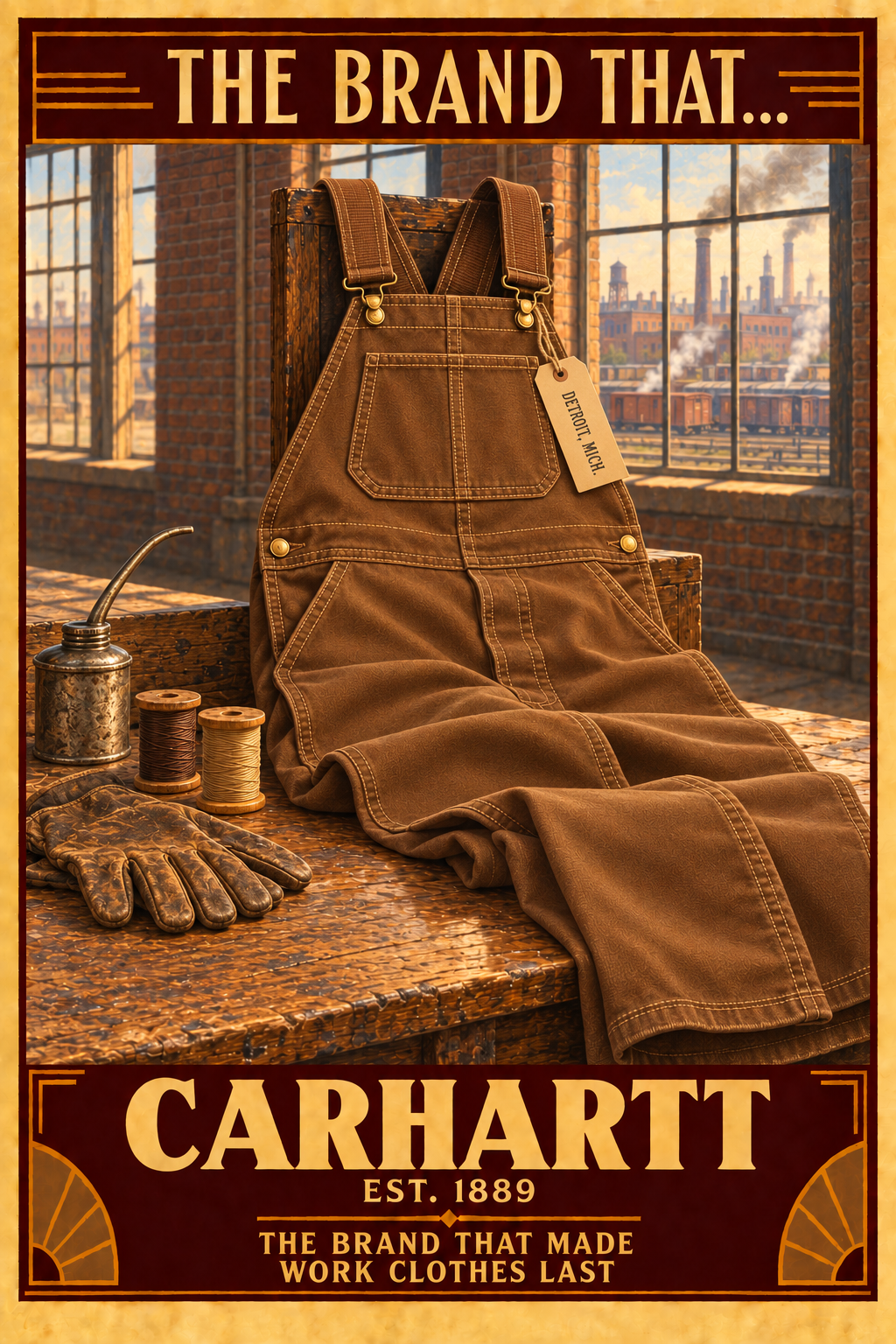
Union Made, Highest Grade, and what became of the first two words.
This is the twenty-fourth profile in The Brand That…, a series about American brands that taught the country a habit, became the word for the thing itself, and outlived the world that made them. We tell their stories plainly and with respect: what they made, what it cost, and what they still are.
The Founding: An Overall for the Railroad Men
Hamilton Carhartt was a salesman first. He started with a horse and wagon and later rode the railroads, the company’s archivist says, asking his customers what they needed. In 1882 he and his father-in-law, Stephen Welling, opened a furnishings wholesale house in Grand Rapids, Michigan. Two years later the family moved to Detroit, a city whose own story comes later in the companion profile The City That Put the World on Wheels. By 1889 the firm made nothing but work clothes.
Carhartt workwear began there, with one garment: a bib overall for railroad men.
By the company’s account it began in a small loft with two sewing machines and a half-horsepower motor, and its first efforts failed. Carhartt went back to the railroad men, asked what was wrong, and built the next overalls to their answers.
He had a harder problem than the pattern. In February 1900 he named it before the U.S. Industrial Commission. “We compete, you know, with sweat shops,” he said. “That is the bitterest competition we have.” A sweatshop overall was cheap because the people who sewed it were paid next to nothing. Carhartt’s advertising made a selling point of the people who sewed his.
The Rise: Union Made, Highest Grade
The first people he hired, by the company’s account, were women who could sew, and in the early years women were about four of every five workers in the shop. In June 1898 a Carhartt advertisement in the locomotive engineers’ journal ran the photograph of one of them. The caption named her as Miss Kate Doody, president of Garment Workers’ Union No. 74, “comprised wholly of the employees of Hamilton Carhartt & Company.” The copy promised the engineers that if they sent for samples, they would never wear scab clothing again.
The union was part of the product. When Carhartt registered his trademark in February 1901, it set a railroad car beside a heart, between the words Union Made and Highest Grade. A company booklet from about the same years called the firm a profit-sharing corporation and printed Eight Hour Work Day on its car-and-heart emblem. Its second page was a blank time sheet for a train crew, with a line for the engine number.
Look at a Carhartt bib today and you will find a small cut in the cloth just above the front pocket. It is there for a watch chain, a nod to the first customers. The pocket beneath it has changed: the archivist says it went plain when men took to wristwatches, and now it zips shut over a phone. The cut stayed. The men it was made for carried pocket watches on chains, and on a railroad a minute wrong could put two trains on one track. Those men are long gone. The little slit is still there, waiting for a chain almost nobody wears.
By 1910 Carhartt had cotton mills in the South and sewing plants from Atlanta to San Francisco, with more in Canada and England. The coat now called the Chore Coat was in its advertising by 1917.
The Turn: Saved by Kentucky, Found by the Street
The Depression nearly finished it. The company says the 1929 crash brought it close to shutting its doors. The cotton slump and the hard years after it cut Carhartt to three plants, in Atlanta, Detroit, and Dallas, and the firm sold off its rights to sell across much of the South and abroad.
In the middle of the Depression, people in Irvine, Kentucky, formed a joint-stock company and raised the money for a factory for Carhartt to run. It cost a little over $35,000 and opened in 1932 with twenty workers. “Though we were born in Detroit,” the company archivist says, “we were saved by Kentucky.”
In May 1937 a car crash in Grosse Pointe killed Hamilton Carhartt’s wife, Annette, and he died of his injuries days later. His son Wylie took over, and in the late 1950s the company passed to Wylie’s son-in-law, Robert Valade.
Around 1990 the coat went somewhere nobody had designed it for. Tommy Boy Records, a hip-hop label, put its logo on Carhartt jackets and gave 800 of them to tastemakers. “It took off immediately,” the label’s president, Monica Lynch, told The New York Times. By 1993 rap groups were wearing Carhartt in videos and on album covers, and the clothes turned up in Vogue.
Carhartt WIP’s own history says rappers, graffiti writers, and corner boys took up the clothes for their toughness. A European importer, Work in Progress, became Carhartt’s distributor there in 1994 and two years later won a license to manufacture Carhartt clothing outside the United States; much of the skate and art following people credit to Carhartt belongs to that separate company. My own guesses add two more reasons: by the nineties, clothes that looked worked-in had a market of their own, and a duck coat is warm on a city corner in January.
The company had a hand in it too. It had sold its clothes in Japan as fashion since 1987, and in 1991 it showed its line at New York fashion shows. Then, in 1993, with its plants at capacity, it turned away department and specialty store chains. Mark Valade, then its marketing vice president, said the trouble was balancing the traditional retailer and the new one. The business history calls it a shortage of capacity. I can’t tell from the record whether it was also a choice.
In 2025 the company told the European trade press, “Carhartt is not a fashion trend, it is a tool you wear.” A Tommy Boy staff jacket from 1992 went to auction at Sotheby’s in 2020: brown duck, blanket-lined, triple-stitched, never worn, the tags still on.
The Reckoning: Where the Work Went
The label still says Union Made on some of the clothes. Those come from Carhartt’s three American plants, in Kentucky and Tennessee, and a union still bargains for many of its American workers. For the year ending June 2026, the company’s own disclosure lists finished-goods factories and material suppliers in 37 countries. The shift south began in the late 1990s with a plant in Pénjamo, Guanajuato, and in 2003 two more in Durango.
The case for the company deserves its full weight. A family that means to keep its company has fewer ways to raise money when a market turns. Work clothes are bought by people who count their dollars. A brand that made everything at home would likely have charged more, sold less, or earned less, and asked its customers or its own books to pay for its conscience.
On October 9, 2023, managers told the workers in Durango and Pénjamo that Carhartt was leaving Mexico, with the last day October 20. Local reports put the losses at 800 to 1,000 jobs in Durango and about 700 in Pénjamo. The company gave no public reason. A Durango business leader called it one of the best-paying maquiladoras in the city. In Pénjamo the local paper expected the damage to reach past the sewing floor, to the drivers who bused workers in, the vendors who fed them, and the cafeteria staff. The company promised severance under the law and offered counseling.
Homero García Santos had worked at the Pénjamo plant for eight years. “My father worked here,” he told El Sol de Irapuato, “and I thought I would retire from this company, like him.”
What Endures: Carhartt Workwear in Its Second Century
Carhartt is still owned by Hamilton Carhartt’s descendants. Since 2024 it has been run by Linda Hubbard, the first chief executive from outside the family, with Mark Valade, the founder’s great-grandson, as executive chairman. The headquarters is in nearby Dearborn. The company told CNBC it took in just over $1 billion in 2019.
In the late 1990s a Carhartt marketing manager visited job sites to see how the clothes were worn. He found workers who bought them for everyday wear and, once they faded, wore them to work. The coat went to town first and to the job second.
In 2023 the company began taking its own used clothes back in trade for store credit. By its count, through 2025 its resale program had taken in 22,166 trade-ins and sold 121,526 reclaimed pieces. Its repair program is based in Irvine, the town that once raised the money for a factory. Some owners mail a worn-out coat straight to the company archive with a letter. Often, the archivist says, the letter runs the same way: the coat is past wearing, and they could not bear to throw it away.
So this is what is left. A slit in the duck for a watch chain no engineer will hang there again. A railroad car and a heart, and the words around them. Kate Doody’s photograph in an engineers’ journal, and the factory Irvine money built in the worst years. A plant in Pénjamo where a son meant to retire like his father. A brown coat in a box on its way home to Dearborn, too worn to wear and too good to throw out.
Carhartt made work clothes last, and that is worth remembering.
Why Carhartt? Carhartt never became the common word for work clothes, the way Kleenex became the word for tissue. It became a credential instead: brown duck that tells people the wearer, or someone before them, did the work, kept believable for 137 years by a family that still owns the company and by clothes still built for the job.
* * * * *
Charles Cranston Jett is an author, civic educator, and Professional Certified Coach based in Chicago. A graduate of the U.S. Naval Academy (Class of 1964) and Harvard Business School, he served aboard nuclear submarines during the Cold War. He is the author of six books, including Super Nuke!, hosts four podcasts, and writes across his Critical Skills Blog platform on history, leadership, and the health of the American republic. In his writing he uses AI tools for research, editing, and occasional image creation; the arguments, the voice, and the final judgment are his. He and his wife, Dr. Nancy Church, live at Water Tower Residences, where they co-host the Chicago Salons.



Leave a Reply