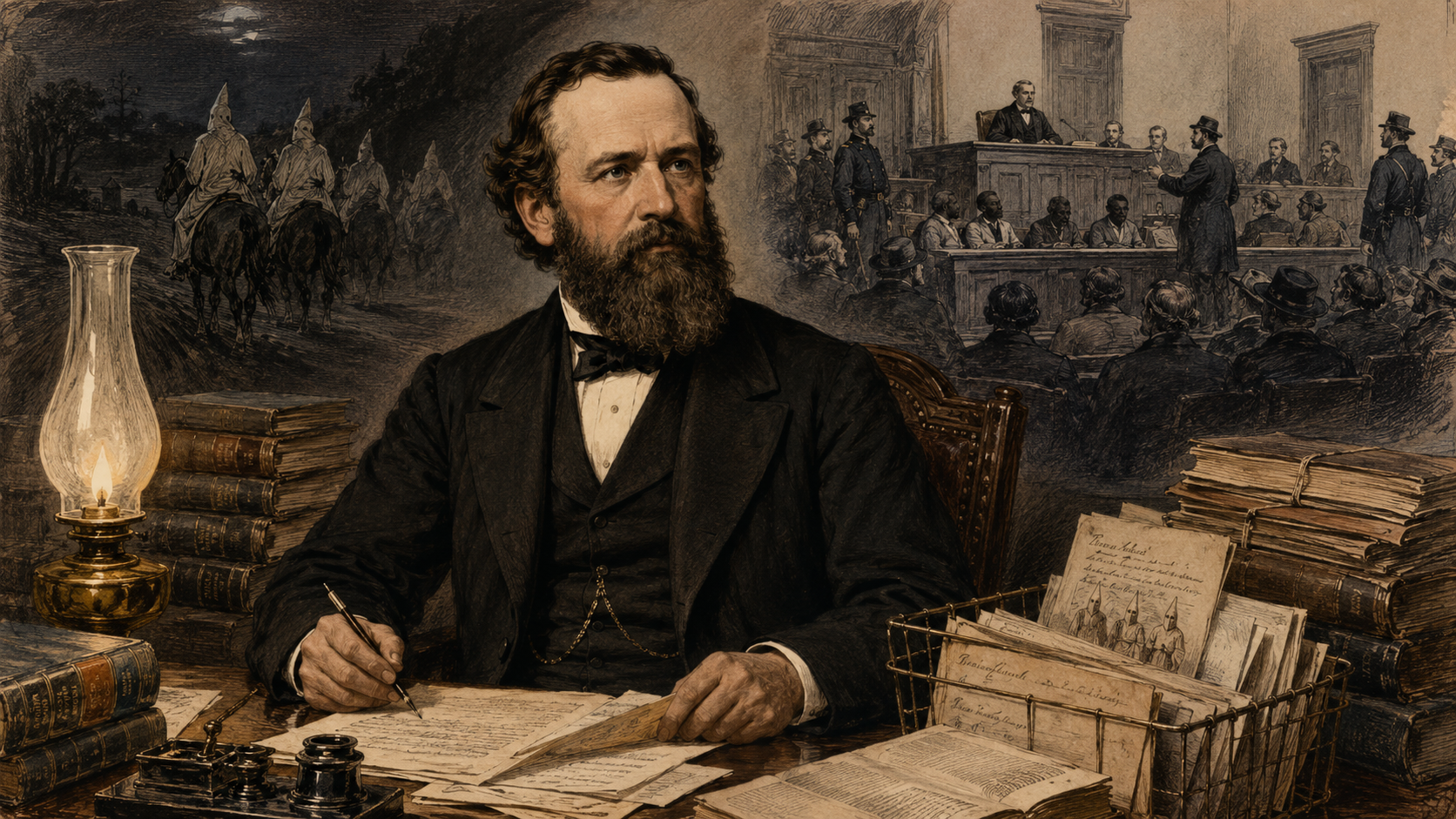
Amos T. Akerman owned slaves, served the Confederacy, and then prosecuted the Ku Klux Klan
This is the next installment of Courage and Consequence — a series about relatively unknown individuals in history who made courageous decisions under extraordinary pressure, and had to live with what followed. Amos T. Akerman needs to be remembered.
He wrote the letter on the twentieth of November, 1871. Three weeks later the President asked him to resign.
The letter went to James Jackson in Georgia, and it said what the Attorney General of the United States had learned that autumn. The Ku Klux was no fable. He could not say it existed everywhere in the South. But it existed in many places, and it was the most atrocious organization the civilized part of the world had ever known. Then the sentence that gives the whole thing away — the sentence of a man who has read the affidavits and knows his correspondent has not. Your blood would curdle, he wrote, if you knew one tenth of what I know about the upper part of South Carolina.
He knew. That was the problem, and it was also the man.
The Person
Amos Tappan Akerman was born in Portsmouth, New Hampshire, in 1821, and graduated from Dartmouth in 1842. He went south to teach — North Carolina first, then Georgia, into the household of Senator John M. Berrien, who had himself been Attorney General of the United States. He read law under Berrien. He passed the Georgia bar. He settled in Elberton, in Elbert County, and built a practice.
He also bought human beings and owned them.
That is the fact, and there is no arrangement of the sentences that makes it sit easier. He was not a Northerner who kept his hands clean while living among slaveholders. He became one. And when Georgia seceded — over his own opposition, he had argued against it — he did not go home to New Hampshire. He stayed. In 1864, at forty-three years old, past any age the Confederacy was reaching for, he enlisted in the Georgia State Guard and served out the war in supply. Nobody made him do that. He had a law practice, a family, and a Northern birth certificate that would have gotten him out. He chose the other thing.
The best argument against Amos Akerman is that he spent forty-four years of his life on the wrong side of every question that mattered, and got to be Attorney General anyway.
The Context
Congress created the Department of Justice on June 22, 1870. Before that the Attorney General was a lawyer with an opinion and no bureau — a man who advised the President and commanded almost nothing. The new department gave him a staff, a budget, and the district attorneys of the entire country. Grant handed it to Akerman.
The tools arrived with the job. The Enforcement Act had passed on the last day of May, 1870. The Ku Klux Klan Act followed on April 20, 1871, empowering the President to suspend the writ of habeas corpus where the terror had become insurrection in fact. On October 17, 1871, Grant used it. The proclamation named nine counties in South Carolina — Spartanburg, York, Marion, Chester, Laurens, Newberry, Fairfield, Lancaster, Chesterfield — and in those nine counties a man could be held without a court asking why.
Akerman did not stay in Washington and read the reports.
The Decision
He went down there.
He went to South Carolina himself, in the fall of 1871, and he ran the enforcement campaign from inside it. Federal marshals arrested more than six hundred men before the year ended. At the November term of the circuit court in Columbia, forty-nine of them pleaded guilty. Four went to trial. Five convictions came out of that term. The following spring the court took eighteen more conspiracy convictions, one for murder, and eighteen additional pleas.
The numbers look small. They are small. What they represent is not.
For the first time in the history of the country, the federal government arrested white men in large numbers for what they had done to Black citizens, and tried them in a federal courtroom, in front of juries that included Black men, in the state where they had done it. The proceedings ran to nearly eight hundred printed pages when the government published them the following year. The men who had ridden at night in Spartanburg and York sat in a room in Columbia in daylight and were asked questions by a lawyer.
What Akerman had that the men above him did not have was the paper. The affidavits, the marshals’ reports, the depositions of people who had been whipped and shot and burned out. He read them. That is the thing to hold onto about the November letter — the phrase is not “you would be appalled.” It is that a man’s blood would curdle. It is a physical description. He is telling a friend that the documents on his desk have done something to his body, and that a tenth of them would do it to anyone’s.
The Aftermath
Grant asked for his resignation on December 12, 1871. Akerman tendered it the same day. His last day in office was January 10, 1872.
Why is where the record stops being clean.
The usual explanation is the railroads. Akerman had ruled that June against land grants and bonds claimed by the Union Pacific and its subsidiaries, and the ruling made permanent enemies of Collis Huntington and Jay Gould, who wanted him gone and said so. Interior Secretary Columbus Delano is supposed to have carried the message to Grant. It is a satisfying story: the man who went after the Klan was destroyed by capital, not by conscience.
The competing explanation is that Grant simply lost his stomach for it — that the mass arrests in South Carolina had started to look like military rule, and an election was coming.
I have gone back and forth on this. The railroad account has the better documentation and the worse witness, because Akerman himself denied it. He did not think the railroads pushed him out. That is not decisive — a man in that position may be the last to know, or may be too proud to say — but it is his own testimony against the story most often told about him, and it deserves to be weighed. Against the second account stands the plain fact that prosecutions continued under George H. Williams, who followed him. Enforcement did not stop on the day Akerman left the building.
What can be said with confidence is narrower and, I think, worse. Both explanations are about something other than the merits. Nobody in the room was arguing that the Klan trials were wrongly brought. The question was whether they were worth the trouble, and men who had never read the affidavits decided that they were not.
The cases stayed on the docket. In South Carolina alone, 1,188 of them. They were not lost at trial. They were not thrown out by a judge. They were disposed of quietly under his successor by nolle prosequi — the prosecutor’s declaration that he will proceed no further — and that was the end of them. The work of building them had been done. The witnesses had come forward. The indictments existed. Somebody read the file, and closed it.
He went back to Georgia and practiced law for nine more years. He died at Cartersville on December 21, 1880, at fifty-nine.
The Meaning
In the last days of December 1871, out of office and explaining himself to Governor Benjamin Conley, Akerman wrote the sentence that has outlived everything else he said. Even atrocities such as Ku-Kluxery did not hold the country’s attention any longer. The Northern mind, he wrote, being full of what is called progress, runs away from the past.
He was describing his own removal, and he was describing the next ninety years, and he did it in December of 1871 while it was happening to him.
The Supreme Court finished the job he had started and lost. Cruikshank came in 1876 and gutted the federal power to prosecute private violence against Black citizens; the framework Akerman had built his cases on did not survive the decade. The scholarship that has looked hardest at the South Carolina trials calls the victory a hollow one — high conviction rates on a legal theory the courts were already preparing to reject.
So the case for remembering him cannot be that he won. He did not win.
What he did was more particular than that. A man who has spent his whole adult life inside a set of arrangements — who has profited by them, fought for them, owned people under them — is the least likely person in the world to turn the machinery of the law against those arrangements when he finally gets his hands on it. The ordinary course is to find reasons. The reasons are always available. Akerman had every one of them, and instead he read the affidavits and went to South Carolina and filed the cases.
He did not undo what he had been. Nothing undoes that. But he had one year with the power to act on what he had learned, and he spent all of it.
Sources: Amos T. Akerman to Hon. James Jackson, November 20, 1871, and Akerman to Gov. Benjamin Conley, December 1871, in the Amos Tappan Akerman Letter Books, 1871–1876, Albert and Shirley Small Special Collections Library, University of Virginia. Proceedings in the Ku Klux Trials at Columbia, S.C., in the United States Circuit Court, November Term, 1871 (Republican Printing Company, 1872). Presidential Proclamation 201, October 17, 1871. Statutes: 16 Stat. 140; 16 Stat. 162; 17 Stat. 13. Allen W. Trelease, White Terror (1971); Lou Falkner Williams, The Great South Carolina Ku Klux Klan Trials, 1871–1872 (University of Georgia Press, 1996); Eric Foner, Reconstruction (1988); William S. McFeely, Grant: A Biography. Federal Judicial Center; New Georgia Encyclopedia.
Next in this series: Levi Nelson — they lined up the prisoners and shot them. He took a bullet, crawled away, and then said the names in court.
* * * * *
Charles C. Jett is an author, civic educator, and Professional Certified Coach based in Chicago. A graduate of the U.S. Naval Academy (Class of 1964) and Harvard Business School, he served during the Cold War aboard the nuclear submarine USS Ray (SSN 653), where his tactical innovations helped inspire Tom Clancy’s Jack Ryan character. He is the author of six books, including Super Nuke!, hosts four podcasts, and writes across his Critical Skills Blog platform on history, leadership, and the health of the American republic. In his writing he employs AI tools in a limited, supporting role for research, occasional image creation, and editing, while the prose and judgment remain entirely his own. He and his wife, Dr. Nancy Church, live and co-host the Chicago Salons at Water Tower Residences.



Leave a Reply