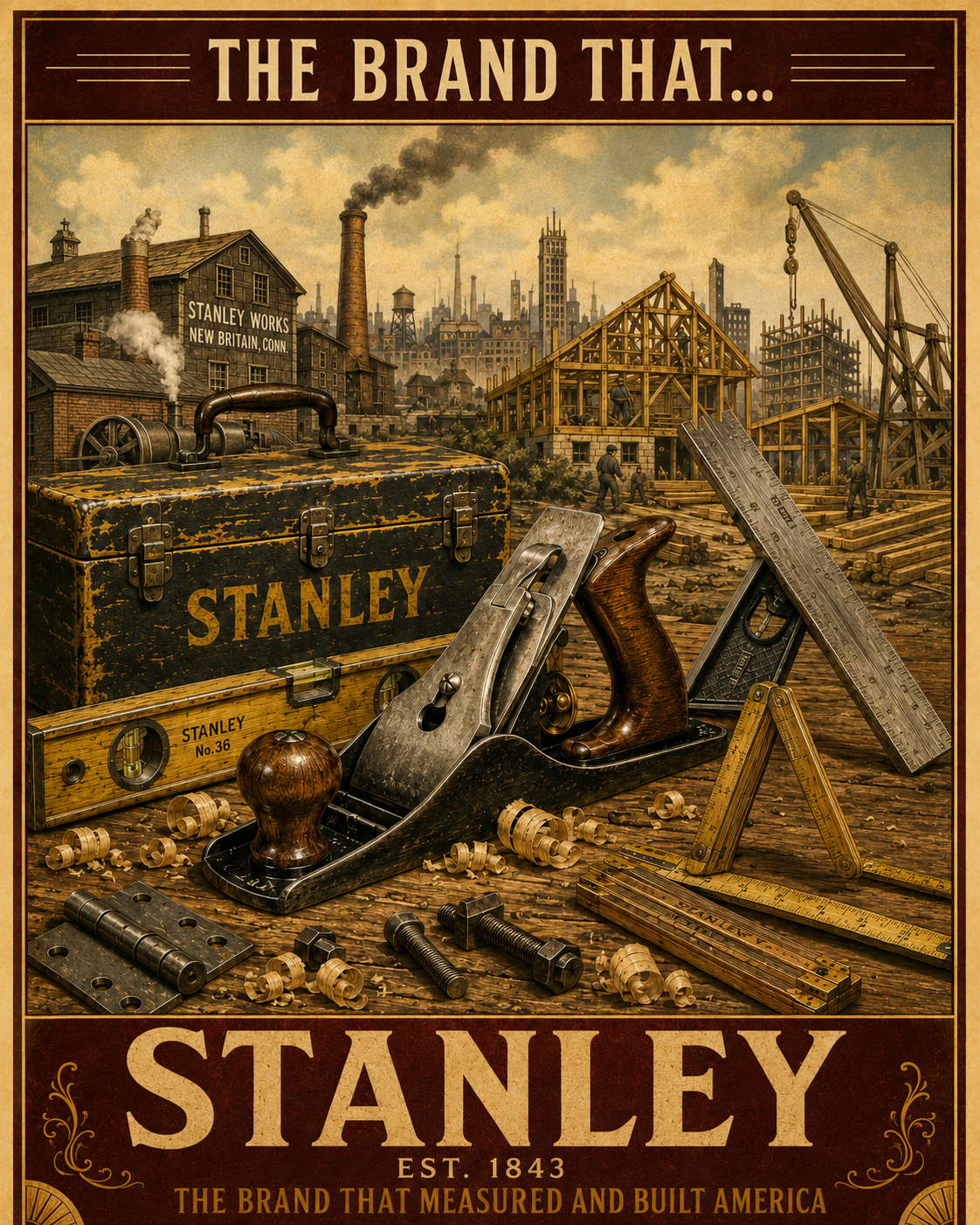
It made the level and the tape, and the toolbox kept the brand name.
This is the ninth profile in The Brand That…, a series about American brands that taught the country a habit, became the word for the thing itself, and outlived the world that made them. We tell their stories plainly and with respect — what they made, what it cost, and what they still are.
The Founding
New Britain, Connecticut had no river worth damming. Piper Brook ran through the town and turned nothing much. In the valley towns to the west the water did the work and the shops grew up along the falls. New Britain had to find another way or stay a farming place. It found steam.
In 1843 Frederick Trent Stanley opened a bolt manufactory there and put a single-cylinder high-pressure engine in it. He was forty-one. He made wrought-iron door bolts, then hinges, then knobs and drawer pulls — the small iron pieces that hold larger things together and that nobody thinks about until one fails.
The engine was the whole argument. It meant a man could make hardware anywhere he could get coal and iron.
He brought the railroad to town in 1850, and the first locomotive through was named the Frederick T. Stanley, and he is said to have ridden it expecting the plaguey thing to explode. He brought gas light and a reservoir and became the city’s first mayor in 1871. He also buried his wife Melvinia at twenty-eight, and then two of their young sons, and after that went to live in his brother’s house.
In 1852 he and a few other men incorporated The Stanley Works to make hinges. They kept it small and separate from the bolt shop, so that if it failed it would fail alone. It did not fail.
The Rise
The tool half of the story starts with a cousin. In 1857 Henry Stanley organized the Stanley Rule & Level Company out of two existing New Britain firms, one making levels and squares, one making rules. Two Stanley companies then ran side by side in the same town for sixty-three years, and neither was the other.
Rule & Level made the name. In 1869 it bought the rights to Leonard Bailey’s cast-iron bench plane, patented two years earlier by a Boston cabinetmaker who had solved the adjustment problem — a blade set fine or coarse by a brass wheel, in iron, repeatably, without shims and guesswork. By 1900 the company was the largest maker of planes in America. For decades the word cast into the bed of those planes was BAILEY. Stanley’s own name went on the cutter, which wore out and got replaced.
That is the pattern under all of it. Stanley did not often invent the thing. It bought the man who did, made it at a price and a consistency nobody could match, and put its name where the customer’s hand would be. Hiram Farrand worked out the concave steel tape — the curved cross-section that lets a flexible ribbon stand out stiff in the air — in a New Hampshire basement; Stanley bought the rights in 1931 and hired him. Justus Traut, a German immigrant at Rule & Level, filed near a hundred and fifty patents across fifty years and was called the Patent King in the shop and almost nowhere else.
What Stanley did invent was the habit. Before the steel tape a carpenter carried a folding boxwood rule, six feet of it, hinged in brass, accurate and slow. Stanley put an accurate measure in a man’s pocket and taught him to trust it. It standardized the sliding hook at the tip, which travels exactly the thickness of its own metal so the reading is true whether you push the tape into a corner or hook it over an edge — a piece of design that removed a fraction of arithmetic from every measurement made in America for a century. In 1963 the engineer Robert West patented the PowerLock, the first tape a man could extend and lock with one thumb.
The name went past its trademark. The No. 199 utility knife came out in 1936, and in Britain and Australia any box cutter of any make is a Stanley knife, and has been so long that most people saying it do not know they are naming a company in Connecticut.
The Turn
In 1920 The Stanley Works bought Stanley Rule & Level and folded it in. The two family firms became one company, the hand tools became a division, and in 1937 that division was named Stanley Tools. Between 1920 and 1935 the tools carried a small stamp, an S and a W inside a heart. Collectors call them Sweetheart tools and pay accordingly, and the romance is theirs — the heart was for William Hart, hired early, who built the packaging and the cold-rolled steel and most of the rest of it, and who was president when he died. Hart, heart. It is the sort of joke a machine shop makes about a man it liked.
Then Stanley bought Mac Tools and Bostitch and Proto and became a diversified manufacturer rather than a hardware house. In 1991 Newell came for it in a hostile bid and Stanley fought it off. In 2010 it merged with Black & Decker — agreed in November 2009 at about $3.46 billion in stock, the $4.5 billion figure that gets quoted including debt — and became Stanley Black & Decker. In 2017 it bought Craftsman from Sears, which is to say the corpse of its last serious American rival.
Somewhere in there the tools stopped being what they had been. Ask a woodworker when and you will get an argument. The usual answer is the war, or just after: rosewood gave way to stained hardwood and then to plastic, castings got thinner, and a plane bought in 1975 needed an hour of work to do what a plane bought in 1925 did out of the box. But the honest reading is harder than a date. The men who bought hand planes were disappearing — the electric router and the power sander took that work — and a company still building 1925 planes for 1965 carpenters would have been building museum pieces at a loss. The decline in the tools and the decline in the market for them happened together, and the record does not say cleanly which moved first. I think the causation runs mostly from the market to the tool. I am not certain, and anyone who has held both planes has reason to doubt me.
The Reckoning
In 2002 the Stanley Works, then a hundred and fifty-nine years old and selling itself on a century and a half of American work, announced it would reincorporate in Bermuda, with management in Barbados. Nothing would move. No plant would relocate, no job would change hands. The company would simply stop being American on paper and save something like thirty million dollars a year in tax.
Here is the case for it, stated as the officers stated it and without the rescue. Stanley competed against firms domiciled where the tax was lower and was losing on cost in a business where cost is the whole contest. Its obligation ran to shareholders, many of them pension funds holding the retirements of working people. The maneuver was legal, disclosed, and put to a vote. A board that leaves thirty million a year on the table out of sentiment is a board that gets replaced. Every part of that is true.
It was also, to the men who had spent their working lives in New Britain, a betrayal, and they said so, and so did the state’s attorney general and the AFL-CIO and a good part of the Senate. The shareholder vote was found to have been mishandled. The pressure grew past what the company could carry and it withdrew. The scar stayed. A brand whose whole equity was that it was the thing your grandfather owned had been caught measuring exactly what that was worth to it.
And the work left anyway, slowly, the way it left everywhere. New Britain called itself the Hardware City for a hundred years on the strength of these payrolls. In March 2026 Stanley Black & Decker announced it would close the Myrtle Street plant, where the tape measures were made, ending production around May and putting about three hundred people out. It was the last thing the company manufactured in New Britain. For the first time in the city’s one hundred and fifty-five years there is a Stanley headquarters there and nothing made there — four hundred corporate employees, and no floor.
What Endures
Stanley Black & Decker is a Fortune 500 company headquartered in New Britain, on the ground where Frederick Stanley put his steam engine, and it owns DeWalt and Craftsman and Porter-Cable and Bostitch and Mac and Proto. That is the deeper layer of advantage, and it is not a romantic one: Stanley outlived its rivals substantially by buying them, and kept its name legible by putting it on the two or three objects every working person touches without thinking. The tape, the knife, the level, the box they live in.
And that is finally what the name is. Go into any garage in America and find the box — steel or plastic, inherited or bought last spring — and open it. Inside: a folding rule with a brass hinge gone green, a level with the bubble still true in its yellow window, a plane with BAILEY cast in the bed and a blade someone sharpened a hundred times, a yellow tape with the hook bent from twenty years of being hooked. None of it was made this year, most of it was not made in Connecticut, and some of it was old when the man who owned it first was young.
It still measures.
That was the promise — that the number would be the same number tomorrow, and in another man’s hands, and in another state — and a country building itself as fast as it could think needed somebody to keep that promise cheaply and everywhere. For a long while a company on a brook that turned nothing did.
Stanley measured and built America, and that is worth remembering.
Why Stanley? Because the tape measure in your pocket and the knife in your drawer are both called by its name, in two hemispheres, by people who have never thought about the company — and because when the planes stopped mattering it had already bought the rules, the levels, the knives, and eventually every American rival it had, which is a duller kind of survival than invention but a far more durable one.
* * * * *
Charles C. Jett is an author, civic educator, and Professional Certified Coach based in Chicago. A graduate of the U.S. Naval Academy (Class of 1964) and Harvard Business School, he served during the Cold War aboard the nuclear submarine USS Ray (SSN 653), where his tactical innovations helped inspire Tom Clancy’s Jack Ryan character. He is the author of six books, including Super Nuke!, hosts four podcasts, and writes across his Critical Skills Blog platform on history, leadership, and the health of the American republic. In his writing he employs AI tools in a limited, supporting role for research, occasional image creation, and editing, while the prose and judgment remain entirely his own. He and his wife, Dr. Nancy Church, live and co-host the Chicago Salons at Water Tower Residences.



Leave a Reply