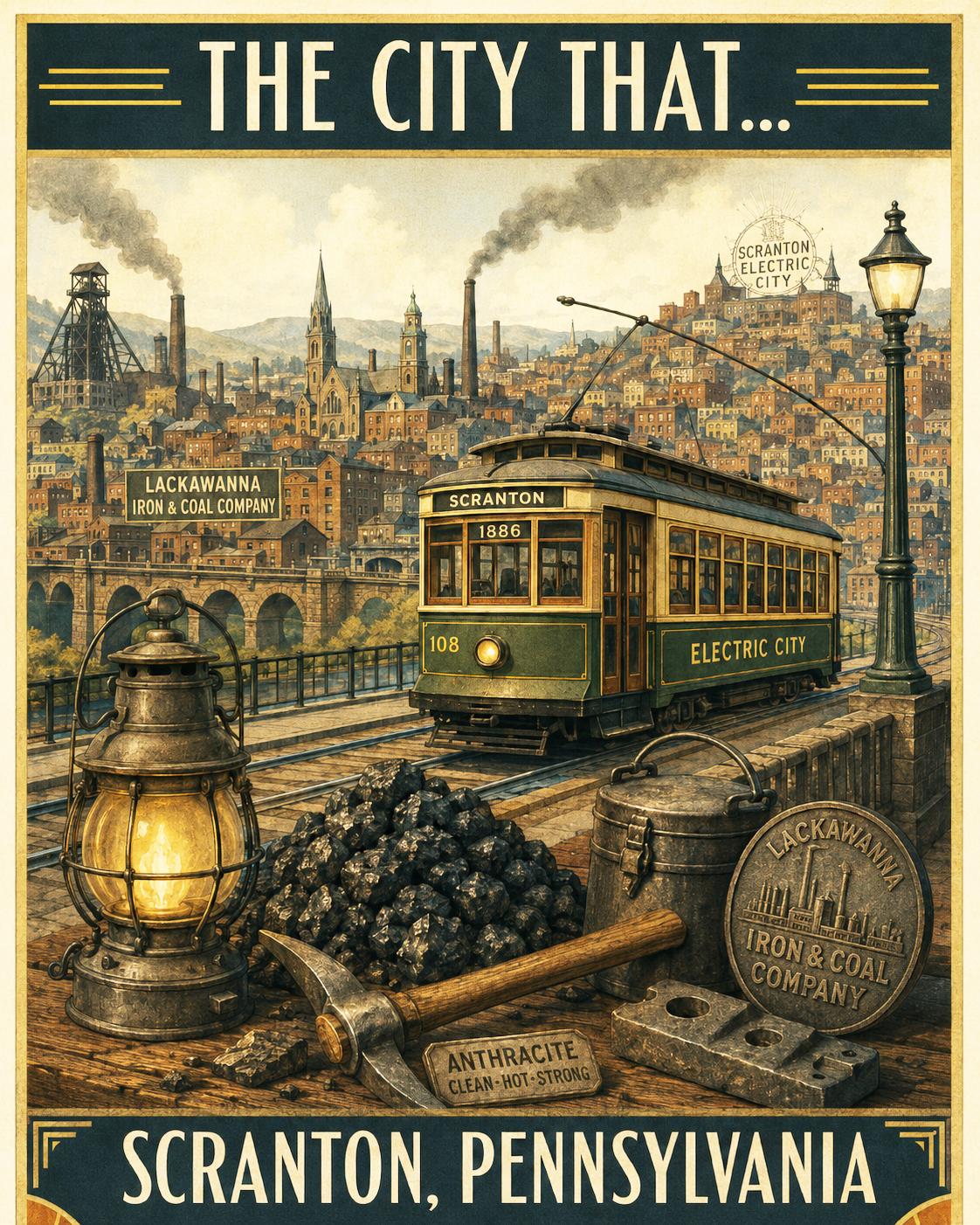
It dug the fuel and lit the first streetcars of the electric age.
This is the tenth profile in The City That…, a series about American cities that invented an industry, led the world in it, and then watched the center move on. We tell their stories plainly and with affection — what they made, what it cost, and what they still are.
The Founding
Before it was Scranton it was Slocum Hollow, a scatter of houses on the Lackawanna River where a forge had run and failed. The valley was no obvious place to build anything; older, richer towns — Wilkes-Barre, Carbondale — already held the money. What it had was three things stacked in the same rock: iron ore, limestone, and coal. Not the soft, smoky bituminous coal of the west, but anthracite. Hard coal. It burned hot and clean and almost without smoke, and a man who could make iron with it needed no charcoal or coke.
That was the bet. In 1839 two brothers from New Jersey, George and Selden Scranton, came up the valley with partners and a theory and began trying to smelt iron with anthracite. The first years were lean; the nails they made were brittle, and the venture nearly died. Then they turned to rails.
The country was laying track as fast as it could roll iron, and the Scrantons learned to roll it. The Lackawanna Iron & Coal Company, founded in 1840 and named for the river, became the first American works to mass-produce the T-rail — the iron rail the young railroads bolted down by the thousands of miles. George Scranton helped charter the Delaware, Lackawanna and Western Railroad to carry it out. The town took the family’s name in 1851. A city had been built to make the thing that other cities were built with.
The Height
The iron made the town. The coal made it large, and made it famous.
Scranton sat on the Northern Anthracite Field — nearly all the anthracite in the world lay in this one corner of Pennsylvania. Hard coal heated the parlors and fired the furnaces of the whole industrializing East, and Scranton dug it and shipped it. The region reached its peak in 1917, near a hundred million tons in a single year; the men who cut it numbered, at the 1914 high point, close to a hundred and eighty thousand across the fields.
They came from everywhere to do it. First the Welsh and the English, who knew deep-shaft mining and brought the craft — the city grew Welsh enough to be called, for a time, the Welsh Athens of America. Then the Irish, out of the famine, into the hardest and lowest-paid work. Then Italians, Poles, Lithuanians, Slovaks, Ukrainians, into the patch towns where the churches told the whole map of the migration in stone: Gothic spires for the Irish, onion domes for the Ukrainians, Romanesque for the Poles. They built a dense, loud, believing civic life on work that could kill a man before noon.
Some of the workers were children. In the breakers — the tall wooden buildings where raw coal was crushed and sorted — sat rows of boys, some no more than ten, bent over the moving chutes, picking slate and rock from the coal with bare hands while the dust rose so thick it hid the far wall. It settled in their lungs and stayed. The state had barred boys under twelve after 1885, but a forged birth paper was cheap and a family needed the wage, and the boys kept picking. When Lewis Hine brought his camera to the Scranton and Pittston breakers in 1911, the pictures he carried out — the small hunched shapes, the old men’s eyes in the young faces — helped shame the country into changing its laws. Hold on that longer than the story needs: a child, bent all day over a coal chute, breathing rock. That was the price under the prosperity, and it was paid in the bodies of the young.
And over all of it, the bright thing. In 1886 an attorney named Sturges hired the inventor Charles Van Depoele to build a streetcar line that ran on nothing but electricity, through overhead wires, and on the last day of November the first car pulled away toward Green Ridge. Other cities had tried electric cars; Scranton’s is remembered as the first in the country built to run wholly on electric power. The city that dug the fuel now moved its people by the current, and took a nickname it has never given back: the Electric City. By 1900 the cars carried more than ten million riders a year over a hundred miles of track.
The Turn
Two pillars held Scranton up. Both came down.
The iron went first, the way industry goes — toward cheaper ore. The Lackawanna works wanted the rich iron coming off Minnesota’s Mesabi Range, and it was cheaper to move the plant to the ore than the ore to the plant. In 1902 the company moved to a lakeside site near Buffalo, taking the steelmaking and the payroll. The city named for the iron family had lost its iron.
The coal took longer and hurt worse, because more people lived on it. The decline began quietly in the 1920s, when oil and gas began heating the homes anthracite used to heat. Then came a problem no market could fix: water. The deeper the mines went, the more groundwater poured in, and it had to be pumped or the coal drowned. By 1920 the region pumped roughly eight tons of water for every ton of coal; by 1950 the ratio had reached twenty-seven to one. People still argue over what really killed the field — the furnace oil, the played-out seams, the union, the operators — and all of it was true at once. But the arithmetic of the water is hard to argue with: when it costs more to lift the water than the coal is worth, the mine is already closed and does not yet know it. Between 1950 and 1955 the region’s mine payroll fell almost by half, from about seventy-five thousand to thirty-seven thousand.
The symbolic end came on the cold morning of January 22, 1959, a few miles down the valley at Port Griffith. The Knox Coal Company had ordered its men to mine upward, illegally, toward the bed of the Susquehanna, leaving a roof of rock too thin to hold. The river broke through, ran through the connected mines of the whole valley, and filled the tunnels with billions of gallons of water. Twelve men never came out; a surveyor named Joe Stella led dozens of others up by reading an old mine map in the dark, chest-deep in the flood. Here the honest thing must be said plainly. This was no act of nature. Knox had mined where it was forbidden to mine, in an industry shot through with corruption — leases held by organized crime, safety rules waived, union men bought. The river came in because greed had sent those men beneath it, and the killing of the twelve was a crime as much as a tragedy. The breakers went on closing; the last big one in Scranton, the Marvine, shut in 1963.
What Was Lost
What was lost was work, and the certainty that came with it. For three generations a Scranton boy knew what he would do: go down as his father had, or into the mill, and the mine would be there. Now the mine was a flooded hole and the mill was in Buffalo, and the skill in a miner’s hands was worth nothing above ground. The young left for the cities still hiring; the old stayed with the closed collieries and the culm banks, the black hills of mine waste that stood over the valley for decades. A city that had sold the country its warmth could no longer sell it.
What Remains
It did not die. Scranton went through long hard decades and came out smaller and changed, but it came out. The economy runs now on what holds a mid-sized city up when the industry is gone — the hospitals, the university, the courts, the service work — and the city keeps its own memory better than most.
It keeps it below ground and above. At McDade Park you can ride a car three hundred feet down into a real anthracite mine and stand in the damp dark where the men worked. At the Anthracite Heritage Museum the story is told through the immigrant home and the corner bar, the people and not the tonnage alone. The Scranton Iron Furnaces still stand, four great stone stacks, the bones of the works the Scrantons built. Steamtown keeps the locomotives on the old Lackawanna yards, and the old railroad station is a hotel now, where travelers sleep where the coal trains once loaded. And on the skyline the Electric City sign still burns — dark for a while in the hard years, lit again by people who passed a hat for it.
The city gave the country more than coal. It gave it Jane Jacobs, born here in 1916 as Jane Butzner, a doctor’s daughter who rode the Scranton streetcars downtown and watched the great pistons work at the railroad station, and grew up to teach the world how a living city breathes — she learned to see cities by watching this one move. And on a March evening in 1965 it gave a smaller, truer thing. A trucker named Eugene Sesky lost his brakes on the steep grade down Moosic Street with fifteen tons of bananas behind him. Witnesses said he climbed onto the running board to wave the traffic off and steered the runaway clear of the crowd until it went over. Fifteen were hurt; only Sesky died. A folk singer heard the story on a bus out of town and made a song of it, and the song is funny until you learn it is true. That was Scranton in one man: on the running board of a thing he could not stop, blowing the horn to save the people in front of him.
Hard coal out of the deepest field in the world; the first rails of a railroad country; the first streetcars of the electric age; and under it all the boys in the breakers and the men who never came up from Knox. The furnaces are cold and the sign is lit. Scranton burned to build the country, and that is worth remembering.
Why Scranton? It dug the hard coal that heated and forged the industrializing East, rolled the first American T-rails, and ran the first streetcar system built to operate wholly on electricity — and for the better part of a century the country was warmed, moved, and bound together by what this one valley produced.
* * * * *
Charles C. Jett is an author, civic educator, and Professional Certified Coach based in Chicago. A graduate of the U.S. Naval Academy (Class of 1964) and Harvard Business School, he served during the Cold War aboard the nuclear submarine USS Ray (SSN 653), where his tactical innovations helped inspire Tom Clancy’s Jack Ryan character. He is the author of six books, including Super Nuke!, hosts four podcasts, and writes across his Critical Skills Blog platform on history, leadership, and the health of the American republic. In his writing he employs AI tools in a limited, supporting role for research, occasional image creation, and editing, while the prose and judgment remain entirely his own. He and his wife, Dr. Nancy Church, live and co-host the Chicago Salons at Water Tower Residences.



Leave a Reply