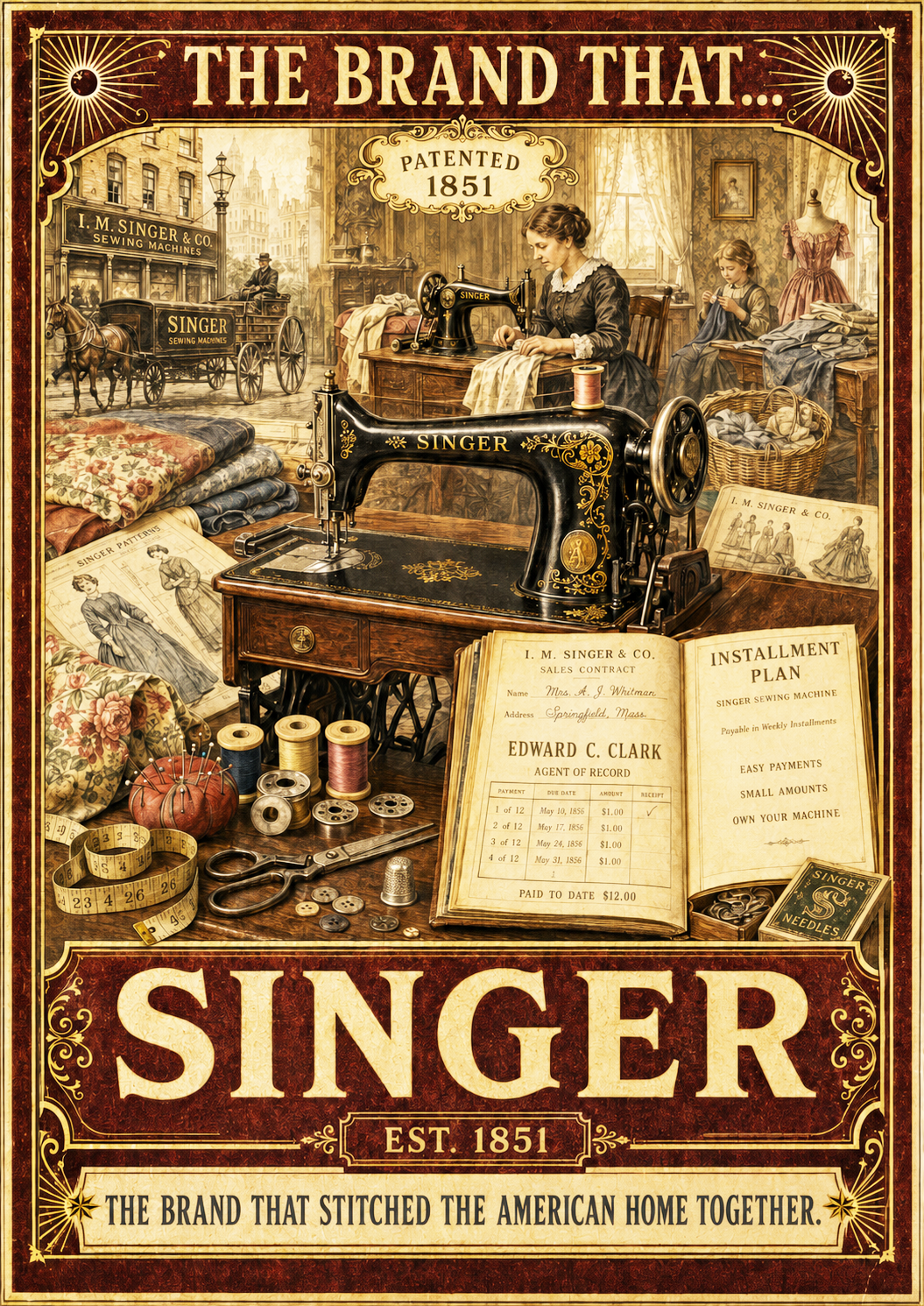
A dollar down, a dollar a week — and a country learned to buy what it could not afford.
This is the eleventh profile in The Brand That…, a series about American brands that taught the country a habit, became the word for the thing itself, and outlived the world that made them. We tell their stories plainly and with respect — what they made, what it cost, and what they still are.
The Founding
In June of 1850 a man carried a machine nobody wanted into a shop at 19 Harvard Place in Boston.
Isaac Merritt Singer was thirty-eight, the eighth child of poor German immigrants, run away from home at eleven. Machinist, cabinetmaker, manager of a failed theatrical troupe. The machine he carried carved wooden type for printers. He rented display space from Orson Phelps and waited for orders that never came.
Phelps built sewing machines on contract. They were hard to use and hard to make. He asked Singer to look at one. Singer refused; he thought the work beneath him. Then he agreed, and in eleven days he was finished.
The fix was small. The old shuttle traveled in a circle and Singer ran it straight. The needle was curved and he made it straight. He added a forward motion to draw the stitch tight and a pad to hold the thread’s tension off the spool. Patent No. 8,294, the twelfth of August, 1851.
He never claimed to have invented the sewing machine. Walter Hunt had built one. Elias Howe had patented one in 1846, and would sue him, and win. Singer built one that worked.
A bookseller named George Zieber put up the money. The shop was Phelps’s. Within a few years both were maneuvered out by Singer and by the lawyer who came to handle the patent suits and took three-eighths of the company in place of his fee. The men who supplied the bench and the capital got nothing from what they made possible, and nothing after excuses it.
The lawyer was Edward Clark. He would matter more than the machine.
The Rise
The 1851 machine was built for shops: cast iron, filed by hand, sold to tailors. The one that took the country came later — a model small enough for a family in 1856, and in 1865 the New Family, four million of them sold before 1882.
They were made to be looked at. The bed was japanned black and laid with gold scrollwork, and it sat on a cabinet of figured wood with drawers for the bobbins and the thimble. A woman who could not have a piano could have this. Stamped into the bed was a serial number, and because the company kept its books, a granddaughter can still read the number off her grandmother’s machine and learn the year it was made and the factory that made it. Not many things in an American house will still tell you that.
The machine cost a hundred and twenty-five dollars. A family’s whole year came to about five hundred.
Clark took his answer from the piano showrooms near the office. Rent the machine to the housewife, the company’s gazette said in 1856, and apply the rent against the price. Installment buying was old. Clark made it the spine of a business. Sales tripled in a year, and a dollar down and a dollar a week put a Singer into houses that had never held anything so dear. By the 1890s his agents were known across the country for how hard they pushed it.
The patent war ended that same year in the way that suited the men suing each other. Four makers pooled their claims as the Sewing Machine Combination, the first patent pool in America, and added the license fee — fifteen dollars a machine, later seven — to the price. The customers paid for the peace.
Then it went everywhere — Kilbowie near Clydebank, and Brazil, and Germany, and Italy. It was among the first American companies to build its factories in other men’s countries. The advertising was the same everywhere and never the same picture: the block S with the name written inside it, and beside it a woman in the dress of wherever the poster hung. In Japan in the 1920s the women hired to teach sewing wore hakama, the pleated garment of men and samurai, and taught a trade to women who wanted money of their own.
Clydebank is where the cost shows. By 1911 the works held some eleven thousand people, run on American methods: piecework, time and motion, the load raised and raised. Ten thousand walked out. The company locked them out, broke the strike, and dismissed four hundred, every union leader among them. No one died. The fired carried what they knew into the yards along the river, and the district became Red Clydeside.
In 1872 the company bought thirty-two acres of waterfront at Elizabethport, New Jersey. The age called it the largest factory on earth given to the making of a single product.
The Turn
In 1908 the company finished a tower at Broadway and Liberty Street, six hundred and twelve feet of red brick and bluestone, the tallest building in the world. It held the title a year. The company sold it in 1963, and by 1969 it was down — the tallest building ever demolished by the men who owned it.
The men who sold the tower were not sentimental, and they were not thinking about sewing. Donald Kircher took over in 1958, when nine sales dollars in ten came from sewing machines, and he thought that was a trap. He bought Friden’s calculators in 1963 and in 1968 paid four hundred and fifty million dollars for General Precision Equipment — flight simulators, guidance systems, gas meters. Twenty-two manufacturers in all. By 1970 sewing was down to thirty-five cents on the sales dollar and revenue had passed one and nine-tenths billion. On the numbers he was right.
The easy account says diversification killed Singer, and the record does not quite hold it. Singer quit American calculator engineering in the mid-1970s because it could not build them for what Japanese plants charged. In those same years Brother and Janome took the sewing machine. Two divisions with nothing in common lost to the same thing at once. And underneath both, something quieter: American women were buying clothes instead of making them, because ready-made had gotten cheap and good, and because they had work of their own. A company can be badly run and still be standing in the path of something that was coming through regardless. Kircher’s ambition reads like the mistake. It may only have been the visible part.
Elizabethport made its last sewing machine on the first of December, 1982, after a hundred and ten years.
What remained drew a raider. In 1988 Paul Bilzerian took the company in a leveraged buyout of a billion and sixty million dollars, sold eight of its twelve divisions, and renamed the shell Bicoastal. He was convicted of fraud on nine counts in June of 1989, and that November the company filed in Tampa. Nine thousand Singer retirees sued for two hundred and thirty-five million dollars, alleging the pension plan had been stripped to carry the debt.
The sewing business survived that and died on its own. A Hong Kong financier named James Ting bought the pieces back, took Singer public again in 1991, and moved production out of Brazil and Italy to China. On the thirteenth of September, 1999, holding twenty-three million dollars against debts of a billion and a quarter, Singer filed for Chapter 11.
Two deaths, eight years apart. Two men. Two reasons.
The Reckoning
The name on all of it belonged to a man his own partner thought a danger to the firm.
By 1860 Isaac Singer kept five households. He had married Catharine Haley in 1830, left her, and divorced her that year on a charge of her adultery. For two decades he lived with Mary Ann Sponsler, who used his name and bore him ten children and whom he never married. There was a family by Mary McGonigal that went by Matthews, and another by Mary Eastwood Walters that went by Merritt. Eighteen children acknowledged by four women that year. Twenty-six by five in the end.
In August of 1860 Sponsler saw him on Fifth Avenue in a carriage with McGonigal and said what she thought of it, and he beat her unconscious. When their daughter Vouletti came between them he beat her unconscious as well. Frank Leslie’s Illustrated Weekly printed it. The court ordered him to keep the peace. He was arrested — the record disagrees on whether the charge was bigamy or the beating — made bail, and in 1862 sailed for England and stayed. He built a house in Devon after the manner of Versailles and called it the Wigwam.
Clark read about the carriage in the newspapers and told him to settle it, because the banks were watching. Hold on to that. The company did not put Isaac Singer out for what he did to his wife and his daughter. It put him out because a man like that could not be trusted near its credit. In 1863 the firm was reorganized as the Singer Manufacturing Company and he was gone from its management. He kept the money. He died in 1875 worth thirteen million dollars, and the son who had testified for his mother got five hundred.
What Endures
The name is in Nashville now, held by SVP Worldwide alongside Husqvarna Viking and Pfaff and controlled since 2021 by a California buyout firm. About one household sewing machine in three sold anywhere in the world carries one of those three names. The engineering is done in Sweden, the software in England, the machines in Asia and Latin America. They are still Singers. None of them are made here.
Gandhi refused nearly every machine the industrial age offered him and made an exception for this one. The Wright brothers stitched the covering of their wing on a sewing machine. Neither is why it mattered. It mattered because a woman who could not buy a coat could make one, and then make one to sell, and keep the money.
In January of 2024 a hundred firefighters fought a four-alarm fire in the old works at Elizabethport, and two roofs and a wall came down.
But go into an old American house and look. There is a machine somewhere — in a hallway, under a window, holding a lamp and the mail. Black bed, gold vines, the wheel on the right, a treadle no foot has touched in fifty years. The number is still stamped in it. The tower is gone, the plant is a burn scar on the Jersey waterfront, the company has died twice and been sold five times, and the machine still works. Thread it and it sews. It was bought a dollar at a time by a woman who wanted a good coat for her child, and it has outlasted the tower, the plant, the founder, the founder’s five families, and every man who ever owned the name.
Singer stitched the American home together, and that is worth remembering.
* * * * *
Why Singer? It put a factory-made machine into ordinary houses, and to do it the company had to invent the way Americans buy expensive things — a dollar down and a dollar a week. The machine made the name, the credit made the machine possible, and both outlived every company that owned them.
* * * * *
Charles C. Jett is an author, civic educator, and Professional Certified Coach based in Chicago. A graduate of the U.S. Naval Academy (Class of 1964) and Harvard Business School, he served during the Cold War aboard the nuclear submarine USS Ray (SSN 653), where his tactical innovations helped inspire Tom Clancy’s Jack Ryan character. He is the author of six books, including Super Nuke!, hosts four podcasts, and writes across his Critical Skills Blog platform on history, leadership, and the health of the American republic. In his writing he employs AI tools in a limited, supporting role for research, occasional image creation, and editing, while the prose and judgment remain entirely his own. He and his wife, Dr. Nancy Church, live and co-host the Chicago Salons at Water Tower Residences.




Leave a Reply