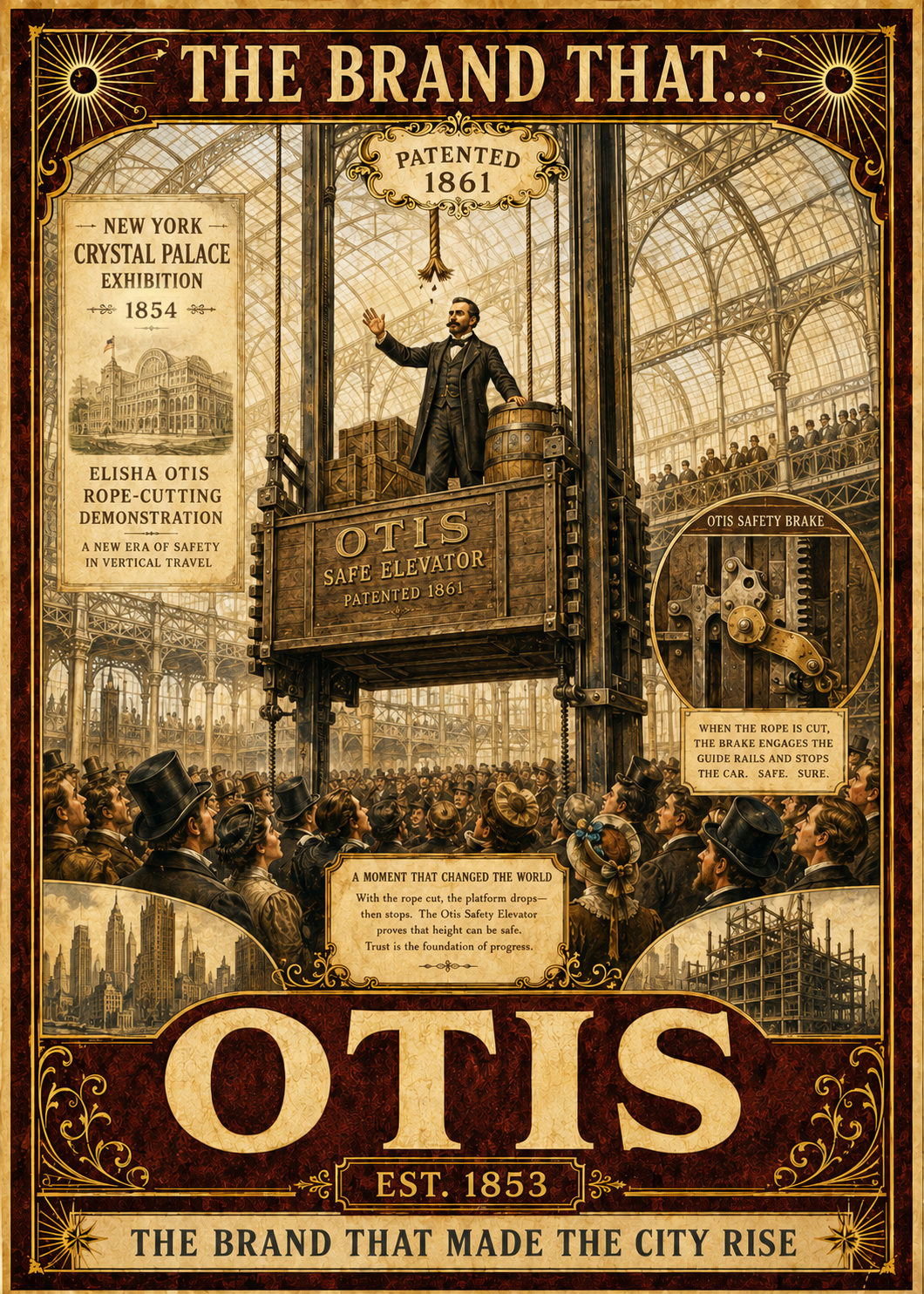
He did not invent the elevator. He invented the reason to trust it.
This is the thirteenth profile in The Brand That…, a series about American brands that taught the country a habit, became the word for the thing itself, and outlived the world that made them. We tell their stories plainly and with respect — what they made, what it cost, and what they still are.
The Founding
In 1852 a mechanic in Yonkers was told to move heavy machinery between the floors of a bedstead factory, and the men would not ride the hoist.
They had reason. Ropes parted and loads fell. Elisha Graves Otis was forty-one, born near Halifax, Vermont, and had been a wagon driver, a carpenter, a builder of gristmills that drew no custom. In Albany he had made a bedstead turner and a railway brake. He was a man who fixed things and could not make a living at it.
His answer was a wagon spring bolted above the platform. The taut hoisting rope held it flexed. If the rope parted, the tension went out of it, the spring snapped open, and its ends drove into sawtooth racks cut into the guide rails. The platform stopped where it was.
He did not patent it. He sold elevators for eight years without protection, and the patent — No. 31,128, Improvement in Hoisting Apparatus — is dated the fifteenth of January, 1861. He died twelve weeks later, of diphtheria, at forty-nine.
The company dates itself to the twentieth of September, 1853, and the first sale of a machine carrying his safety. The name over the door was Union Elevator and General Machine Works. He sold three elevators that first year at three hundred dollars each. At the end of it the whole concern came to a hundred and twenty-two dollars and seventy-one cents — a secondhand lathe, two oil cans, and the account book the figures were written in. Eight the next year. Fifteen the year after that. In its first seven months the shop took one order.
There was no obituary when he died. His estate was five thousand dollars against eight thousand two hundred in debts.
What We Actually Know About the Rope
The story is that he stood on a platform above a crowd at the New York Crystal Palace, had the rope cut, and dropped a few inches, and that he took off his hat and called out that all was safe.
Here is what the record holds.
He performed from May to October of 1854, repeatedly, at the Exhibition of the Industry of All Nations. P. T. Barnum was president of the association that season and had put his own money into it, and Otis’s company says today that Otis arranged with Barnum, and produces no document. Barnum wrote at length about running the Crystal Palace and never mentioned him.
The New York Daily Tribune of the thirtieth of May, 1854 describes the inventor riding his platform and now and then cutting the rope that holds him. So he cut it himself. The paper names no axe and no saber. It gives no height. It does not say how far he fell. The Times covered that fair nearly every day and never wrote about him at all.
The line about all being safe cannot be found in print before August of 1978, in American Heritage. The crowded engraving, the assistant with the axe — those came later too. The account we all know was assembled by his son Charles in 1911 and repeated by the company for a century.
And he was not working alone. Otis Tufts of Boston patented a vertical screw elevator in 1859 and put one into the Fifth Avenue Hotel — a car driven up a great turning screw, safe by its construction because there was no rope to part. It was slow, and it was costly, and it did not last. But the trade press went on naming Tufts as the man who gave America the passenger elevator well into the 1900s. The question of who was first stayed open a long time after Otis began answering it in its own catalogs.
What can honestly be said is smaller and stranger than the legend. Over one summer, in a hall full of other exhibits, a failing mechanic cut his own rope again and again in front of whoever happened to be standing there, and almost nobody wrote it down.
The Rise
The company was not made by the machine. It was made by a piece of paper.
In 1861 Otis put steam hoisting equipment into Horace Claflin’s dry goods house on lower Broadway, and Charles Otis wrote out the maintenance agreement in longhand — he would take charge of the equipment and give it his “frequent personal examination” — for seven hundred and eighty dollars a year. The father died that year. The son had already invented the business.
It was slow to be understood. For decades the work was done by thousands of independent repairmen, and Otis management thought the idea of taking it in-house unwise. A standardized flat-fee contract did not appear until 1921, in Springfield, Illinois. By the late 1930s there were more than ten thousand of them, and they paid whether anyone was putting up new buildings or not.
What the elevator did to the American city, it did to the inside of the American building first. Before the machine, height was a penalty. The good apartments were low. At the Dakota, the largest were placed on the lower floors, and the top was given to servants, storage, and laundry. Andreas Bernard’s history of the elevator has a section called From the Attic to the Penthouse, and that is the whole movement in five words. It was not the elevator alone — light, air, quiet, setbacks, and salesmanship all did work — but the elevator is what made the top of a building somewhere a person would choose to live.
The rest followed. A roped hydraulic machine at 155 Broadway in 1878. Contracts for the Capitol and the White House in 1880. Twelve hundred and fifty passenger elevators in New York City by 1884. In December of 1889 the Demarest Building got what the company called the first successful direct-connected electric elevator, though William Baxter had put an electric machine into Baltimore two years before. Gearless traction came in 1902, and that is the thing that let buildings go as high as anyone wanted.
In Paris the exposition charter barred foreign material and Otis was refused on that ground. The bidding was extended and extended, and no French firm would take on the two curved legs, and in July of 1887 the commission gave the north and south pillars of the Eiffel Tower to Otis for twenty-two thousand five hundred dollars. The lifts were hydraulic. They were taken out in 1910. Otis did not win the Eiffel Tower. Otis won the part of it nobody else would touch.
In 1898 Otis Brothers was consolidated with several major competitors into the Otis Elevator Company, capitalized at eleven million dollars. How many firms went into it is still not settled — the surviving documents count negotiating parties, transferor corporations, plants, and subsidiaries, and they do not agree. Eight years later, in a federal consent decree entered in June of 1906, Otis and some two dozen other manufacturers were enjoined from fixing prices and from allocating markets and customers.
And the word got away. Jesse Reno’s inclined conveyor and George Wheeler’s step design both came before the machine Otis sold, but it was Charles Seeberger who coined “escalator,” registered it as No. 34,724 on the twenty-ninth of May, 1900, and assigned it to Otis. In 1950 a competitor petitioned to cancel the mark as generic and won, and the evidence against Otis was Otis’s own advertising, which had used the word in lower case exactly as it used “elevator.” A series about brands that became the word for the thing has to stop here for a moment. Otis became the word so completely that a hearing officer took it away.
The buildings are all verifiable and they are the ones you would name. The Flatiron in 1902, on hydraulics. The Singer Tower in 1908. Metropolitan Life in 1909. Twenty-six gearless machines in the Woolworth Building in 1913. The Chrysler in 1930.
The Turn
In October of 1975 United Technologies came for the company with a cash tender at forty-two dollars a share.
Otis fought it in federal court and won. Judge Lawrence Pierce enjoined the offer in a forty-one-page ruling on disclosure grounds. United Technologies withdrew, came back all-cash for every share, raised the price to forty-four, and took the company for about two hundred and seventy-six million dollars. The merger closed on the seventh of July, 1976. Otis won its case and lost itself anyway.
Then the plants went. Harrison, New Jersey stopped on the last day of 1980, after seventy-seven years. On the thirtieth of November, 1982, after some fifteen million dollars had been spent modernizing it, the company announced it would close the Yonkers works — the place where Elisha Otis had worked and died. About three hundred and seventy-five people were left there. In better years it had held between one and three thousand. The work went to Hamilton, Ontario and Bloomington, Indiana. The city sued.
For forty-four years Otis was a division inside a defense and aerospace conglomerate. On the third of April, 2020 it was spun back out with six point three billion dollars of debt raised to pay its former parent, which is what a spin-off is. It had first listed on the New York Stock Exchange on the eighteenth of March, 1920. A hundred years, out and back.
The Reckoning
There are two, and they are the same one seen from opposite ends.
The first belongs to the men and women who ran the cars. Automatic elevators existed from the early 1900s and nobody would ride them; given a stair or an empty automated car, people took the stair. In March of 1936 a New York building service strike — one of only eight strikes in the country that year involving ten thousand workers or more — took elevators and heat away from something like a million people. In 1945 sixteen thousand six hundred elevator operators and service workers walked out of twenty-one hundred Manhattan buildings and stayed out five and a half days, and the commercial city stopped.
After that the owners moved. The industry answered with advertisements of children pressing buttons and grandmothers riding alone, a recorded voice in the car, and a large red stop button. It worked. The Census counted seventy-six thousand five hundred and fifty elevator operators in 1960 and twenty-one thousand nine hundred and eighty-two in 1980. Not every one of those fifty-five thousand positions was taken by a machine — buildings changed, job titles changed — but the direction is not in question. The confidence that replaced those people was manufactured deliberately, and it was cheaper than they were.
The second reckoning is the company’s. On the twenty-first of February, 2007 the European Commission found four national cartels running from the mid-1990s into 2004. Otis was fined forty-seven million seven hundred thirteen thousand and fifty euros in Belgium, one hundred fifty-nine million forty-three thousand five hundred in Germany, and eighteen million one hundred seventy-six thousand four hundred in Luxembourg — two hundred twenty-four million nine hundred thirty-two thousand nine hundred and fifty euros in all. In the Netherlands the fine was zero, because Otis went to the Commission first and got immunity. The decision still records its Dutch participation from April of 1998 to March of 2004. Immunity is payment for cooperation. It is not a finding that nothing happened.
Read what the agreements covered. In Belgium, Luxembourg, and the Netherlands the companies agreed not to compete for maintenance and modernization work. Germany was the exception; there it was new installations.
That is the honest complication and it should not be softened. The installed base is what makes this company remarkable — long-lived equipment, specialized knowledge, high cost of switching, contracts that run for decades. Those are exactly the conditions under which incumbents stop competing. The thing Otis is admired for and the thing Otis was fined for are the same thing looked at from two sides. The appeals failed in 2011 and again in 2012, and the damages litigation is still alive: in November of 2025 the Dutch Supreme Court held Otis and Kone jointly and severally liable and sent the claims on to be counted.
What Endures
It would be easy to write the elegy here, and it would be false.
Otis is not a relic. In fiscal 2025 it took in fourteen billion four hundred thirty-one million dollars, of which nine billion four hundred forty-two million came from service. That is sixty-five percent of sales and ninety-one percent of segment operating profit. The company maintains roughly two and a half million units. It is not a survivor of a vanished order. It is a large, profitable, listed multinational that makes nine dollars in ten from looking after machines it already sold, and it is working hard right now on holding its service contracts, because for the first time in a long while some customers are declining to renew.
Nor did one company make the city rise. The steel frame made tall buildings buildable; Otis’s own history says so. Then there were the deep foundations, the fireproofing, the electric light, the telephone, the money, and the land prices. And the trust — the actual trust, the kind you exercise without noticing — was not built by an advertisement in 1854. It was built by building codes, by inspectors, by insurers, by the interlock that keeps a door shut until the car is there, by standards written after people died. A great many of the people who made vertical life safe never worked for Otis at all.
What is left of Elisha Otis is not the rope. It is the paper his son wrote out in longhand in the year he died, promising to come back and look at the machine.
Go into any tall building. Press the button. You will not look up at the cable, or wonder what holds the car, or think about the ratchet on the rail. You will step into a steel box hung in a shaft and let it carry you off the ground, and you will be thinking about something else entirely. That habit is a hundred and seventy years old and it was sold to us on purpose, at a price, by a company that has not always deserved it.
Otis made the city rise, and that is worth remembering.
* * * * *
Why Otis? It sold a machine and discovered it was in the business of promises — that someone would come back, check the brake, and keep the box in the air. The elevator made height habitable; the maintenance contract made the company. Both outlasted the man who cut the rope.
Charles Cranston Jett is an author, civic educator, and Professional Certified Coach based in Chicago. A graduate of the U.S. Naval Academy (Class of 1964) and Harvard Business School, he served aboard nuclear submarines during the Cold War. He is the author of six books, including Super Nuke!, hosts four podcasts, and writes across his Critical Skills Blog platform on history, leadership, and the health of the American republic. In his writing he uses AI tools for research, editing, and occasional image creation; the arguments, the voice, and the final judgment are his. He and his wife, Dr. Nancy Church, live at Water Tower Residences, where they co-host the Chicago Salons.



Leave a Reply