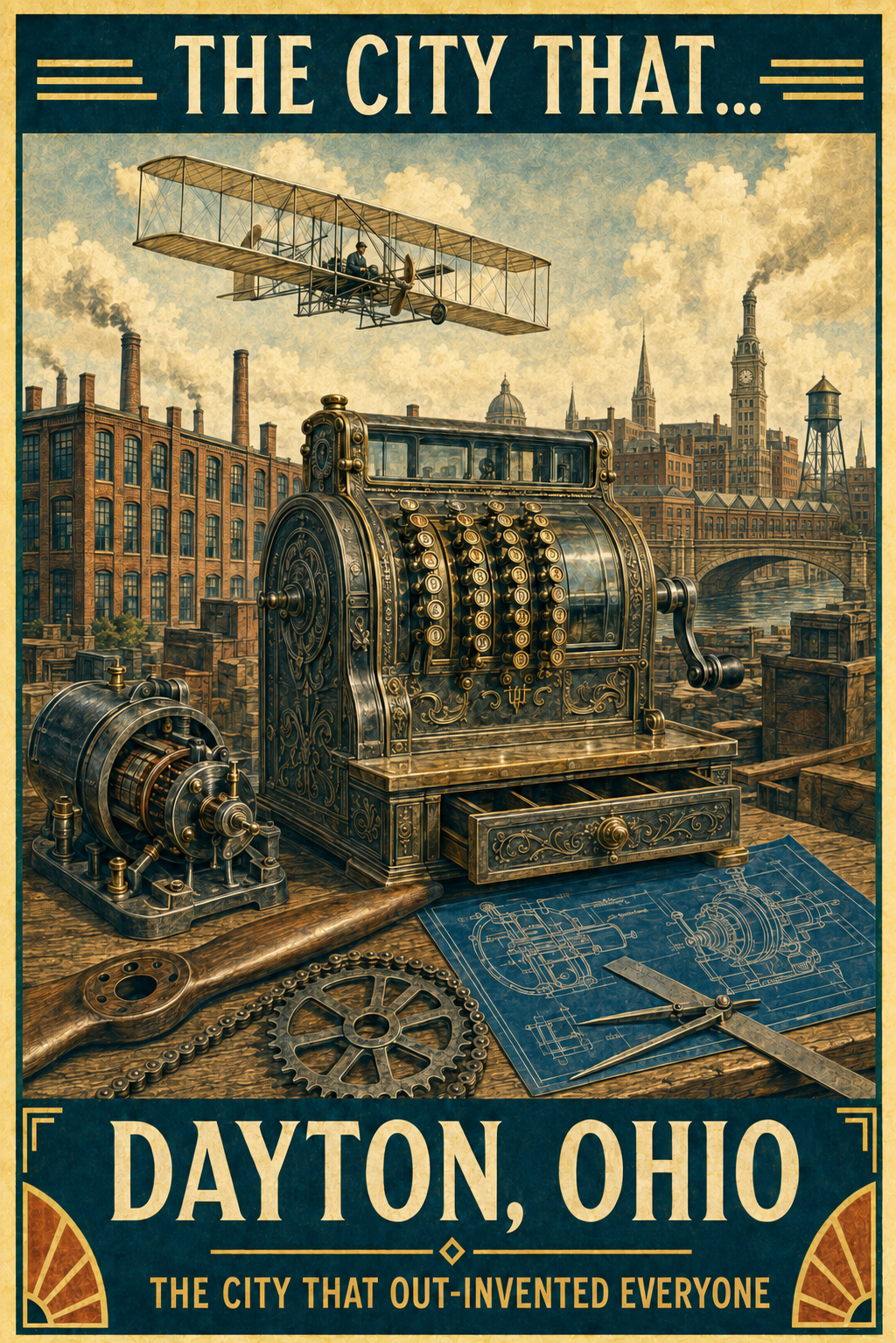
The city whose product was invention itself.
This is the sixteenth profile in The City That…, a series about American cities that invented an industry, led the world in it, and then watched the center move on. We tell their stories plainly and with affection — what they made, what it cost, and what they still are.
The Founding
Dayton has a boast, and the boast is too small for the city.
For a century Daytonians have said their town once produced more patents per person than anywhere in America. The evidence is thinner than the claim: an economist comparing thirty-five large cities put Dayton first in patents per capita in 1900 and second, behind Lynn, Massachusetts, by 1910. One metric. One sample. One good decade.
Set the statistic down and look at what came out of the place.
In twenty-five years one mid-sized Ohio town produced the airplane, the modern sales organization, the electric self-starter, electricity for American farms, and the industrial research laboratory itself. No sample size is needed to find that disproportionate. In 1907 the Chamber of Commerce was already calling Dayton the City of a Thousand Factories; the Census counted 1,045 in the county.
James Ritty kept a saloon and could not keep his bartenders honest. Crossing the Atlantic in 1878 he watched a device count the revolutions of a propeller shaft, went home, and built one to count money. He called it the Incorruptible Cashier. In 1884 a merchant named John Patterson bought control of the company holding Ritty’s patents, then tried the next day to get out of it. The seller said he would not have it back as a gift.
The Height
By 1906 the National Cash Register Company claimed, in its own annual report, ninety-five percent of the registers sold in the world. Patterson built the factory walls out of glass because he believed men worked better in daylight. There were hot lunches, bathhouses, night classes, and no unions, ever.
The invention there was not the register. It was the selling of it — the first sales school, the first primer, the first territory, the first quota. Every company that has ever handed a salesman a number is working from a Dayton design.
In 1913 Patterson fired his best man. Thomas Watson took the method with him and built IBM.
Eight miles northeast, in a pasture a banker lent them for nothing, two bicycle mechanics learned to fly. Kill Devil Hills proved the arithmetic in 1903; the flying happened here. On the fifth of October, 1905, Wilbur flew twenty-four miles over that pasture and came down owning a practical airplane. The Wright Company then put up a brick shed on Coleman Avenue, four thousand square feet in a cornfield — the first building in America built to make airplanes.
In a barn on Central Avenue, Charles Kettering and Edward Deeds worked nights with the men they called the Barn Gang. Delco came out of it in 1909, then the self-starter on the 1912 Cadillac, and Delco-Light, a bulb over kitchen tables the grid would not reach for twenty years.
Then the water came.
In March 1913 the Great Miami came over its levees and put downtown under twenty feet of moving water. More than 360 people died in the valley. Patterson stopped the cash register line. He sent the carpentry department — men who built cabinets for money machines — to build flat-bottomed rowboats, and they built more than two hundred of them out of green lumber, unfinished, unpainted, going out the factory door and down to the water as fast as hands could carry them. The plant on the hill became a hospital, a bakery, a shelter, and a morgue.
Say what you like about John Patterson. He had two hundred boats in the water while the state was still working out what had happened.
Afterward, twenty-three thousand citizens subscribed two million dollars of their own money and built five dry dams and forty-three miles of levees. In 1917, from that flood-control district — the one Dayton had paid for — Deeds leased two thousand acres to the Army.
The Turn
Dayton’s factories mostly did not close. They were bought.
The airplane went first: the Wright Company was incorporated in New York in 1909, on Vanderbilt and Belmont money. General Motors bought Dayton-Wright in 1919 and quit airplanes in 1923, turning the plants over to steering wheels. Delco went to General Motors, and Kettering with it, running GM Research from Detroit for twenty-seven years. Frigidaire went to Cleveland, Mead to Connecticut, Duriron to Dallas.
NCR held on longest and fell hardest. Earnings of $2.11 a share in 1969; four cents in 1971. Fifty-five acres of Dayton factory building machines out of nine thousand kinds of screws, all of it obsolete at once, while the computer business it never mastered ate the franchise from underneath. Production left in 1977. On June 2, 2009, after a hundred and twenty-five years, the headquarters moved to Georgia.
It is tempting to call this a robbery, and I do not think that is honest. Nobody stole the Wright Company; Wilbur wanted investors who were men of consequence, and New York had them. The pattern is real — Dayton invented and Dayton did not own — but I’m not sure whether that was the city’s failure or the nature of the thing. Kettering’s greatest invention was the research laboratory, built to make invention repeatable at industrial scale, and scale is what a city of two hundred thousand does not have.
But it may be colder than that: a place can be brilliant and still be a supplier, and suppliers do not decide. Between 2000 and 2015 Dayton produced 3,500 technology patents against Silicon Valley’s 143,000.
The city that out-invented everyone stopped out-inventing anyone.
And not everything invented here should have been. On December 9, 1921, in Kettering’s Dayton laboratory, Thomas Midgley’s team found that tetraethyl lead stopped an engine knocking. It went on sale at a Dayton pump in February 1923 under the name Ethyl, chosen so the word lead would not appear where a customer could read it. It stayed in American gasoline for sixty years and damaged the brains of a generation of children. That was Dayton work, done in the shop of the most admired man the city ever produced.
What Was Lost
The city held 262,332 people in 1960 and 137,644 in 2020. Metro manufacturing ran 78,800 jobs in 1990 and about 41,500 today. More than a quarter of the people inside the city limits are poor.
The leverage went last.
In March 1996 three thousand brake workers at Dayton’s Delphi plants walked out and shut twenty-six of General Motors’ twenty-nine North American assembly plants, idling 177,000 people. That is what Dayton hands were still worth. Two years later the same local ratified an agreement eliminating up to 1,700 of its 3,400 jobs.
At Moraine, General Motors built Frigidaires from 1951, then Chevrolets, then sport utilities. A thousand jobs went in September 2008 when the second shift ended, fourteen hundred more at the close. The last vehicle came off the line on December 23, 2008. Two days before Christmas.
Toledo kept its glass.
Akron kept its rubber.
Dayton kept nothing of the cash register at all.
What Remains
Now the loan comes back.
The Army leased Deeds’ two thousand acres in 1917 and called it Wilbur Wright Field. It is Wright-Patterson Air Force Base today, more than 38,000 people, the largest single-site employer in Ohio. In 2002 it was 19,000. The base doubled in twenty years while the city’s factories halved. The Air Force Research Laboratory is headquartered there, direct heir to McCook Field. Joby Aviation began making propeller blades at the Dayton airport in October 2025, and Sierra Nevada rebuilds Air Force aircraft in hangars beside the runway.
In the Moraine shell where the Frigidaires and the Blazers were built, a Chinese glass company cuts windshields, for less than half what the union used to pay.
Not one of the ten largest employers in the metropolitan area is primarily a manufacturer. Hospitals, universities, governments, a warehouse. In the city of a thousand factories, that is the arithmetic.
Go out to Huffman Prairie on a summer afternoon and it is a pasture, mowed, with a marker at the edge. The wind moves the grass the way it moved when two men in stiff collars hauled a machine out of a shed and taught themselves to turn in the air. Six miles off, the 1905 Flyer III sits in a sunken room at Carillon Park, given by Orville, the only airplane in the country designated a National Historic Landmark. The factory where they built the first airplanes for sale still stands on Wisconsin Boulevard, burned in 2023, waiting on the Park Service. And a company in Atlanta still publishes a support number with a Dayton area code.
A pasture, an airplane, a burned brick building, and a number that still rings here.
Dayton out-invented everyone, and that is worth remembering.
Why Dayton? Its industry was invention itself — the airplane, the cash register, the self-starter, the research laboratory — and for roughly forty years around the turn of the twentieth century a town this size set the country’s pace, then watched nearly all of it end up owned somewhere else.
* * * * *
Charles C. Jett is an author, civic educator, and Professional Certified Coach based in Chicago. A graduate of the U.S. Naval Academy (Class of 1964) and Harvard Business School, he served during the Cold War aboard the nuclear submarine USS Ray (SSN 653), where his tactical innovations helped inspire Tom Clancy’s Jack Ryan character. He is the author of six books, including Super Nuke!, hosts four podcasts, and writes across his Critical Skills Blog platform on history, leadership, and the health of the American republic. In his writing he employs AI tools in a limited, supporting role for research, occasional image creation, and editing, while the prose and judgment remain entirely his own. He and his wife, Dr. Nancy Church, live and co-host the Chicago Salons at Water Tower Residences.



Leave a Reply