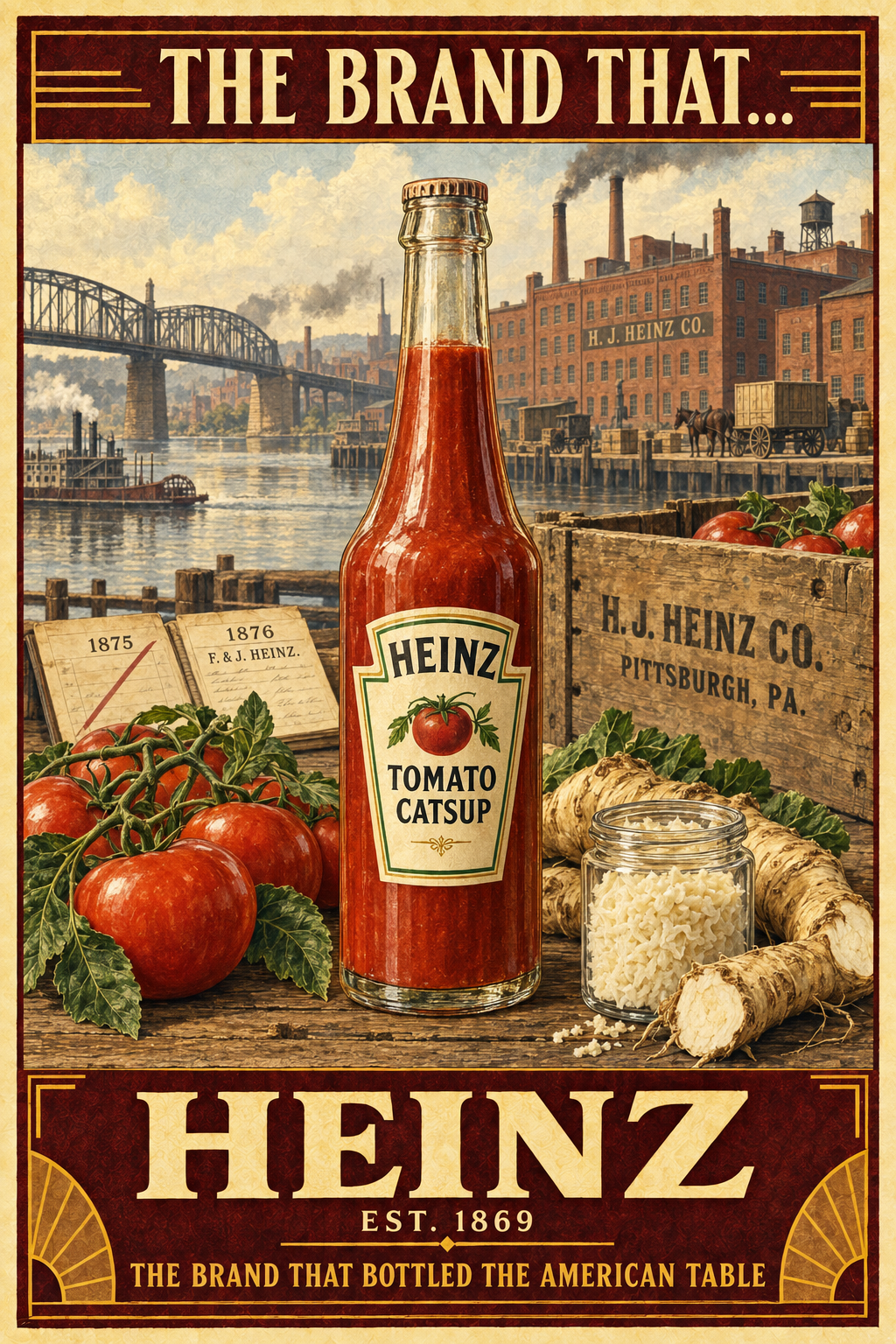
Thirty-two billion in write-downs, and the accountants never touched the ketchup.
This is the sixteenth profile in The Brand That…, a series about American brands that taught the country a habit, became the word for the thing itself, and outlived the world that made them. We tell their stories plainly and with respect — what they made, what it cost, and what they still are.
The Founding
Sharpsburg, 1869. Henry Heinz was twenty-four, and the house was his family’s. The Heinzes had moved up the Allegheny from Pittsburgh’s South Side when he was five. His father made bricks there, his mother kept a garden, and the boy sold what it grew to the grocers in town. By twenty-four he had a partner, L. Clarence Noble, three-quarters of an acre of horseradish, the basement of the house his family had just left, and — by the company’s telling — his mother’s recipe. That is the beginning of Heinz ketchup history, though there was no ketchup in it yet.
What he had, past all that, was a bottle. Horseradish in those years came in green glass or brown, and the glass hid what the makers put in it: turnip, wood fiber, whatever ground white and cost less than the root. Heinz bought clear glass. It cost more. A woman in a Pittsburgh grocery could hold the jar to the window and see the shreds of the root and see nothing else. He did not have to say it was pure. The glass said it, and the glass was also the best advertisement he ever ran.
The firm grew into Heinz, Noble & Co., opened houses in St. Louis and Chicago and contracted for the cucumber crop of eight hundred Illinois acres. Then the Panic of 1873 reached Pittsburgh. In December 1875 Heinz & Noble entered bankruptcy with about $110,000 in assets against $160,000 owed, and Henry Heinz, the partner who had done the financing, was bankrupt with it. His parents’ furniture was levied for the sheriff and his father’s brickyard was sold. Creditors accused him of hiding stock and he was arrested. He was thirty-one.
The Rise
On New Year’s Day 1876 the family met, and he offered the only terms he had: someone else would own the company and he would run it for wages. On February 14 his brother John and cousin Frederick raised three thousand borrowed dollars and formed F. & J. Heinz. The initials were theirs. His wife Sallie held half the firm. He held nothing and drew $125 a month, and carried a notebook marked M.O. — Moral Obligations — listing every Heinz & Noble creditor. By 1879 every one of them was paid at a hundred cents on the dollar. The court did not release him from the bankruptcy until February 3, 1885. “Thank God I am a free man,” he wrote in his diary that day. He had been running the company for nine years.
The company added tomato ketchup that first year, spelled catsup on the label, and the ketchup became the thing the name meant. He bought John out in 1888 and put his own name on the door. He bought a glass works in Sharpsburg in 1892 so no one else would make his bottle. He built the plant at Allegheny City, now Pittsburgh’s North Side, and opened it to the public, which no food maker did; by 1907 thirty thousand people a year walked through it and watched the girls in white pack pickles. Pittsburgh’s own story — the forge, the mills, the iron — is told in the companion series, in The City That Forged the Modern World. Heinz was the mild thing the hard city made.
In 1893 at the Chicago fair he gave away a million gutta-percha pickle charms, and the New York Times reported the gallery floor sagging under the crowd. In 1896, by the company’s telling, he saw a car card on a New York elevated train advertising twenty-one styles of shoes, and stopped counting his own at 57 because he liked the number; the company made more than sixty. In 1900 a six-story electric pickle went up at Fifth Avenue and 23rd Street. He set 57 into hillsides in concrete. It is still on the bottle.
The Turn
Heinz ketchup used chemical preservatives — salicylic acid, then benzoate of soda — into the new century. Around 1900 Heinz set his laboratory to work on a ketchup that would keep without them, and the early batches popped their corks at sixty hours. The answer was more tomato, more vinegar, and a clean kitchen, and by 1906 the company was filling five million bottles a year without benzoate and printing the fact on the neck. That June Congress passed the Pure Food and Drug Act. Heinz had sent his son Howard to Washington to win Roosevelt to it, and Harvey Wiley, the government’s chief chemist, later wrote to Howard that he would have lost it without the Heinzes.
His biographer Robert Alberts called the stand “idealism and noble purpose compounded with pragmatic self-interest,” and both halves held. The law’s sanitary standards were written to the scale of plants like his, and historians have argued they finished off countless small and regional producers who could not meet them. The clear bottle was a promise. It was also a moat. He had placed his bet before the law passed, and the law protected the bet.
The founder died of pneumonia at home in Pittsburgh on May 14, 1919. His son ran the company, then his grandson. The family took it public in 1946 and gave up management in 1969, and the company went on buying companies and selling them again. In 2013 Warren Buffett’s Berkshire Hathaway and the Brazilian firm 3G Capital took Heinz private for $28 billion with debt. In 2015 they merged it with Kraft.
The Reckoning
3G’s method was zero-based budgeting: every expense justified from nothing, every year. It had a case. The brands were old, the plants were many, and a fourteen-ounce bottle of Heinz sold at Walmart for three dollars against a store brand under one. Cutting cost was the sane response to a shrinking business, and nobody has shown a better one the shareholders would have stood for.
In February 2019 Kraft Heinz disclosed an SEC investigation, cut its dividend by 36 percent, and wrote down $15.4 billion, mostly the Kraft and Oscar Mayer trademarks. The SEC later found the company had run what it called a long-running expense-management scheme, booking $208 million of procurement savings that did not exist, and Kraft Heinz paid $62 million to the government and $450 million to its shareholders to settle. Buffett said he had overpaid.
Whether the cost-cutting caused the write-down is an analyst’s judgment; the company blamed valuations and consumer shifts. I have gone back and forth on it. The savings were real for a while, and the brands did fade, and the brands were fading before 3G arrived, and the same decade was hard on every packaged-food company that had not cut a dollar. I don’t know that the starvation theory is wrong. I know that it is the tidy one.
Here is the fact that is not tidy. The 2019 write-down did not touch the Heinz mark. Neither did the $9.3 billion write-down of 2025 nor the $7.4 billion of this past summer, which fell on Kraft, Velveeta, Lunchables, Maxwell House. Through some $32 billion of impairments, the accountants who had to put a value on every name in the house never once marked down the one on the ketchup.
What Endures
As of this writing, Heinz belongs to the Kraft Heinz Company, headquartered in Pittsburgh and Chicago, with $24.9 billion in sales last year and falling. On September 2, 2025, the company announced it would split in two, with Heinz leading the half built on sauces. On February 11, 2026, a new chief executive paused the split with no end date and put $600 million into marketing and research instead. Berkshire has registered its whole 27.5 percent stake for sale and, at last filing, had not sold a share. The parent has not decided what it is. The bottle has.
The ketchup is made in Fremont, Ohio, and Muscatine, Iowa. The North Side plant is apartments. The Sharpsburg house was floated down the Allegheny on a barge in 1904 and trucked to Michigan in 1954, where it stands in Henry Ford’s village. In 2010, the last year Heinz reported alone, it counted 650 million bottles and eleven billion single-serve packets a year, and the packets are the moat the founder would have recognized: every diner in the country keeps a box of them, and the name on the box is the name of the thing.
Hold the bottle up to the window. The glass is clear because a young man in Sharpsburg paid extra so a stranger could see the horseradish. The label is a keystone because the state is Pennsylvania. The number is 57 because he liked it, and the red inside is the color of a tomato and nothing else because in 1906 he made sure of that and printed it on the neck. The man went bankrupt and owned nothing and ran the company for wages under his brother’s initials, and every table in America learned to tap the neck of the glass. Heinz bottled the American table, and that is worth remembering.
Why Heinz? Heinz made its name the word for ketchup by putting the product in clear glass and taking the preservatives out before the law required either, and it outlived the world that made it because the name held its value on the balance sheet through thirty-two billion dollars of write-downs that took down every other name in the house.
* * * * *
Charles Cranston Jett is an author, civic educator, and Professional Certified Coach based in Chicago. A graduate of the U.S. Naval Academy (Class of 1964) and Harvard Business School, he served aboard nuclear submarines during the Cold War. He is the author of six books, including Super Nuke!, hosts four podcasts, and writes across his Critical Skills Blog platform on history, leadership, and the health of the American republic. In his writing he uses AI tools for research, editing, and occasional image creation; the arguments, the voice, and the final judgment are his. He and his wife, Dr. Nancy Church, live at Water Tower Residences, where they co-host the Chicago Salons.



Leave a Reply