“Woman has the right to mount the scaffold; she must equally have the right to mount the rostrum.” — Olympe de Gouges, 1791
The Walk
She walked to the scaffold on November 3, 1793, with what an anonymous Parisian chronicler called a calm and serene expression on her face. The crowd admitted it. The executioners admitted it. 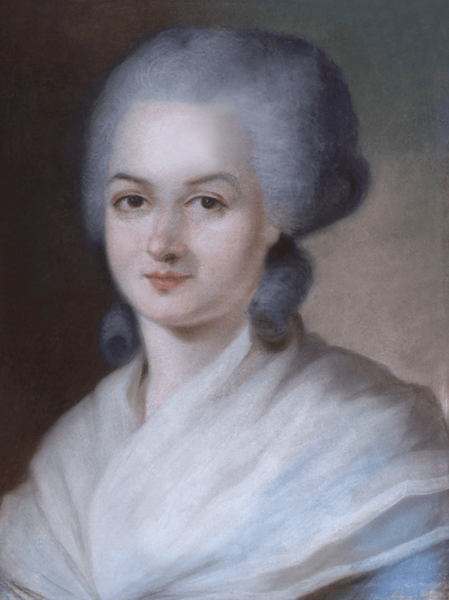 A woman who could not read her own name — or so her enemies said — had written a document that would outlive every man who signed her death warrant.
Her name was Marie Gouze. She called herself Olympe de Gouges. She was forty-five years old. A butcher’s daughter from the south of France. A playwright who reportedly dictated her work because she could not write it herself. She had done one thing, in one year, that the French Revolution could not absorb and could not forgive.
She had taken the Revolution at its word.
The Broken Promise
In August 1789, the National Constituent Assembly ratified the Declaration of the Rights of Man and of the Citizen. It was a magnificent document. Its first article proclaimed that men are born and remain free and equal in rights. Liberty. Property. Security. Resistance to oppression. These were natural, inalienable, sacred rights.
They belonged to men.
Women were excluded. So were domestic servants, day laborers, slaves, actors, and hangmen. The Revolution had abolished the old regime and erected a new one. It had transferred sovereignty from a king to a nation. It had forgotten half the nation.
De Gouges saw it immediately. She had greeted the Revolution with hope. She had written pamphlets, plays, and open letters from the start. She had fought in court to force the Comédie-Française to stage her anti-slavery play. She understood what the Revolution was supposed to mean. She understood what it actually meant.
She decided to correct it.
The Mirror Document
In September 1791, she published the Declaration of the Rights of Woman and of the Female Citizen. Seventeen articles. A direct, article-by-article rewrite of the 1789 Declaration.
This was the genius of it. She did not argue from outside the Revolution’s principles. She did not appeal to sentiment, tradition, or the church. She took the Revolution’s own language — its logic of natural rights, its claim of universal citizenship — and followed it to where it had stopped. Then she kept going.
Article I: “Woman is born free and remains equal to man in rights. Social distinctions may be based only on common utility.”
Article X: “Woman has the right to mount the scaffold; she must equally have the right to mount the rostrum.”
That second article was prophecy. She was describing herself, two years before it happened, from the wrong side.
She added a postscript that the legislators never read in session but history has never forgotten: “Women, wake up; the tocsin of reason sounds throughout the universe.” She appended a model marriage contract proposing full community property and equal legal standing between spouses — a direct attack on the gendered inheritance regime that the Revolution had left entirely intact while proclaiming equality.
She dedicated the document to Marie Antoinette. This looked politically paradoxical. It was strategically deliberate. She was using the Queen as a lever, warning that monarchy would destroy itself if it did not align with justice. It was the kind of move that required explaining at the time. It does not require explaining now.
The Abolitionist Foundation
This was not her first fight. In 1788, three years before the Declaration, she had published Réflexions sur les hommes nègres — Reflections on Black Men — demanding that France reckon with slavery in its colonies. She argued that autocratic monarchy and slavery were the same institution in different clothes. Both required the submission of human beings to those who held power by birth and force.
Her play L’Esclavage des Noirs was staged at the Comédie-Française in 1785. The slave trade lobby mounted a press campaign against it and paid hecklers to disrupt performances. The play closed after three nights. She sued and forced the theater to stage it. This is who she was before the Declaration. A fighter who understood that rights are not divided by gender. They are either universal or they are nothing.
The Declaration of the Rights of Woman was not a detour from her abolitionist work. It was its logical extension. She was constructing a philosophy of universal human dignity in a country building the opposite while using the word freedom.
The Fatal Miscalculations
She was also making mistakes. Large ones.
She opposed the execution of Louis XVI. In December 1792, when the King was about to be tried, she wrote to the National Assembly offering to defend him. She argued he was guilty as a king but innocent as a man. The deputies were outraged. She had handed her enemies a weapon.
She associated herself with the moderate Girondin faction at the precise moment the Jacobins were destroying it. On June 2, 1793, the Montagnards imprisoned the prominent Girondins, who went to the guillotine in October. De Gouges kept writing.
Her final pamphlet, Les Trois Urnes — The Three Urns — appeared in the summer of 1793. It called for a national plebiscite, asking the French people to choose among three forms of government: a unified republic, a federalist state, or a constitutional monarchy. Under Terror law, advocating any return to monarchy was a capital offense. She knew this. She published anyway.
She was arrested on July 20, 1793.
The Trial
She spent three months in prison without a lawyer. The presiding judge denied her the right to legal counsel on the grounds that her extensive writing demonstrated she was more than capable of representing herself. It was the cruelest possible use of her intelligence against her.
At her trial, she claimed to be pregnant. “I am pregnant,” she told the tribunal, “and will bear a citizen for the Republic.” The court ordered a medical examination. The officials declared her claim false.
She was charged with composing and printing writings that provoked the dissolution of the national representation and the reestablishment of royalty. The prosecution’s theory was that public debate itself was a threat when it reopened settled questions under wartime emergency.
The Revolutionary Tribunal sentenced her to death.
Her letter to her son, written the day before: “I die, my dear son, a victim of my idolatry for the fatherland and for the people. Under the specious mask of republicanism, her enemies have brought me remorselessly to the scaffold.”
“Children of the Fatherland, you will avenge my death.”
The Legacy
She was right.
Not quickly. Women did not gain the right to vote in France until 1944 — a hundred and fifty-three years after her Declaration. But the document lived. It traveled. Mary Wollstonecraft read it and wrote A Vindication of the Rights of Woman in 1792 — the foundational text of English feminist thought. Simone de Beauvoir cited de Gouges in The Second Sex in 1949 as one of the few women in history who “protested against their harsh destiny.”
Her text is preserved in the Bibliothèque nationale de France’s Essentiels collection — the canon of documents that shaped French civilization. She sits there alongside Montesquieu and Rousseau, the men of the Enlightenment who built the philosophy she completed.
The United Nations Convention on the Elimination of All Forms of Discrimination Against Women, adopted in 1979 and now recognized in nearly every country on earth, carries the institutional DNA of what she wrote in a pamphlet in 1791 that the National Assembly did not bother to debate.
A bust was installed in the Assemblée nationale in 2016. The Revolution that killed her eventually put her face on its walls.
The Critical Skills Verdict
In the framework of the Eight Critical Skills, Olympe de Gouges is a case study in both mastery and failure — and in how one does not cancel the other.
Her Critical Thinking was extraordinary. She identified the logical fraud in the Revolution’s most sacred document before most of her contemporaries were willing to name it. Her Communication skill was the argument itself: she did not explain what was wrong, she demonstrated it, article by article, in the Revolution’s own language — the rhetorical equivalent of turning a weapon around. Her Courage was absolute. She wrote when silence was survival. She published when publication was a capital risk.
Her Judgment failed her. She accumulated enemies on every faction simultaneously — the hard-line republicans who wanted the King dead, the Jacobins consolidating power, the slave lobby, the theatrical establishment. She understood principles perfectly and misread politics almost as completely. She could not stop writing when stopping might have saved her life. That is either a flaw or a definition of integrity. Depending on where you stand.
The scaffold she predicted in Article X became hers in fact. She understood the risk from the beginning. She published anyway.
That is the whole story. One document. One execution. One enduring legacy. And a question she posed in 1791 that republics are still answering: The Revolution said Rights. She asked: Whose?
Charles C. Jett is an executive coach, civic educator, and author based in Chicago. He is the founder of criticalskillsblog.com and civicsage.com, and the author of six books including Super Nuke! The Courage and Consequence series profiles men and women who acted on principle at personal cost and changed the world.




Leave a Reply