The X-ray was ordinary medicine within a year. The first safety rule took thirty-two.
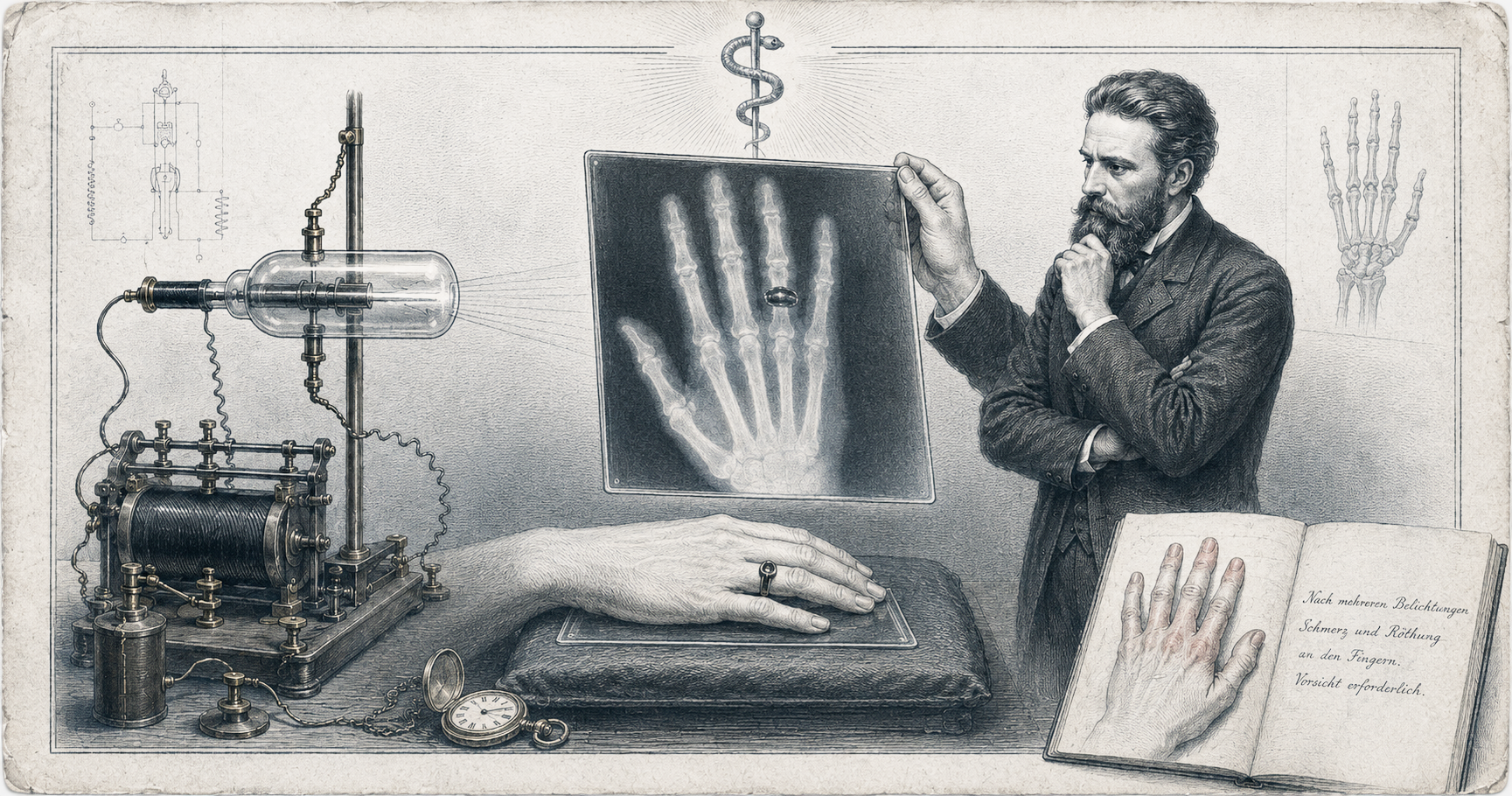
On the twenty-second of December, 1895, a woman in Würzburg laid her left hand on a photographic plate and held it still for fifteen minutes.
Her name was Anna Bertha. Her husband ran the tube. The coil made its noise in a dark room and nothing about those fifteen minutes appeared to cost anything, because whatever passed through her hand could not be seen or felt or smelled, and left no mark on the skin when she lifted it away.
Then the plate was developed. She saw the bones of her own fingers, and her wedding ring riding on one of them like something suspended in water.
Until that afternoon the living body was a closed room. The physician worked its surface. The ear laid against the back, the finger tapping a chest, the probe pushed blind into a wound until it struck something hard. Anatomy was known in detail, and known from the dead. What a surgeon understood about the inside of a living man he understood by analogy, from bodies that had stopped.
To see inside a living one, you cut him open. That was the whole of it. The cutting was the seeing, and the seeing killed a fair share of the men it was meant to save.
It had begun seven weeks earlier, by accident, in the way that only prepared men have accidents. On the eighth of November Röntgen was working with a discharge tube he had wrapped in black cardboard, and he saw a coated screen glowing across the room, well out of reach of anything he could account for. He shut the tube off. The glow stopped. He turned it on. The glow came back.
He told almost no one and worked seven weeks. He photographed a set of weights inside a wooden box and coins inside a purse, and those, not the hand, were the first radiographs. He established that the rays rose from the point where the cathode stream struck matter, that they went through flesh and were stopped by bone and metal, and that they would darken a plate. He could not say what they were. He called them X.
The hand was the demonstration. It was the first image of living human anatomy, and it was the one that traveled.
On the twenty-eighth of December he submitted a paper to the Würzburg Physico-Medical Society and it was in print before the year ended. On the first of January he mailed prints to colleagues. By the fifth the Vienna papers had it. Within days, the world did.
What followed has no equal in the history of medicine. On the eleventh of January, in Birmingham, a physician radiographed a needle in a man’s hand. On the third of February, in Hanover, New Hampshire, a college physics instructor and his brother the doctor photographed the broken wrist of a boy named Eddie McCarthy, who had gone down skating on the Connecticut River. Inside six months, army surgeons were locating bullets with it. Inside a year it was ordinary.
Röntgen took no patent. He held that the thing belonged to everyone, and the consequence was that any man with an induction coil and a glass tube could build the apparatus by the end of the week. They did. Physicians built them. Dentists built them. So did showmen and portrait studios and men who charged a coin to let you look at your own hand.
The burns started the same year as the pictures.
They were reported almost at once. Reddened skin, blistering, hair coming out in patches. They were also argued about, because the injury arrived days after the exposure and the exposure was felt by nobody. In late 1896 Elihu Thomson settled the question in the only way then available to him. He put the little finger of his left hand under a tube for half an hour a day, several days running, and wrote down what happened to it. Pain. Swelling. Stiffness. Erythema. Blistering. He published.
It changed less than it should have.
In February of 1898 a physician rose before a medical society in Denver and read a paper protesting the fear of X-ray burns. The fear, he said, had grown so large in the public mind that it was hampering good surgeons who knew what the rays were worth. Every burn on record could be traced to poor apparatus, or to an exposure held too long, or to a tube set too close to the patient. The rays were sound. Careless men were the trouble.
He was no fool and he was not lying. Each of his three explanations was, as far as it went, correct.
The first bill did not go to the patients. It went to the men who made the pictures. Clarence Dally was Edison’s glassblower, and the way you checked whether a tube was working was to hold your own hand in front of it and look. Dally did that for years. He lost the use of the left hand, then the hand, then four fingers of the right, then both arms, and he died in 1904 at thirty-nine of a cancer that had gone into his chest. The Times called him a martyr to science. Edison quit the field and said plainly that the rays frightened him.
In Hamburg there is a wall with the names of the dead cut into it. It went up in 1936 carrying a hundred and sixty-nine names. More were added, until there were better than three hundred and fifty.
The paper record runs like this. A one-page warning from the German Röntgen Society in 1913. Rules for British operators in 1915. A protection committee, the first in any country, meeting in London in the spring of 1921. And in Stockholm in 1928, three and a half pages adopted as the first international standard.
Thirty-two years from the first documented burn to the first international rule. The evidence sat in the journals the whole time. What made the delay possible was the shape of the harm, which was slow and silent and arrived years behind the picture that caused it, while the picture itself was good the same afternoon.
Every account of that December afternoon ends with Anna Bertha looking at the plate and saying that she had seen her death. It is the best line in the history of radiology and I cannot find a soul who can source it. Every telling carries a reportedly somewhere in it. Röntgen left instructions that his laboratory papers be burned, and they were burned, which is why so much of that room is reconstruction. So I do not know whether she said it. I know it has been said for her, for a hundred and thirty years, because it is the sentence the picture deserves.
And if she did say it, she was wrong about herself. Anna Bertha lived until 1919. The ones who died of what was in that room were the ones who kept coming back to it. The glassblowers. The demonstrators. The operators who held a hand up to the tube one more time to see whether it was lit.
What endures is a habit of mind, that the inside of a living person is a thing to be looked at. We look now with better machines and heavy shielding and a rule about holding the dose as low as it can reasonably be held, and every one of those rules was written by somebody reading a casualty list.
It cannot be undone, and most of us would not undo it. That is the bargain medicine made.
The bones gave themselves up easily; they cast a shadow and asked nothing for it. The heart cast none, and would have to be taught to write.
* * * * *
Charles C. Jett is an author, civic educator, and Professional Certified Coach based in Chicago. A graduate of the U.S. Naval Academy (Class of 1964) and Harvard Business School, he served during the Cold War aboard the nuclear submarine USS Ray (SSN 653), where his tactical innovations helped inspire Tom Clancy’s Jack Ryan character. He is the author of six books, including Super Nuke!, hosts four podcasts, and writes across his Critical Skills Blog platform on history, leadership, and the health of the American republic. In his writing he employs AI tools in a limited, supporting role for research, occasional image creation, and editing, while the prose and judgment remain entirely his own. He and his wife, Dr. Nancy Church, live and co-host the Chicago Salons at Water Tower Residences.




Leave a Reply