
Oxford, 1941 — the rule nobody proved, and the bill everybody pays.
Fleming’s warning was heard. That is the part the story leaves out.
The lecture of December 1945 did not vanish into a hall of applauding Swedes. It was quoted, taught, and turned into instruction, and within a generation the profession had rendered it as four words handed across a pharmacy counter.
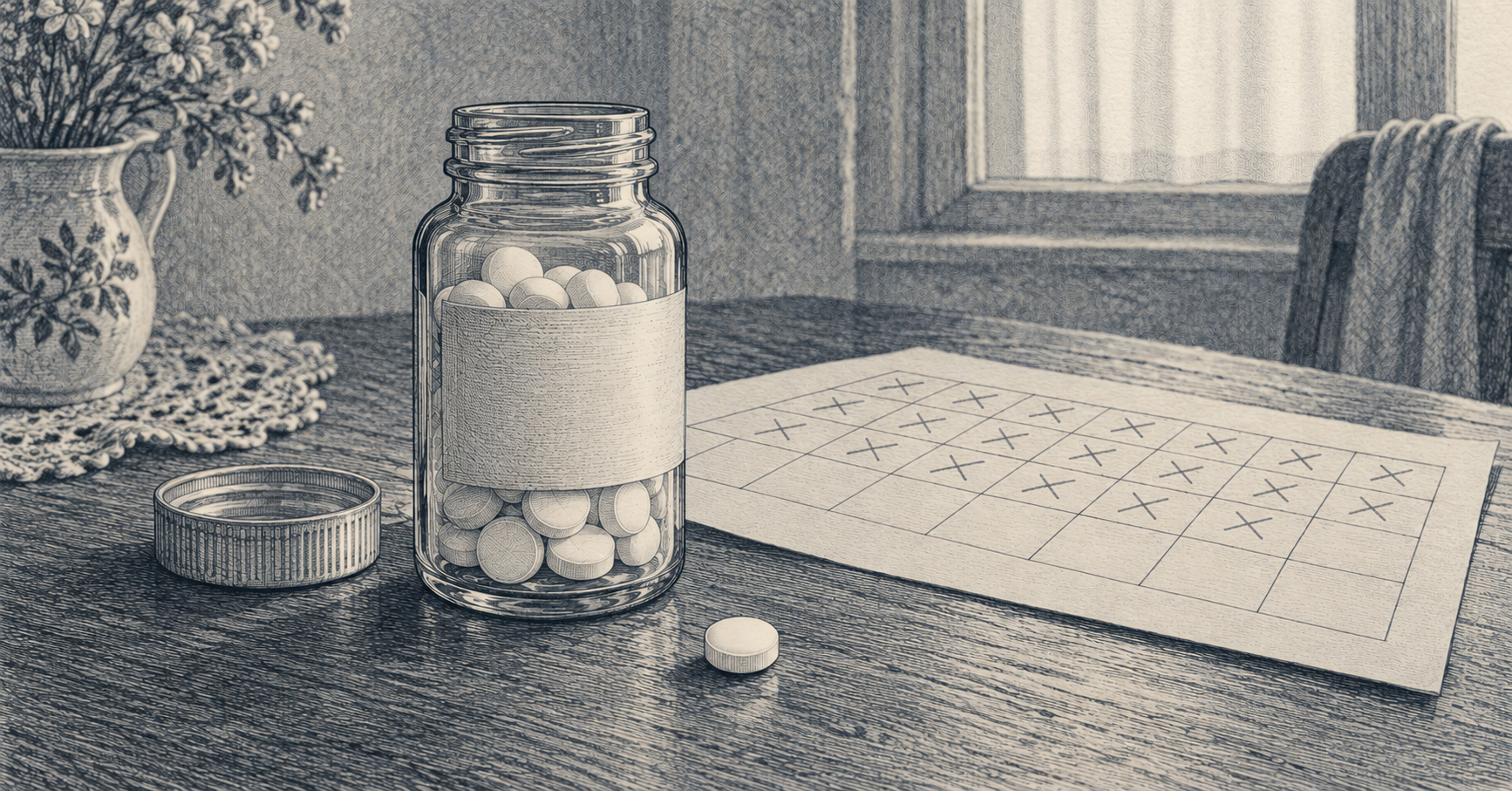
Finish the course. Take all of them. Do not stop when you feel better.
The World Health Organization put it into public campaigns. Britain put it into the school curriculum. It became one of the few pieces of medical instruction that people who could not name a single bacterium could recite from memory.
In the form it was taught, it was not supported by evidence.
Where the rule came from is not documented, and the best guess is a man from the last article. Albert Alexander got his two hundred Oxford units in February 1941, improved for four days, and then the supply ran out. They pulled what they could back out of his urine and it was not enough. He relapsed and died with staphylococci throughout him.
Never run out, never stop early, whatever else happens, finish — that is a natural lesson to draw from that bed, and my reading is that this is roughly where the instruction started. I cannot prove it. Neither can anyone else, which is worth saying before the rest of this rests any weight on it.
What can be shown is what happened to the rule afterward. In July 2017 a group of British infection specialists went looking in the British Medical Journal for the evidence that stopping an antibiotic early breeds resistance, and reported that for common bacterial infections there is none. What the evidence does support is a relationship between resistance and total exposure. The more antibiotic a population takes, the more resistance it selects. For most of the infections the rule was applied to, a course longer than the illness requires is itself exposure.
This is not a correction of Fleming. He was talking about dosage, and about dosage he was right: bacteria held in concentrations too weak to kill them are being trained rather than treated, and the laboratory has confirmed that many times since. What happened afterward is that a specific warning about giving too little hardened into a general rule about stopping too soon, and those are different claims. The rule outran its evidence and then outlived it. Unteaching it has been slow and embarrassing, because the public had been scolded into it, and people do not surrender a scolding easily.
It helps here to know what resistance actually is, because the ordinary picture of it is wrong in a way that matters later.
The familiar version is Darwin at full speed.
A drug kills the susceptible bacteria, a few survivors carry some trick that saves them, and their descendants inherit it. That happens. It is not the whole of it. Bacteria also hand resistance genes to each other sideways, across species lines, on loops and cassettes of DNA that move between cells like contraband — plasmids, transposons, integrons. A gene that defeats a tetracycline can pass from one organism to an unrelated one sharing the same gut, and out of that gut into another animal, and out of that animal into a person, without any of the organisms involved being descended from one another.
Resistance is inherited, and it is also traded.
That is why what happens in a feedlot is a question about a hospital at all. It is also why resistance, once it is loose, is so hard to call back.
The record of what was known, and when, does not read like ignorance anywhere. In 1969 a British committee under Michael Swann reported that feeding antibiotics to livestock at low doses was raising resistance in farm bacteria, and recommended keeping penicillin and the tetracyclines out of feed. In 1977 the Food and Drug Administration proposed to withdraw those approvals in the United States, on the grounds that they had not been shown to be safe. Congress asked the agency to do more research first.
The agency did more research. It also built frameworks, issued guidance, and proposed strategies. What it never did was finish the proceeding it had opened, and in December 2011 it formally withdrew its own 1977 proposals — thirty-four years after making them, without ever having acted on them.
What the science supports here is narrower than the use it gets put to. The largest review of the question gathered a hundred and eighty-one studies of what happens when antibiotics are restricted in food animals, but only twenty-one of those measured resistance in human beings and only thirteen could be pooled. Inside that thin evidence the direction is consistent — fewer resistant organisms carried by people in the intervention groups, the effect strongest among those who work with the animals. What is being counted is carriage, which is not illness and is not death. Against it, sceptics have argued that no published risk assessment has attributed more than about a hundred American deaths a year to farm use, which is a claim about particular organisms travelling particular routes rather than a proven ceiling on the practice.
Why the argument never resolved is visible in the paperwork. In 2004 the Journal of Antimicrobial Chemotherapy ran a long review concluding that the actual danger was small and that most human resistance had come from human prescribing. The authors stated in the paper where they had come from: they had been convened as an advisory board by the Animal Health Institute, the American trade association of the animal drug manufacturers, and the Institute had paid the costs of preparing the review. They added that it was neither commissioned nor approved by anyone there. In the same journal, the veterinary arm of the FDA and the Danish national institutes replied that the paper was fraught with misleading citations and was not an unbiased review. Those Danish institutes had also designed and run the bans whose value was in dispute, which is a different kind of stake from a trade association’s, and worth naming as one.
American sales of medically important antibiotics for food animals rose sixteen percent in 2024.
The other half of the bill came due in the laboratory, and nothing there was suppressed. Nobody stopped looking. But from the middle of the nineteen-eighties onward the classes that reached patients were drawn down from stock laid in decades earlier, and against the Gram-negative organisms that fill intensive care units — the ones with the second outer membrane that keeps most drugs out — nothing new arrived at all after the monobactams in 1986.
Then it did. In March 2025 gepotidacin was approved for urinary infection: a new class, striking bacterial enzymes at a site no existing drug uses, and active against E. coli. A second new class followed in December, for gonorrhoea. In the laboratory, a compound called zosurabalpin is in late-stage trials against one of the most stubborn organisms in any hospital, working by a mechanism nobody had managed to drug before.
So the drought broke, roughly forty years on. It is worth being exact about what that proves. It shows the science was solvable. It says nothing about whether the system will pay for the solving, and the evidence on that question runs the other way.
A California company called Achaogen spent years on plazomicin, an old class re-engineered against carbapenem-resistant infections. The trial in those infections — the ones that most needed the drug — could enrol sixty-nine patients in total; approval rested on a much larger study in urinary infection. The drug was cleared in June 2018, reached the market in July, and by the end of the year had sold eight hundred thousand dollars’ worth. Achaogen filed for bankruptcy on 15 April 2019, and its assets went at auction for sixteen million. An Indian firm bought the rights outside Greater China for a few million more, then abandoned the European application in 2020, citing no commercial prospect; the regulator had also flagged unresolved manufacturing questions. Two other antibiotic companies failed that same year.
The arithmetic underneath is public. A federal analysis in 2014 modelled the expected net present value of a new antibiotic at the outset of development, indication by indication. For hospital-acquired and ventilator-associated pneumonia — the infections that kill people in intensive care — the central estimate was negative four million dollars. The highest central estimate anywhere in the study, for community-acquired pneumonia, was thirty-seven million. The threshold the analysts used for a company deciding to proceed was a hundred million, a figure they themselves called somewhat arbitrary, and they surrounded all of it with wide uncertainty. The same analysis put the value of a new hospital-pneumonia antibiotic to society at roughly twelve billion dollars.
Twelve billion to everyone, less than nothing to whoever would have to make it. No amount of laboratory success closes that gap. A reserve antibiotic is one held back and used sparingly, which is what good stewardship asks of a drug that still works and what no revenue model tolerates. A bill to pay for availability rather than for volume has been introduced in four consecutive Congresses without reaching a floor vote in either chamber.
More children still die because no effective antibiotic reaches them than because the antibiotic they were given failed. In a rural clinic without a laboratory, a nurse looking at a feverish child has no way to know whether the fever is bacterial, no test to run, and no capacity to send a sick child home with nothing in her hand. She gives the broad-spectrum drug.
Stewardship guidance does not tell her to withhold treatment. It tells her which drug to reach for and for how long, and it says in its own documents that access is half the problem. But the campaigns, the headlines and the moral weight have gone overwhelmingly to restraint, and restraint is the half that costs a poor clinic something and costs a wealthy one very little. Access and excess are the same failure seen from opposite ends, and only one end has been much discussed in the countries that did most of the spending.
Nor does restraint reliably repair the damage. Britain restricted sulphonamide prescribing until the annual count fell from three point two million to seventy-seven thousand, better than a ninety-seven percent cut. Resistance in E. coli at a London hospital, measured before and after, did not fall — just under forty percent, then forty-six, a difference too small to call a rise with any confidence.
That is the finding: prescribing collapsed and the resistance sat where it was. Sometimes it does reverse. Denmark banned avoparcin in 1995, and glycopeptide-resistant enterococci in its broiler flocks fell from seventy-three percent of sampled isolates to under six within five years. Sometimes the gene has hitched itself to something else the bacterium is keeping anyway, costs nothing to carry, and simply stays. Which case you are in tends to become clear only afterward.
What is in the hospital now is not a projection about 2050. Investigators at the Centers for Disease Control reported in 2025 that carbapenem-resistant organisms carrying an enzyme called NDM had risen more than fivefold across the reporting states between 2019 and 2023, going from a small minority of the carbapenemases found in those isolates to something close to half. Several of these organisms defeat the newer drugs built specifically to treat the older resistant ones. The World Health Organization reported last October that in its 2023 surveillance, one in six laboratory-confirmed bacterial infections carried resistance to the antibiotics normally used against them.
The last article ended by saying that everything modern medicine does — the surgery, the transplant, the chemotherapy, the childhood that no longer ends in a fever — assumes that a bacterial infection is a thing that can be stopped.
That assumption is being withdrawn, and it is going from underneath.
A hip replacement is a clean operation performed on the understanding that a single dose beforehand will keep it clean. A caesarean section is the same wager under worse conditions. A patient whose treatment is expected to leave them profoundly short of white cells, for long enough, is given antibacterial cover for precisely that reason. Each of those is a bet placed against infection rather than a treatment of one, and the collateral behind every such bet is the same collateral, posted once and drawn on ever since.
Fleming’s Mr. X is still going home with his tablets. He was warned about taking too few of them, and the warning was sound. The rule that grew out of it pointed him at his own bottle — when the number that mattered, in the end, was the one all of us were taking together.
It cannot be undone, and most of us would not undo it. That is the bargain medicine made.
Five years before Fleming left his plate on the bench, three men in Toronto signed their insulin patent over to their university for a dollar, so that no manufacturer could corner it.
A century on, insulin is a drug Americans ration.
* * * * *
CHARLES CRANSTON JETT is an author, civic educator, and Professional Certified Coach based in Chicago. A graduate of the U.S. Naval Academy (Class of 1964) and Harvard Business School, he served during the Cold War as an officer aboard nuclear submarines. He is the author of six books, including Super Nuke!, hosts four podcasts, and writes across his Critical Skills Blog platform on history, leadership, and the health of the American republic. In his writing he employs AI tools in a limited, supporting role for research, occasional image creation, and editing, while the prose and judgment remain entirely his own. He and his wife, Dr. Nancy Church, live and co-host the Chicago Salons at Water Tower Residences.



Leave a Reply