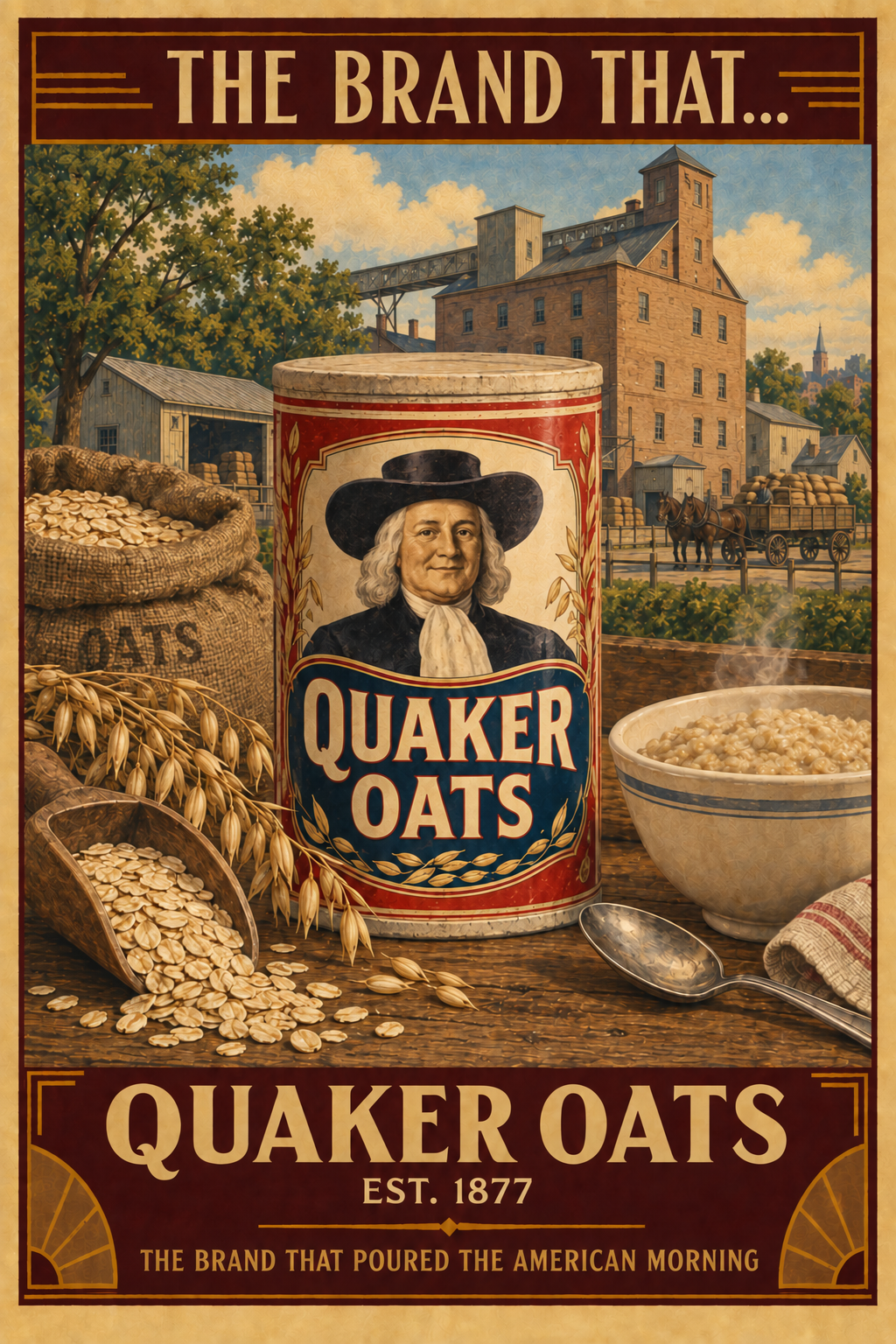
The Quaker on the box was never endorsed by any actual Quaker.
This is the nineteenth profile in The Brand That…, a series about American brands that taught the country a habit, became the word for the thing itself, and outlived the world that made them. We tell their stories plainly and with respect — what they made, what it cost, and what they still are.
The Founding
Two men opened an oat mill in Ravenna, Ohio, in 1877 and gave it a name that did not belong to them.
Henry Seymour and William Heston were not Quakers. Heston came of Quaker ancestry out of Bucks County, and that is the whole of the connection. What they wanted was what the name carried in an era when a man buying food could not be sure what was in it: integrity, honesty, purity.
That autumn the Patent Office recorded the mark as a figure of a man in Quaker garb. Quaker has said ever since that it was the first trademark registered for a breakfast cereal — a company claim, repeated everywhere and documented nowhere. The ground beneath it is softer still: the Act of 1870, under which such a registration issued, was struck down by the Supreme Court in 1879 as beyond the power of Congress.
The mill failed anyway. By 1881 it was bankrupt, and a twenty-six-year-old from Cleveland named Henry Parsons Crowell bought it. He did not want the machinery. He wanted the name.
The Rise
Crowell’s invention is easy to overlook because it is made of paper.
In 1882 he weighed out two pounds, sealed them in a clean box, and printed the cooking directions on the outside. The trade sold oats from an open barrel on a grocery floor, scooped by a man with a tin measure, and what was in the barrel was between the grocer and his conscience. A sealed box, with a name on it and the face of an honest man and directions for a woman who had never cooked the stuff, was an argument you could hold in your hand.
The Quaker Man was not ornament. He was the warranty. Everything the company has sold since rests on the proposition that the outside of the box tells the truth about the inside.
It was a hard sell at first. Americans held that oats were horse feed, and the newspapers made sport of oat-eaters, who were said to be robbing animals of their feed and developing a whinny. Crowell put the Quaker Man in national magazines anyway, the first cereal advertised that way, and sent boys on bicycles through Portland, Oregon, with a free half-ounce for every house in the city.
Then the industry consolidated by fire. Ferdinand Schumacher, the Oatmeal King, had milled in Akron since the 1850s. Crowell and Robert Stuart opened a price war on him in 1885, and at two in the morning on March 6, 1886, Schumacher’s Jumbo Mill caught fire. The damage ran to a million dollars against $113,500 of insurance; he had thought the buildings fireproof and balked at the rates. Crowell raised his prices the same week, and before the year was out the Oatmeal King had joined the men who beat him.
Seven millers combined as the American Cereal Company in 1888, and the Ravenna mill was swallowed three years after that. Then the men inside it went to work on each other. Schumacher forced Stuart out, and when that was done he forced Crowell out, and for a season he had back what the fire had taken from him. The two younger men spent that season buying shares quietly. They came for him in 1899 and took the company away, and Schumacher sold what was left of his holding and went home to Akron. Two years later the firm stopped calling itself American Cereal and took the name of the brand that had beaten it.
The Friends had noticed. In 1916 they backed a bill to bar religious names in trade, telling the House Judiciary Committee that the name was their personal, private property. The company’s counsel answered that they were asking for a name they had never used in trade. The bill died.
The company was less philosophical about its own names. In 1939 it went to federal court against General Mills over a cereal it wanted to call Oaties, which General Mills said would be mistaken for Wheaties. Quaker sent survey-takers into several states to ask shoppers who made what, and its housewives were put on the stand and grilled about the answers they had brought back. A firm that had helped itself to the name of a religion spent two years in court over four letters and a vowel.
The Turn
In 1946 the company paid for a study.
MIT wanted to know whether the phytates in cereal grain interfered with the absorption of iron. Quaker wanted to know whether oatmeal did it worse than farina. The same question from two directions, with money in the answer. Robert S. Harris, a biochemist at MIT, ran the work at the Walter E. Fernald State School in Waltham, a Massachusetts institution for children the state called feeble-minded. Seventeen boys ate seven breakfasts across forty weeks with radioactive iron in the milk poured over their cereal. Between 1950 and 1953, fifty-seven more received radioactive calcium, nine of them by injection. A 1956 paper on injected radiocalcium acknowledges Quaker’s funding, so the money reached past the breakfast table.
The boys were recruited into a Science Club. Membership brought a quart of milk a day, trips to Fenway Park and the beach, dinners outside the walls, a Christmas party. The state task force that examined it fifty years later called these incentives an institutionalized child would find hard to refuse.
The letters went home over the superintendent’s signature. The one from November 1949 offered a special diet rich in iron and vitamins, blood tests at intervals, no discomfort, and possibly some improvement. The one from May 1953 said the boys of the Science Club had many additional privileges, and closed: if you have not expressed any objections we will assume that your son may participate.
No letter mentions radiation. Consent was assembled out of silence, and for the boys who were wards of the state the superintendent consented on their behalf and approved the research from the same chair. The federal committee that reviewed the record in 1995 found no basis for the implication that any of it was meant to benefit the children. Its words were that this was simply not true.
The Reckoning
The research was never secret. It ran in the Journal of Nutrition in 1950 and sat there forty years.
Then on December 26, 1993, Scott Allen put it on the front page of the Boston Globe. One of the researchers told him he felt just as good about it as the day he did it. The state task force reported that April that the research had violated the fundamental human rights of the subjects involved. Edward Kennedy’s committee wanted to know why nobody had thought to propose radioactive breakfasts for the boys at private schools. In October 1995 President Clinton apologized for the United States. At the end of 1997, MIT and Quaker Oats settled for $1.85 million, paid primarily by MIT, with no admission of wrongdoing.
The case for the company deserves its strongest form. Quaker funded the work and did not design it, and no document shows it dictated the protocol, restricted publication, or required a result. The men who ran it wrote that the poor of the world must eat diets high in cereal, and that the effect of phytates therefore mattered. The doses were small. The federal review modeled the added lifetime cancer risk at three hundredths of one percent for the iron study and concluded it was extremely unlikely that any child was harmed.
All of that is true. None of it touches what was done. These children were not chosen because they were the right subjects. They were chosen because they were there and could not refuse.
There is a letter from Harris to the clinical director, dated May 1, 1953, noting that three boys had objected and suggesting they might be induced to change their minds by emphasizing the Science Club angle. The record holds the objection and the proposal. What became of those three is not in the documents, and I will not supply it.
A second reckoning sits alongside it, and the two came out differently. Under a 1925 contract Quaker acquired Aunt Jemima Mills and carried the character for ninety-five years — a brand drawn from a minstrel figure, embodied first by Nancy Green, born into slavery, dead in 1923 and in an unmarked grave until 2020. In June 2020 the company retired the name, saying plainly that it rested on a racial stereotype and did not reflect its values. The same company apologized for a pancake box. For Fernald no apology from Quaker Oats has ever been located, and Massachusetts has not apologized either. In November 2025 the Commonwealth opened the institutional records, which is not the same thing as saying sorry.
Fred Boyce, who joined the Science Club as a boy and heard the truth on his car radio in 1994, told the federal committee they had bribed him with privileges, knowing he had so little he would do almost anything for attention. He died in 2006, at sixty-five.
What Endures
The company’s own turn came from a bottle. In 1994 Quaker paid $1.7 billion for Snapple, outbidding Coca-Cola to get it. Three years later it sold Snapple for three hundred million. William Smithburg, who had bought Gatorade in 1983 and built it into the thing PepsiCo would eventually come for, went out the door that October. In August 2001 PepsiCo bought what was left, and what it wanted was Gatorade.
Then in December 2023 Quaker recalled granola bars and cereals for possible salmonella, widened it in January to more than sixty product lines, and shut the plant at Danville, Illinois, that June, putting five hundred and ten people out of work. The FDA found Salmonella Cubana in swabs there, called it a likely resident strain, and said it may have been in the building since 2020. In early 2025 Quaker Foods North America ceased to be a reportable segment, and the brand a company had once renamed itself after became a line in somebody else’s.
I have gone back and forth on whether these are one story. A trademark chosen in 1877 for what it connoted, a study funded in 1946, a strain of salmonella in a wall in Danville — different decisions, different men, a century apart, and nothing shows the first caused the last. What can be said is narrower and still worth saying. This was a company whose whole proposition was that you could trust what was in the box, and three times the inside was not what the outside promised.
The mill at Cedar Rapids has run since 1873. It turns two million pounds of oats a day behind two hundred and forty silos, most of the grain coming down by rail out of Canada, and roughly seven in ten Quaker products still carry something made there.
The man on the box has been kept up as carefully as the mill. He lost his legs at mid-century, when the full-length figure became a head and shoulders. In 1957 Haddon Sundblom, who had painted Coca-Cola’s Santa Claus, gave him his color. Saul Bass cut him down to a single flat tone at the start of the seventies. In 2012 a design firm took the double chin off him, trimmed his hair to show a neck, and left the crow’s feet; the man in charge said they had taken about five pounds off him. Inside the company they call him Larry.
On August 28, 2026, PepsiCo published a retrospective on a hundred and fifty years of innovation, nutrition and trust. It does not mention Fernald, and it does not mention Aunt Jemima.
And somewhere this morning a lid came off a round paper box and the smell came up, dry and faintly sweet, the way it has since before anyone now living was born.
Water, salt, eight minutes, a spoon.
The oats were always honest.
It was the promise on the outside that had to be checked, and for most of a hundred and fifty years nobody did.
Quaker Oats’ whole history, the morning and the moral injury alike, deserves to be remembered.
Why Quaker Oats? It did not invent oatmeal; it invented the idea that a sealed box could be trusted, and that idea built the American packaged-food business. The name was borrowed from a people who never agreed to lend it, and the trust it bought was spent, once, on children who could not say no.
Charles Cranston Jett is an author, civic educator, and Professional Certified Coach based in Chicago. A graduate of the U.S. Naval Academy (Class of 1964) and Harvard Business School, he served aboard nuclear submarines during the Cold War. He is the author of six books, including Super Nuke!, hosts four podcasts, and writes across his Critical Skills Blog platform on history, leadership, and the health of the American republic. In his writing he uses AI tools for research, editing, and occasional image creation; the arguments, the voice, and the final judgment are his. He and his wife, Dr. Nancy Church, live at Water Tower Residences, where they co-host the Chicago Salons.


Leave a Reply