
For a generation, Pittsburgh’s name was the price of steel.
This is the twenty-first profile in The City That…, a series about American cities that made one industry their own, led the world in it, and then watched the center move on. We tell their stories plainly and with affection — what they made, what it cost, and what they still are.
The Founding: Fire Before Carnegie
On the evening of a dark December day in 1866, the biographer James Parton was taken to an iron railing at the edge of a bluff and invited to look down on Pittsburgh.
Below him lay the low part of the city, near the level of the rivers. Smoke filled it. For long moments he could see no flame at all. Then the wind would push the smoke aside, and the whole black floor of the valley would show itself, lit, he wrote, with “dull wreaths of fire.” Then the smoke closed over it again. He watched it open and close.
He wrote that anyone who wanted a spectacle as striking as Niagara need only walk up the long hill to Cliff Street and look over into “hell with the lid taken off.” The Atlantic Monthly printed it in January 1868. People still credit the line to Dickens. It was Parton’s, and he offered it as a sight worth the climb.
Mark the date. Carnegie’s great steel works was nine years off. The fire Parton saw came from a city that had cast iron, blown glass, and burned coal for generations, and by 1860, as the Census Bureau later recorded, one Pittsburgh firm was already making crucible steel in regular production. Pittsburgh was a forge before it was a mill.
The place had what the work needed. Coal lay in the hills. The rivers ran to the markets of the West and South. The coke for the big furnaces came from the Connellsville district to the southeast, and later the iron ore came down the Great Lakes by ship and rail.
Andrew Carnegie came into that system, bought and joined its pieces, and made it bigger.
The Height: The Price of Pittsburgh Steel
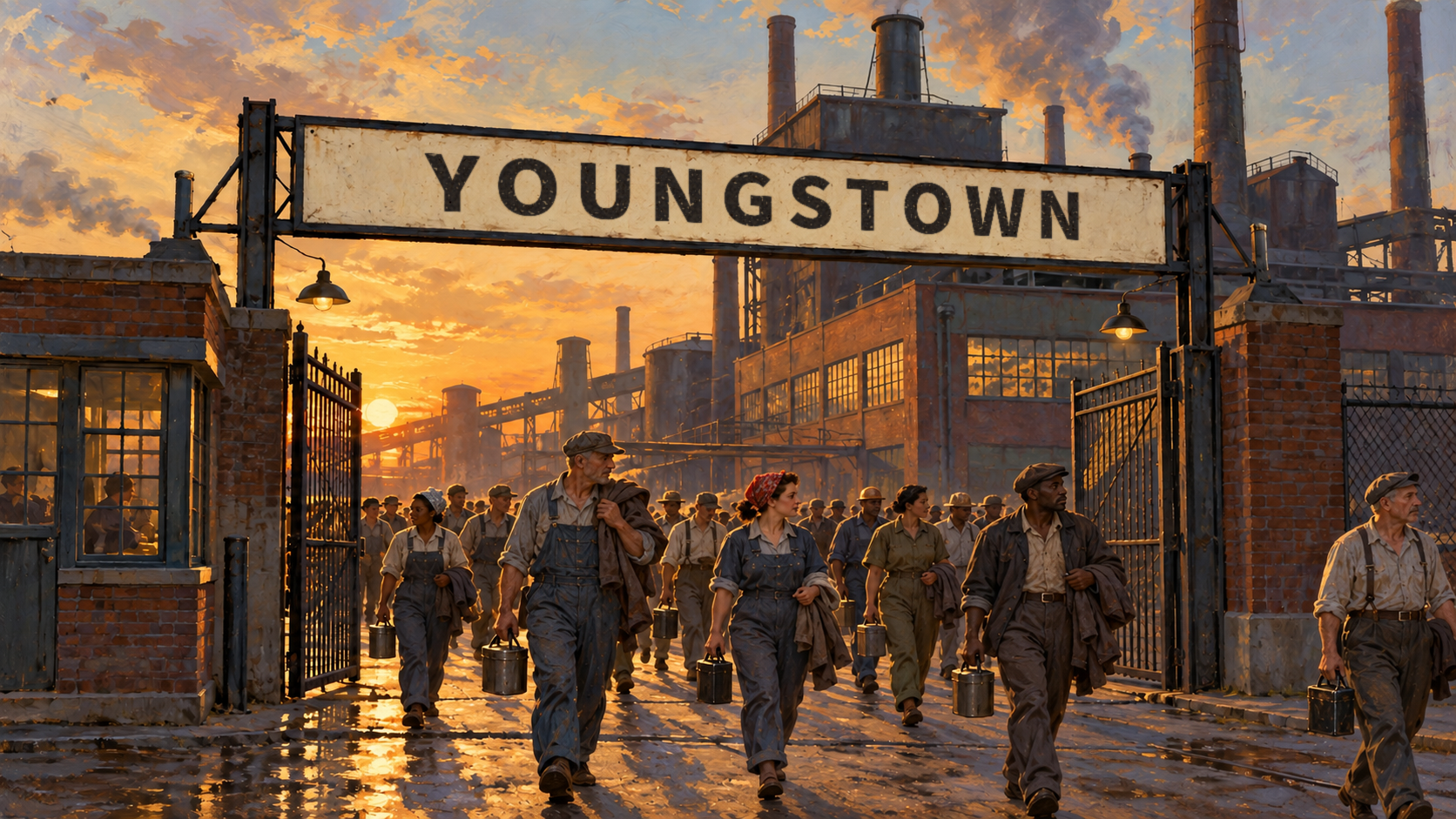
In 1875 Carnegie’s Edgar Thomson Works began making rails at Braddock, ten miles up the Monongahela. Homestead came to his interests in 1883 and Duquesne in 1890, and by 1901, when he sold out, his mills were the heart of the new United States Steel Corporation.
The Census Bureau’s count for 1909 gives the scale. That year the Pittsburgh district’s steel mills and blast furnaces employed an average of more than 56,000 wage earners and turned out nearly a quarter of the value of all such work in the country.
The surest proof of the place is a price. For years, much of America’s steel was priced as if it had been made in Pittsburgh, wherever it was made. A Chicago steel user who bought steel from a Chicago mill paid the Pittsburgh price plus the freight from Pittsburgh to Chicago, on steel that never made the trip. By July 1919 that phantom freight came to $5.40 a ton. The system was called Pittsburgh Plus.
Western steel users fought it. Thirty states joined them. The Federal Trade Commission took more than 18,000 pages of testimony, found that it discriminated against steel buyers in the West and South, and on July 21, 1924, ordered U.S. Steel to stop.
At Homestead in 1892 the company locked out the union and sent three hundred Pinkerton guards up the river to secure the works. On July 6 the town met them at the landing. Seven workmen and three Pinkerton men died of that day’s fighting. Six days later the state militia marched in. The men held out into November, and lost.
The Turn: The Long Slide and the Short Fall
Pittsburgh’s share was slipping long before the collapse. Pennsylvania, which made its steel mostly in the western third of the state, produced more than 40 percent of the country’s raw steel in 1920 and less than a quarter by 1960. Then came the factory shock of the late 1970s, which the Cleveland Fed’s economists lay to the oil crisis, foreign trade, and plants moving to other parts of the country. Pittsburgh and the places like it took the worst of it.
Then came the twin recessions of the early 1980s. In January 1983 the region’s unemployment rate passed 17 percent, unadjusted for the season, and it averaged 15.7 percent for the year. In Beaver County, down the Ohio, it reached 27 percent. By the University of Pittsburgh’s count, the seven-county region lost about 133,000 manufacturing jobs between 1979 and 1987. Duquesne shut down in 1984. The Homestead Works closed in 1986.
What Was Lost: Braddock
Braddock shows it plainest. Edgar Thomson, the first of Carnegie’s steel works, never left. The borough of Braddock, where it stands, held 16,488 people in 1950. The census of 2020 counted 1,721. The mill is still working. The town lost nearly nine people in ten.
The region’s numbers came back sooner than its people did. The unemployment rate fell through the 1980s, and a Pittsburgh newspaper, looking back in 2012, said why: the rate came down because “the young and able-bodied left the region.”
Economists who studied the Rust Belt reached the same finding, that the jobless rates fell through people leaving more than through jobs arriving.
The metro area lost about 200,000 people in that decade, the steepest drop among the nation’s fifty largest.
What Remains: The Mill That Still Runs
Bethlehem kept its cold furnaces as a monument. Carnegie’s first steel works is still making steel. Edgar Thomson casts its steel into slabs and sends them seven miles by rail to be rolled. U.S. Steel is Japanese-owned now, bought by Nippon Steel in June 2025, and it keeps its headquarters in Pittsburgh. In June 2026 the company announced up to $2.5 billion for its Mon Valley works, including a new hot strip mill at Edgar Thomson. The engineering is under way.
At Homestead the old ground holds a shopping center and U.S. Steel’s research center.
In October 1979, four years before the worst of it, Carnegie Mellon opened a Robotics Institute with commitments from Westinghouse and from the Navy’s research office. The university began as Carnegie’s technical schools in 1900. Today robotics research and advanced manufacturing go on at Mill 19 in Hazelwood, inside the stripped steel frame of a Jones & Laughlin mill building. It was put up around 1943 to house wartime munitions work, and it runs about a quarter mile along the Monongahela.
The Labor Department’s preliminary count for August 2026 shows how the region’s work is weighted now. In a metro area drawn wider than before, private education and health services held about three payroll jobs for every one in manufacturing. In 1970, manufacturing had supplied almost a third of the region’s jobs.
Why the region’s jobless rate and incomes recovered while boroughs like Braddock kept emptying is harder to answer than the celebrations allow. Three answers have evidence behind them. The city cleaned its air early; the smoke law passed in 1941 and reached the mills and railroads in 1946, a generation before the closings. It was a city of head offices and universities as well as mills, home to U.S. Steel and PPG and to the food company this series profiled in The Brand That Bottled the American Table, and in 2016 the Cleveland Fed still counted the management of companies, education, and health care among its specialties. And after 2005 it had shale gas, though the Fed says it is hard to tell whether the gas caused the rise in incomes that followed.
The universities come with a caution. Akron turned to its polymer labs when the tire plants left. A 2017 Brookings study, cited by the Fed, found the region doing at least twice the national average of research in robotics and related fields, while those industries held a smaller share of local jobs than they did nationally.
A fourth answer is in the Braddock numbers: people left. My reading is that no single cause explains the recovery, and that the leaving did part of the work.
The work is still dangerous. On August 11, 2025, an explosion at U.S. Steel’s Clairton coke works, up the Monongahela, killed two men, Steven Menefee and Timothy Quinn. The rivers are not clean yet. The regional sewer authority estimates about nine billion gallons of overflow a year, and its plan to cut most of it runs to 2036.
Look up the Monongahela now. Edgar Thomson is pouring steel more than a hundred and fifty years after its first rails, and a wartime mill frame at Hazelwood holds laboratories. At Homestead a marker recalls the fight at the landing. And in Braddock, in July 2026, the steel company laid out its plans for a new mill inside the library Andrew Carnegie dedicated there in 1889, the first of his libraries in America to open its doors.
Pittsburgh forged the modern world, and that is worth remembering.
Why Pittsburgh? In 1909 its district made nearly a quarter of the value of the nation’s steel-mill and blast-furnace output, and until 1924 much of America paid for its steel as if it had come from Pittsburgh. For a generation the city’s name was the price of the metal.
* * * * *
Charles Cranston Jett is an author, civic educator, and Professional Certified Coach based in Chicago. A graduate of the U.S. Naval Academy (Class of 1964) and Harvard Business School, he served aboard nuclear submarines during the Cold War. He is the author of six books, including Super Nuke!, hosts four podcasts, and writes across his Critical Skills Blog platform on history, leadership, and the health of the American republic. In his writing he uses AI tools for research, editing, and occasional image creation; the arguments, the voice, and the final judgment are his. He and his wife, Dr. Nancy Church, live at Water Tower Residences, where they co-host the Chicago Salons.
Leave a Reply