

An American admiral’s sworn answers helped keep Karl Dönitz’s submarine-warfare violations out of his sentence. They did not clear him.
This is the third of five articles in the series Hitler’s Generals. The first, Hitler’s Generals: Who They Were, What They Did, and What Happened to Them, told what the generals did and how they ended. The second, Hitler’s Generals and the Oath, asked why they followed him. This one turns to the navy and to the submarine war. I am a former nuclear attack submarine officer. My service was in the late 1960s, not in World War II.
On the afternoon of July 2, 1946, a German naval judge named Otto Kranzbühler offered a document in evidence to the International Military Tribunal at Nuremberg. His client was Grand Admiral Karl Dönitz, who had commanded Hitler’s submarines and then his navy. The document was marked Exhibit Doenitz-100. The judges knew what he meant to prove with it, Kranzbühler said, and he need not read it. The presiding judge answered that the Tribunal would like to have it read.
Kranzbühler read it aloud, in English. He gave the date as May 11, 1940. The presiding judge interrupted to ask whether he meant 1946. Kranzbühler corrected it and went on.
What he read was a list of questions, with the answers given to them under oath seven weeks earlier by Fleet Admiral Chester W. Nimitz, Chief of Naval Operations of the United States Navy. Nimitz had commanded the Pacific Fleet through the war against Japan.
The Pacific had been declared a theater of operations. American submarines there attacked merchant ships without warning. Hospital ships and ships sailing under safe conduct were the exceptions. The order for unrestricted submarine warfare against Japan was given on December 7, 1941, the day of Pearl Harbor.
Dönitz was on trial for the same thing, and for a good deal more. How the Tribunal answered that accusation is the best-known part of his case. How it answered the rest matters as much.
The War on Shipping
Germany had acceded to the London Protocol of 1936, which held a submarine to the rules that bound a surface warship. A merchant ship that did not resist was not to be sunk until her passengers and crew had been put in a place of safety. A submarine has no room for them, and one that surfaces to give warning can be shelled or reported by radio.
The rule came under strain at once. Britain armed its merchant ships, sailed them in convoy, and had them report every submarine they sighted. Germany widened, step by step, the waters in which its U-boats could sink ships on sight.
Dönitz ran that war. His method was the wolfpack: a group of submarines brought together by radio against a single convoy. The target was Britain’s supply line. After December 1941 it was America’s as well. In the first half of 1942 the U-boats sank several hundred ships off the American coast, in the Gulf of Mexico, and in the Caribbean.
The spring of 1943 turned it. In March the Allies lost more than eighty ships. By then American yards were building ships faster than the U-boats were sinking them, the escorts carried radar, and the first American escort carrier had put aircraft over the middle of the ocean. British codebreakers, shut out of the U-boat cipher for most of 1942, were reading it again. Dönitz suspected a leak more than once. His signals experts assured him that the cipher was safe, and the secret was kept for nearly thirty years after the war.
In May 1943 Germany lost some forty U-boats. One of them carried Dönitz’s son. Dönitz pulled his boats out of the North Atlantic. “We had lost the Battle of the Atlantic,” he wrote afterward.
What Nimitz Said
The point of the document was plain. If the United States Navy had fought this way from its first day at war, the practice could not be treated as a crime peculiar to Germans.
Nimitz was asked about survivors too. American submarines, he said, did not as a rule pick them up where that meant undue hazard to the boat or kept it from its mission. He added: “In numerous cases enemy survivors were rescued by U.S. submarines.” He also said that Japanese merchant ships were usually armed and always attacked when they could.
He declined two questions as outside his wartime command. He offered no opinion of Dönitz or of Germany. Of his own navy’s campaign he said that it was justified by the Japanese attacks of December 7, 1941.
Where the Comparison Stops
The comparison with submarine operations in the Pacific holds firmly for one practice: sinking enemy merchant ships without warning, on orders from the top. The Tribunal dealt with that practice in two steps. For attacks on British armed merchant ships it declined to hold Dönitz guilty at all, on the ground that Britain had made those ships part of its naval defenses. The American evidence came in later, at sentencing.
On survivors the comparison holds only in part. Nimitz described a practice that turned on the danger to the boat and that included rescues. Dönitz, in the end, forbade them. The Tribunal also found a breach in his orders to sink neutral ships without warning inside zones Germany had declared. The Protocol had no exception for such zones.
Then there was the Laconia. On September 12, 1942, a U-boat torpedoed that British liner. She carried some 2,700 people, most of them Italian prisoners of war. The U-boat’s captain, Werner Hartenstein, took survivors aboard and in tow, and Dönitz sent other boats to help. On September 16 an American bomber attacked Hartenstein’s boat as it towed lifeboats under a Red Cross flag. The next day Dönitz issued a standing order for every sinking to come: no attempt of any kind was to be made to rescue the crews of ships sunk. Commanders were told to be harsh.
The prosecution said the order was a veiled instruction to kill survivors. The Tribunal found that this was not proved. It called the order ambiguous and deserving “the strongest censure.” And it held that forbidding rescue was itself a breach. A commander who cannot rescue should let the ship pass.
The line between leaving survivors and killing them was real. In March 1944 Heinz Eck, commanding U-852, sank the Greek steamer Peleus and then turned machine guns and grenades on the men clinging to her rafts. Three lived. Eck said he meant to destroy wreckage that could give his boat away. A British court in Hamburg convicted him, and he was shot on November 30, 1945. He did not plead superior orders.
An American case raises the same question. On January 26, 1943, the submarine Wahoo sank the Japanese transport Buyo Maru. Lieutenant Commander Dudley Morton ordered fire on the lifeboats. Among the men aboard the transport were hundreds of Indian prisoners of war. Accounts differ over who fired first and whom Morton intended to hit. I deplore what Morton did.
The Admiral and the Party
Dönitz’s defense rested on the picture of a sailor outside politics. As commander of U-boats he was, the judges found, a line officer with tactical duties. He was not at the conferences where Hitler’s wars were planned, and they acquitted him of conspiracy. Even so, they found that he had helped to wage those wars. He drafted the U-boat orders for the invasion of Norway.
On January 30, 1943, he became Commander-in-Chief of the Navy. From then on Hitler consulted him almost continuously. Over the course of the war the two conferred on naval problems about 120 times. On January 30, 1944, Hitler gave him the Golden Party Badge. Dönitz told the Tribunal that he took it as a decoration and supposed it made him an honorary member of the Party. He said he had not been politically active until May 1945.
His own speeches say otherwise. On February 15, 1944, he told his senior commanders that the whole officer corps must be indoctrinated, and that “the idle chatter that the officer is nonpolitical is sheer nonsense.” On March 12 he told the navy and the nation what Germany owed to Hitler and National Socialism, and he spoke of Jewry as a poison.
Two of the acts he answered for at Nuremberg had nothing to do with submarines. The first concerned Hitler’s Commando Order of October 1942, which directed that captured Allied commandos be killed. In July 1943 the crew of a Norwegian motor torpedo boat, six Norwegians and one British sailor, were captured near Bergen, questioned, handed to the SS security service, and shot. Dönitz argued that the order did not cover men taken in naval warfare, and said he was never told of the shooting. The Tribunal held him responsible because he had let the order stand when he took command.
The second was a conference in December 1944 at which he said that 12,000 concentration camp prisoners would be employed in the shipyards as additional labor. The judgment notes that he had no authority over shipyard construction. He told the Tribunal it was only a suggestion and that he never learned whether the men were supplied. The Tribunal found that a man in his position must have known that those camps held citizens of the occupied countries.
Hitler’s will, dated April 29, 1945, named him head of state. On May 1 he ordered the armed forces to fight on in the East. He said he did it to give civilians time to flee and the army time to withdraw. He tried to surrender in the West piece by piece. Montgomery accepted one such surrender on May 4, and Eisenhower refused any more. Dönitz then authorized General Alfred Jodl, whom readers met in the first article, to sign the surrender at Reims on May 7. He was arrested at Flensburg on May 23.
Raeder
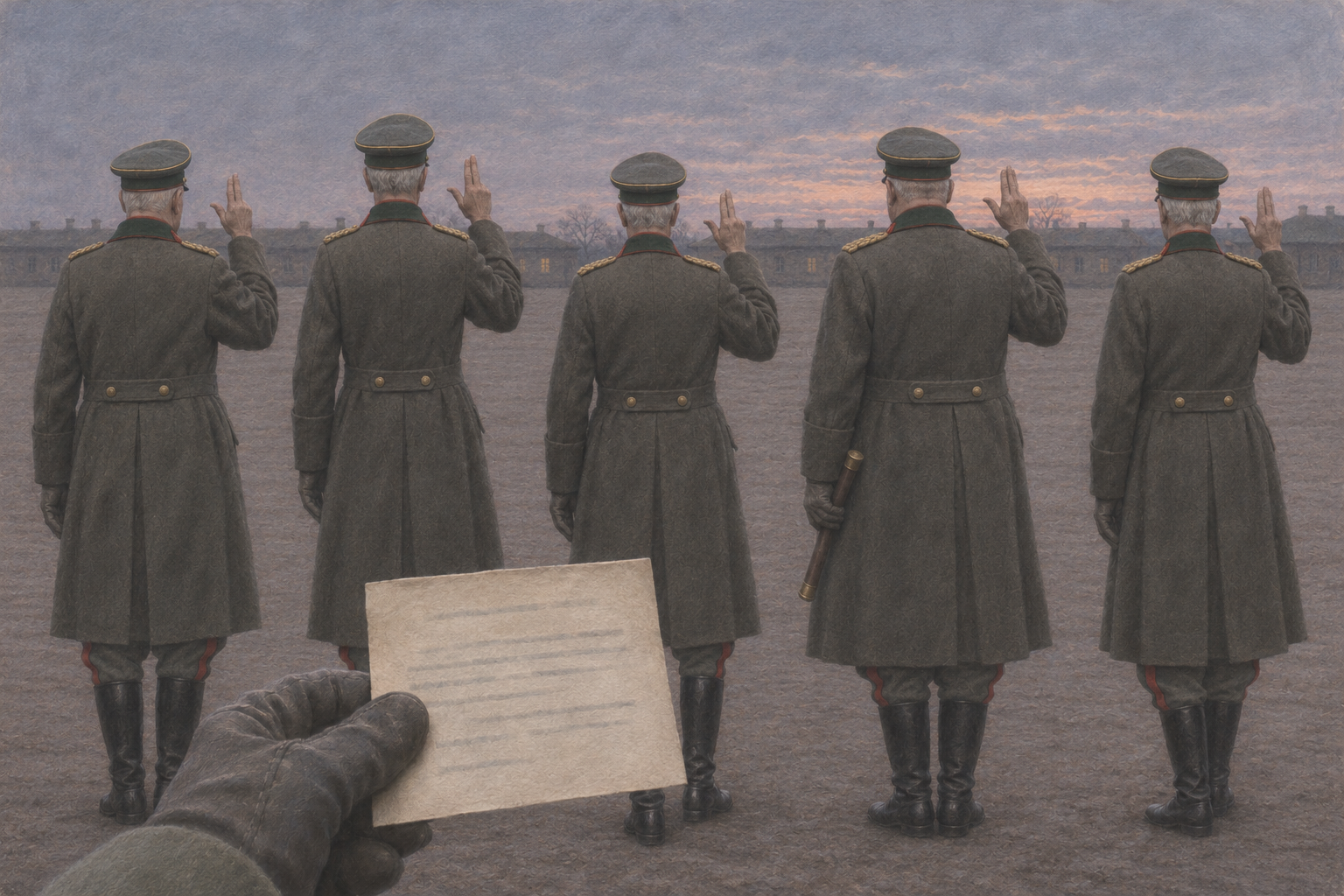
Erich Raeder built the navy Dönitz inherited. He commanded it from 1928 to 1943. He was one of the service chiefs Hitler swore in on August 2, 1934, the day described in the second article. At Nuremberg the British prosecutors put the oath law in evidence against him. Raeder answered that none of the chiefs had any part in writing the oath.
Raeder was not a submarine man. He wanted a balanced fleet of battleships, cruisers, and U-boats. He commanded the war on shipping all the same, and the Tribunal made the same findings on it against him as against Dönitz, up to the day he left.
What set his case apart was a seat at the table. He was one of five leaders at Hitler’s conference of November 5, 1937, the meeting the prosecution treated as the plan for war. The Tribunal found that the idea of invading Norway reached Hitler from Raeder. Raeder argued that Germany was only forestalling Britain. The judges called the invasion aggressive war.
He left over the big ships. After a German squadron failed against a British convoy on the last day of 1942, Hitler turned on the surface fleet. Raeder asked to be relieved and left on January 30, 1943, naming Dönitz as one of two possible successors.
A Submarine Officer’s View
I was born in 1941 and knew nothing of the war until the day my mother came running into the house, shouting that the Americans had dropped an atom bomb on Japan. I remember my mother and father talking about “the dictator.” I knew who they meant, and it scared me.
I first thought about the submarine war at the Naval Academy, where I studied naval history between 1960 and 1964. I felt then that the American submarine force had done the right thing against Japan. I felt that in Dönitz’s shoes I would have done the same thing regarding naval tactics. The greatest danger to Germany was the United States supplying Great Britain and the Soviet Union, and he used the weapon he had against it. His naval strategy was correct, even though I saw it from the other side.
Later, as a submarine officer, I often thought about what the submarines of that war did: periscope approaches and sonar approaches to sink enemy shipping. The Navy taught periscope approaches at submarine school. In 1969 and 1970 they were still part of the tactical course for prospective commanding officers of nuclear submarines. My thought at the time was how ridiculous it would be to risk a nuclear submarine making a periscope approach. If we were detected, we were essentially sunk. The idea that we might be detected always haunted me. A surfaced U-boat in World War II was vulnerable. A submerged nuclear submarine in the Cold War was vulnerable if detected. The weapons could “find you.”
People might not like the fact that I defend his naval strategy. I do not defend anything those admirals did against the Jews, or their simply obeying their oath to the Führer. The Nazi strategy and the war crimes are another matter. I totally reject them. What I would have done in the same circumstances, I am not sure. The instinct to be a professional officer is, in my view, strong. Add the oath German officers had sworn to a person, and the knowledge of what might follow from either taking part in the non-military side of the command or ignoring it, and the pressure to conform to others would be powerful. As a plebe I memorized a line of Matthew Fontaine Maury’s from Reef Points, the plebe bible: “When principle is involved, be deaf to expediency.” It is easy to say. It is a different matter when you are in the middle of it.
The Verdicts
The Tribunal gave judgment on October 1, 1946. It found Dönitz not guilty of conspiracy and guilty of waging aggressive war and of war crimes. It found Raeder guilty on all three counts. Neither admiral had been charged with crimes against humanity, the fourth count on which Keitel and Jodl were convicted.
The judges cited a British Admiralty order of May 1940 to sink ships at sight in the Skagerrak, and the answers of Admiral Nimitz. In view of both, they did not assess Dönitz’s sentence on his breaches of the law of submarine warfare. They had found the breaches. They declined to punish a German admiral for breaking rules the British and American navies had also set aside. The American judge, Francis Biddle, had argued for acquitting him altogether and was outvoted. I think the Tribunal got Dönitz right.
The rest of the judgment stood. It recorded, among other things, what became of Hitler’s Commando Order in the German navy. Raeder’s staff passed it down, and the navy shot two commandos at Bordeaux in December 1942. Dönitz took over the command and let the order stand, and under it seven men were shot near Bergen. On two counts, Dönitz was sentenced to ten years. On three, Raeder was sentenced to life.
Raeder was released in 1955, in poor health, and died in 1960. Dönitz served all ten years, was released in 1956, wrote his memoirs, and died in 1980.
If you served in submarines, have studied this trial, or read the Nimitz answers differently, I would welcome your view in the comments. If this series is useful to you, a like or a share helps it reach other readers.
Next in this series: Hitler’s Generals Who Went to Work for America.
* * * * *
Charles Cranston Jett is an author and civic educator based in Chicago. A graduate of the U.S. Naval Academy (Class of 1964) and Harvard Business School, he served aboard nuclear submarines during the Cold War. He is the author of six books, including Super Nuke!, hosts three podcasts, and writes across his Critical Skills Blog platform on history, leadership, and the health of the American republic. In his writing he uses AI tools for research, editing, and occasional image creation; the arguments, the voice, and the final judgment are his. He and his wife, Dr. Nancy Church, live at Water Tower Residences, where they co-host the Chicago Salons.


Leave a Reply