
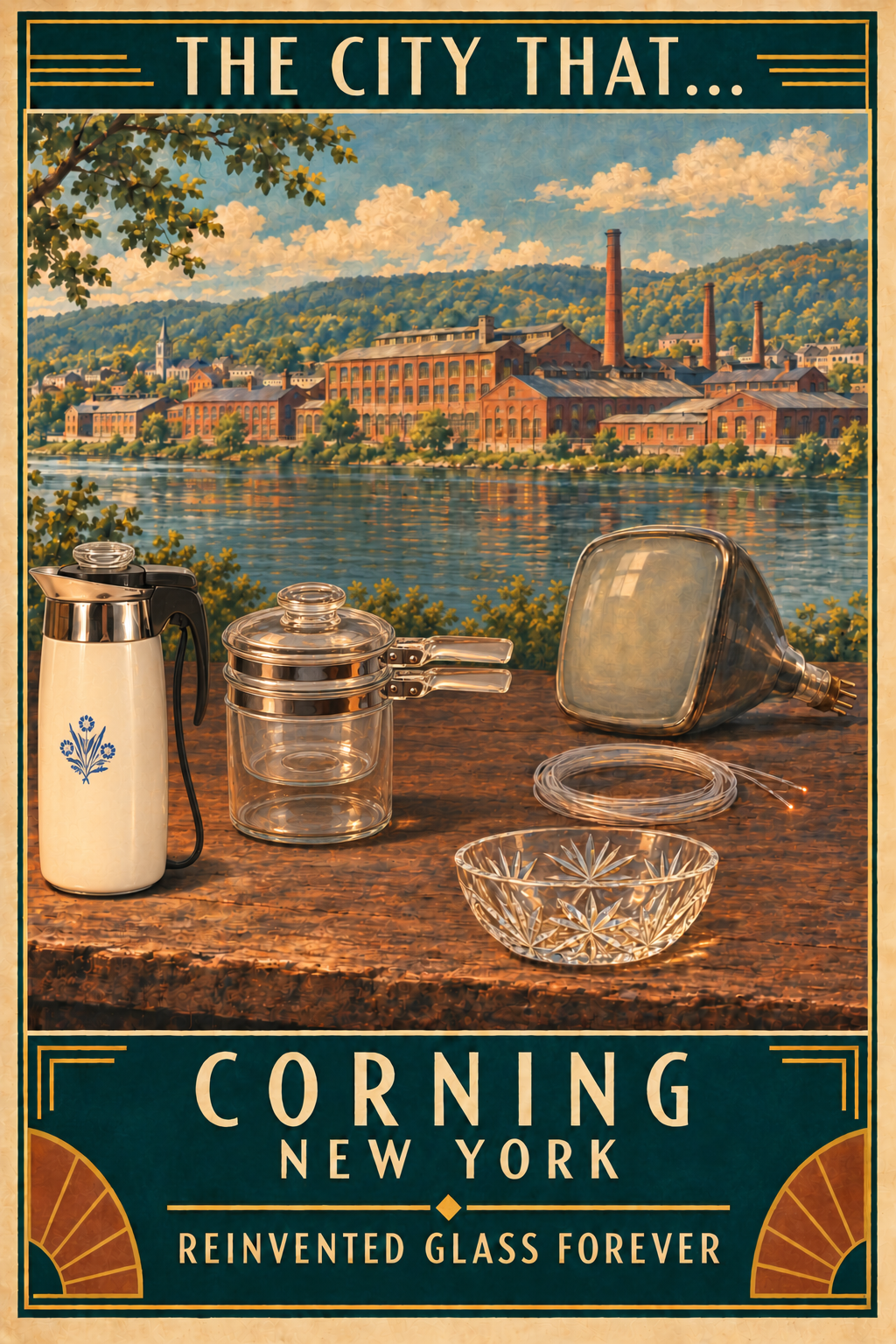
Local money brought the glassworks in 1868. The company never left.
This is the twenty-sixth profile in The City That…, a series about American cities that became, for a time, the word for what they made. Most watched the center move on; a few held on. We tell their stories plainly and with affection — what they made, what it cost, and what they still are.
A Glassworks Comes to Corning, New York
In the 1830s a group of Albany capitalists laid out a village where a canal feeder met the Chemung River and named it for one of their own, Erastus Corning, a banker and railroad man. A railroad built in 1839 and 1840 brought coal up from the Pennsylvania mines at Blossburg to the canal.
In 1868 local money landed a glassworks. A flint-glass company in Brooklyn wanted out of the city, and its owners named their price: investors here would buy at least fifty thousand dollars of its stock. Elias Hungerford, a Corning man with a patent for glass window blinds, raised it. On May 30 he handed Amory Houghton a certified check, and ten thousand dollars of it came from Erastus Corning himself.
Nearly a hundred glassworkers came from Brooklyn with their families, and the works opened on October 22 with about a hundred and twenty men. Townspeople came to watch the first batch melt. A Brooklyn firm called Hoare & Dailey took space in the new building and set up its wheels to cut the blanks.
The works nearly failed at once. The local coal did not suit the furnaces, chimney arches gave way, new pots cracked, and better-placed glasshouses around Pittsburgh competed hard. In September 1870 a court named a receiver, and late the next year a Boston creditor took control. The founder’s sons, Amory Houghton Jr. and Charles, got the works back.
The Crystal City
The cutting shops multiplied. Thomas Hawkes came from Ireland as a teenager and supervised Hoare’s shop before he started his own around 1880. In 1889 his firm took a grand prize at the Paris Exposition, and by 1900 it employed several hundred men. By the 1890s the town had a second name, the Crystal City. One count of the 1905 city directory found 490 glass cutters there.
At the end of 1890, by the company’s own history, the Glass Works’ bulb blowers walked out, and it hired others. By January a group of Corning glassblowers had found work in Findlay, Ohio. On July 3, 1891, on their way home, they were riding in the rear car of a passenger train stopped at Ravenna when a freight ran into it from behind. Eighteen members of the American Flint Glass Workers Union were killed. Their union’s monument stands in St. Mary’s Cemetery, a tall stone arch with a carved glassblower on top, and its inscription, dated 1892, says they had been kept from their friends at home “by an effort to improve their industrial condition.”
In 1903 Hawkes brought Frederick Carder from England to make blanks, and Steuben, the works they founded, became a division of the Glass Works in 1918. Virginia Wright, who arrived in 1958 as a new Glass Works designer’s wife, remembered a Market Street of bars and men’s shoe stores that seemed to her made for the men of the Works. She said she came home and cried.
The Wheels Stop
The brilliant cutting that made the Crystal City went out of style in the years around the First World War, and wartime shortages hurt the trade further. The shops went one at a time. Hoare closed in 1920. Hawkes, the largest, lasted until 1962, though by its last years it was no longer cutting glass. Hunt Glass Works, cutting since 1895, closed in the early 1970s, and the historians of Corning’s cut glass wrote that the town hardly noticed.
The country stopped wanting what the Crystal City did best, and nothing obliged it to keep buying. Steuben, the crystal American presidents had given as gifts of state since 1947, lost money in seventeen of its last twenty years under Corning, by the Associated Press’s count, and in 2008 Corning sold control of it. The new owners blamed declining sales in a bad economy and closed the factory on November 29, 2011, with sixty to seventy people on its floor. A few found jobs at Corning.
The old Main Plant on the riverbank, where Pyrex double boilers were made in the 1940s, came down in stages, and in October 1993 the company’s people began moving into a new headquarters on the old plant ground. When the telecommunications market broke, company employment in the Corning area fell by more than a third in under two years. The city, which counted 17,684 people in 1950, was down to 10,551 by 2020, while the neighboring towns of Erwin and Corning had gained about 5,400 between them since 1950.
Glass in the Ground
For generations the waste from the company’s plants, what the state now calls ash, brick, and glass, was dumped or spread as fill. The state says such fill was widely used for drainage, building lots, and flood repair. In November 1920, when the Houghton estate sold the properties that became the Houghton Plot on the Northside, the deed kept for the Glass Works “forever” the right to maintain its ash dumps as they then lay. In 1978 the company told the state Health Department it had used the Plot for disposal; by then, the list records, the Plot was paved and covered with homes. In 2012 a capital project at Corning-Painted Post High School, next door, turned the fill up. The state has found arsenic, cadmium, and lead in it, among other contaminants.
The state put out a guide to what the material looks like in the soil, and a fact sheet under the heading What about my garden? Then the crews came to the Houghton Plot. Where they found the fill they dug it out, as much as two feet down, hauled it away, and rebuilt the yards. By the fall of 2025 the state counted 307 properties there remediated and under site management, with several still waiting, and Corning Incorporated had done the work under a state order. Some homeowners went to court. The state has since found it at about seventy places around Corning and still tells people what to do if they dig some up.
What Corning Kept
Why did the company stay when so many glass companies scattered?
The company’s own historians point to the money already sunk here and the advantage of keeping management, research, and plants close together. The newest plants go where the business is: the three optical factories announced in May 2026 are going to North Carolina and Texas. Amo Houghton, who ran the company, called it “a country company, not a city company,” and said it had to concentrate its efforts where it was already established, which cuts both ways. My own reading is older: the company and the town share a name, and a Houghton sat at or near the head of the firm until 2007. If tradition pulled, self-interest pulled the same way, and the record does not pull them apart.
A 1966 urban renewal plan called for tearing down 175 buildings, and in 1970 the Glass Works Foundation gave the city more than $1.4 million toward the plan’s civic center. Virginia Wright and Jean Wosinski pushed the other way with a slide show about the ornate upper stories of Market Street. Ernestine King hauled a sculpture of Pan out of the opera house rubble in her children’s red wagon. Tom Buechner, the museum’s director, took up their cause.
In June 1972 the Agnes flood put Market Street under water, and at least eighteen people died in and around Corning. Amo Houghton, the company’s chairman, went on the radio to say the company was not leaving. The east end gave way to the civic center; the restoration took the five western blocks of Market Street. In 1973 Mayor Joseph Nasser wrote, “We are not dealing with a world of make believe.” In 1974 a new restoration agency, seeded by the Foundation, hired Norman Mintz to talk the merchants into restoring their storefronts. By 1979 even the company’s own white Pyroceram had come off a Victorian building on East Market Street. Mary Means, who started the National Trust’s Main Street program, later said that watching Mintz work persuaded her to put a full-time manager in each of its first three towns.
The company keeps its headquarters by the river and thousands of people at work in and around the city. The reinventing in this profile’s title, from bulb glass and oven glass to optical fiber and phone screens, came out of its works and laboratories, as the companion profile of the company tells. Corelle dishes are still pressed on Steuben Street, by a different company now. The museum draws more than three hundred thousand visitors a year and oversees a small line of Steuben, made under license by outside makers.
What Corning keeps, then, is a ten-thousand-dollar stake bought by the man the town was named for; a stone glassblower raised for eighteen union men; a Victorian front with the modern skin pried off; a neighborhood on the Northside dug up yard by yard and still under the state’s watch; and on the riverbank where the Main Plant once made double boilers, the headquarters of a company that took the town’s name in 1868 and has kept it.
Corning reinvented glass forever, and that is worth remembering.
Why Corning? Toledo, earlier in this series, was a great glass town whose companies were sold, merged, and moved; Corning is the one that held on. The glassworks took the town’s name in 1868 and never left, and for a century and a half the work done under that name, from the cut glass of the Crystal City to the laboratories that followed, kept the place near the front of its trade.
Correction, November 23, 2026: An earlier version of this profile said a Houghton sat at or near the head of the firm until 1996. James R. Houghton came out of retirement in 2001 to lead the company through the telecom collapse and remained its chairman until 2007.
* * * * *
Charles Cranston Jett is an author and civic educator based in Chicago. A graduate of the U.S. Naval Academy (Class of 1964) and Harvard Business School, he served aboard nuclear submarines during the Cold War. He is the author of six books, including Super Nuke!, hosts three podcasts, and writes across his Critical Skills Blog platform on history, leadership, and the health of the American republic. In his writing he uses AI tools for research, editing, and occasional image creation; the arguments, the voice, and the final judgment are his. He and his wife, Dr. Nancy Church, live at Water Tower Residences, where they co-host the Chicago Salons.



Leave a Reply